The Unique Role of the Notary
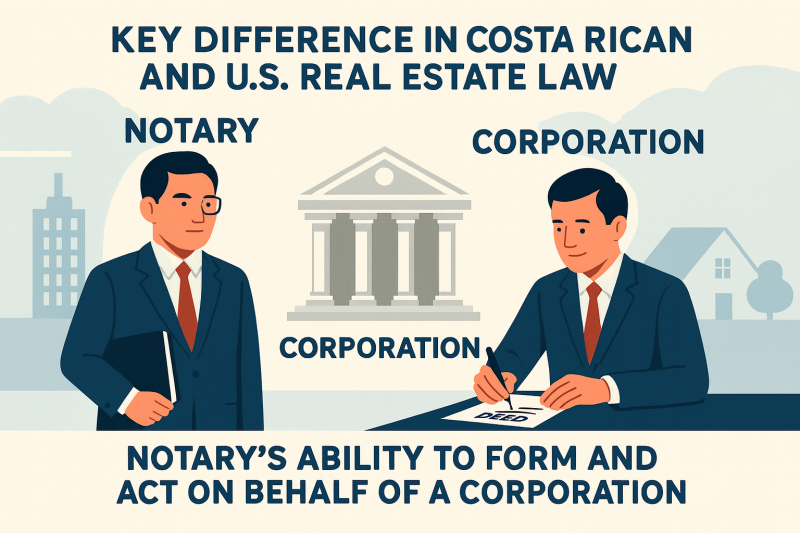
When purchasing real estate in Costa Rica, one of the most surprising differences for U.S. and Canadian buyers is the unique legal authority of the notary public (notario público). In the United States, a notary merely verifies identities and witnesses signatures. In Costa Rica, a notary is a state-appointed attorney with judicial powers. This distinction is so fundamental that it allows the notary to do something that would be impossible in the U.S.: create a corporation, appoint themselves as its representative, and sign a property deed on its behalf — all in one seamless process.
How the Costa Rican Notary System Works
Under Costa Rican law, every property transfer, mortgage, and corporate formation must be executed in a public deed (escritura pública) drafted and certified by a notary. This document isn’t simply notarized — it’s created by the notary. Once authorized and entered into the Registro Nacional (National Registry), it carries public faith, meaning it’s legally binding and presumed authentic without the need for further validation.
In essence, Costa Rican notaries are legal architects. They confirm identities, draft the instruments, ensure compliance with law, and personally guarantee the validity of the act. The state entrusts them with this authority under strict professional oversight from the Dirección Nacional de Notariado and the Corte Suprema de Justicia.
Why the Notary Can Sign for the Buyer
In real estate closings involving foreign buyers, the notary’s expanded powers become especially practical. Here’s how it often works:
Formation of a Corporation
The notary drafts an escritura pública incorporating a new Sociedad Anónima (S.A.) or Sociedad de Responsabilidad Limitada (S.R.L.) to hold title to the property. The notary names himself or herself as the company’s initial legal representative (president or manager).Execution of the Purchase
Acting in that capacity, the notary signs the property transfer deed (escritura de traspaso) on behalf of the newly formed corporation. Since the company exists immediately upon signing and registration, the notary’s representation authority is valid and visible in the public record.Transfer of Control to the Buyer
After the closing, the notary transfers the shares (S.A.) or membership quotas (S.R.L.) to the buyer through a private share transfer document and resigns as representative. The buyer then appoints himself or another person as the new legal representative by a simple notarized act recorded at the registry.
The result: the buyer owns 100% of the corporation, which in turn owns the property — without ever needing to travel to Costa Rica for the signing.
Why This Differs from the U.S. System
In the U.S., corporations are formed through filings with the Secretary of State. Officers derive their powers from bylaws and board resolutions, not from the act of incorporation itself. A U.S. attorney or notary cannot legally create a company, name themselves as its officer, and execute contracts for it.
By contrast, Costa Rican law — derived from the civil law tradition — creates corporate existence and representation authority within the notarial act itself. Once the notary executes the incorporation deed, both the company and its legal representative come into being immediately. The notary’s authority is therefore not assumed — it’s legally recognized and registrable.
Civil Law vs. Common Law: Two Traditions, One Goal
Both systems aim to ensure security and transparency — they simply get there differently. Costa Rica’s model emphasizes front-end validation by a trusted public official; the U.S. system emphasizes post-execution oversight through courts and corporate governance.
A System Built on Trust and Oversight
Because notaries in Costa Rica wield substantial authority, they’re held to the highest professional standards. Misuse of that power — for instance, failing to transfer shares to a client — would constitute a serious offense, subject to disbarment and criminal penalties.
That’s why working with an experienced, reputable notary-attorney is essential. When handled properly, this system makes Costa Rican real estate closings fast, efficient, and secure — especially for foreign investors who cannot attend in person.
Conclusion
The ability of a Costa Rican notary to form a corporation and sign a deed on its behalf isn’t a legal loophole — it’s a cornerstone of the Costa Rican civil law system. By combining the roles of lawyer, registrar, and state-certified witness, the notary ensures that real estate transactions are executed with both speed and integrity.
For foreign buyers, understanding this key difference demystifies the process and highlights one of Costa Rica’s great advantages: a property system built on legal precision, efficiency, and public trust.