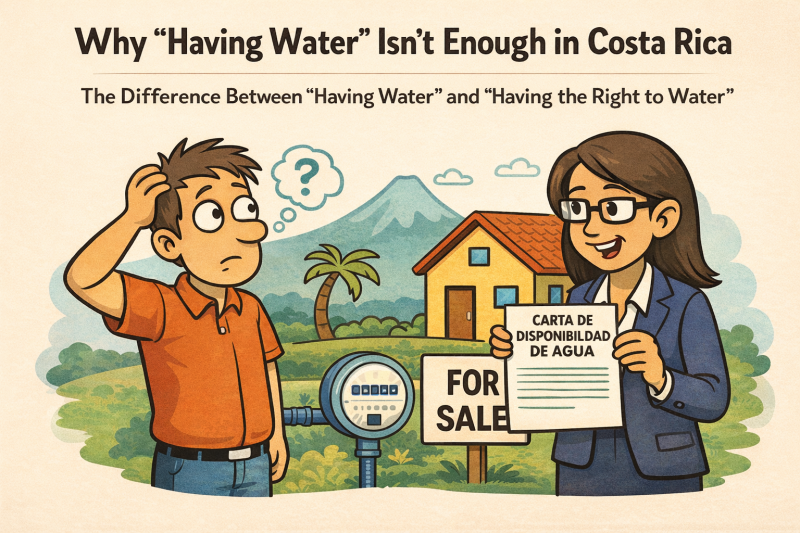
The Difference Between “Having Water” and “Having the Right to Water”
If you’ve bought or sold property in Costa Rica, especially in rural, mountain, or coastal areas, you’ve probably heard an attorney or escrow agent ask for a “water letter” from the local ASADA or AyA.
At first glance, this often feels unnecessary. The house already has a water meter. Water is flowing. Bills are being paid. So why would anyone need a letter proving access to water when the property is already connected?
The answer lies in an important legal distinction in Costa Rica between having water in practice and having a legally recognized right to water.
A functioning water meter and an active ASADA account only confirm that water is currently being delivered to the property. They do not necessarily prove that the connection was legally authorized under current regulations, that the service is permanent and transferable, that the property is formally recognized by the water authority, or that there are no restrictions, moratoriums, or pending issues affecting the supply.
In short, the meter proves physical access to water, but the water letter proves legal entitlement to water.
This distinction exists because Costa Rica’s water system, particularly in rural and environmentally sensitive areas, has evolved over many decades. Many properties were connected long before modern zoning, environmental regulations, watershed protections, and source capacity limits were put in place. As a result, some properties today have water physically connected, even though that same connection might not be approved if it were requested for the first time today.
In many cases, ASADAs continue to provide service to existing homes to avoid hardship, but that does not automatically mean the connection is formally compliant, transferable to a new owner, or expandable for future construction or subdivision.
This is where the water letter becomes important. A proper water letter from ASADA or AyA typically confirms that the property is formally registered in their system, that the service is authorized and recognized rather than informal or provisional, that there are no pending sanctions or disputes, that the water service can be transferred to a new owner, and that the property complies with current land use and environmental rules as they relate to water availability.
From a legal and risk perspective, water is a fundamental requirement for habitability, financing, permitting, and resale. Buyers need assurance that their access to water cannot later be revoked, denied, or limited due to an administrative or regulatory issue that existed before they purchased the property.
For that reason, attorneys, escrow companies, and lenders often insist on a water letter during due diligence. It functions much like a zoning compliance confirmation or title verification, but specifically for water. It turns water from a practical reality into a legally defensible right.
You may notice that some transactions proceed without a water letter while others do not. This usually depends on the attorney involved, the buyer’s risk tolerance, whether a lender is part of the transaction, and the location and regulatory sensitivity of the property. In urban areas with AyA service, the letter is often little more than a formality. In rural, coastal, or mountainous areas where water sources are limited or regulated by ASADAs, it can be critical.
If you are selling a property and a water letter is requested even though the house already has water, it does not mean anyone doubts that water exists. It means the legal status of that water is being verified.
In Costa Rica, there is a meaningful difference between having water today and having a secure, transferable, and legally recognized right to water tomorrow. Understanding that distinction helps protect buyers, sellers, and the long-term value of the property.