In a country where unpredictability is constant, sweeping conclusions are usually the first mistake.
Costa Rica has a way of turning Murphy’s Law into something closer to a governing principle. Whatever can go wrong probably will, usually at the exact moment you’re trying hardest to avoid it.
That reality becomes especially apparent on the road. The tighter your schedule, the more determined the country seems to complicate it — which is why we joke down here that if you arrive on time, you’re actually early, and if you’re thirty minutes late, you’re right on schedule.
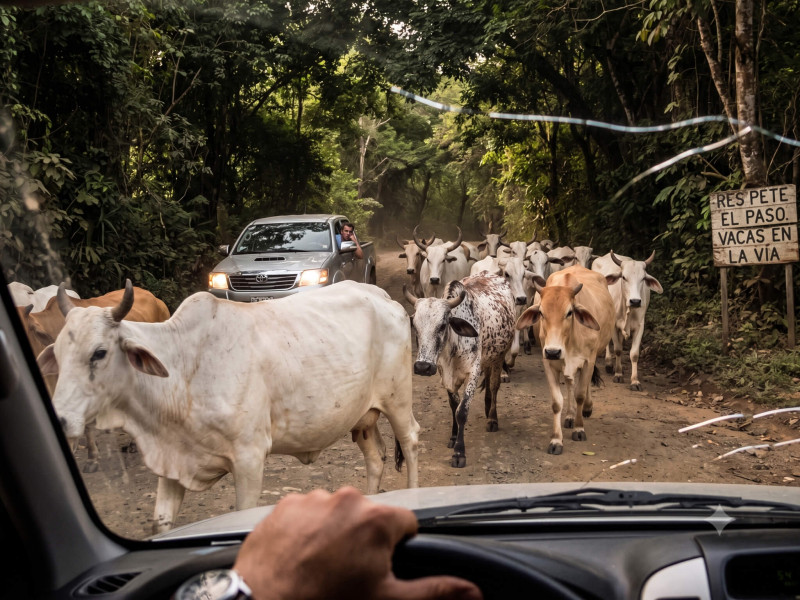
Come around a bend on an empty mountain road and there’s a farmer calmly herding cattle down the middle of it. Costa Rica operates on its own logic, and the sooner you accept that, the better.
And yet — this is also a country where exceptions constantly masquerade as rules.
That tension is one reason I get irritated by the flood of confident “expert advice” circulating through expat Facebook groups and forums, where people explain how things “really are in Costa Rica” based entirely on a single personal experience.
Anecdotal truth rarely travels well. One bad mechanic doesn’t indict an entire country. One rocky deal doesn’t make everyone crooked.
A recurring example: the advice that you should never use a realtor in Costa Rica because there’s “no licensing,” and therefore all agents are charlatans waiting to fleece foreigners.
Apply some common sense. Most desirable properties are listed or marketed through established real estate channels. If you rigidly avoid all realtors, you dramatically limit your access to the best opportunities available.
Then there’s the companion wisdom — find a local “insider,” preferably not a realtor, who can negotiate for you, speak Spanish, and protect you from “gringo pricing.” The irony is that some of the people most obsessed with avoiding gringo pricing are also the most likely to end up in poorly structured deals.
Does foreigner pricing exist in Costa Rica? Sure — you might encounter it at a mechanic shop, buying a horse, hiring certain services. But real estate generally doesn’t work that way.
Property values reflect market exposure, and fair pricing is typically established through open competition — which usually means the property is listed and actively marketed. A good realtor, properly registered and compliant, can be one of your most valuable assets before, during, and long after a transaction closes.
Yes, bad realtors exist here. Some operate informally, lack proper legal work status, or aren’t compliant with financial regulations. Working with one of those people can produce a genuinely bad outcome. But that’s a reason to vet carefully — not a reason to write off an entire profession.
The same logic applies to Costa Ricans generally. Petty theft exists here. Use common sense. Don’t leave valuables unattended, secure your home, be thoughtful about who you trust quickly. These are reasonable precautions. What they’re not is evidence that Costa Ricans are dishonest people.
I’ve lived here more than two decades. I’ve had things stolen. I’m careful about who I trust. And I’ve found ticos to be, overall, remarkably honest, hardworking, kindhearted, and generous — people who deserve the same fairness and respect they typically extend to the foreigners who arrive here, sometimes with enormous assumptions and very little patience.
One of the fastest ways to fail in your expat adventure is to get on the wrong side of that relationship. Arrive with unrealistic expectations, trust the wrong strangers too quickly, and then let one bad experience calcify into resentment toward an entire culture.
It happens. And when it does, it tends to say more about the arrival than the place.
Costa Rica resists rigid formulas. Rules function more like suggestions. Plans unravel and reassemble on their own schedule. Murphy’s Law doesn’t so much govern the country as describe its texture — the feeling that you’re never quite in control, that the unexpected is always one bend in the road away.
But here’s what the law leaves out: sometimes what’s waiting around that bend isn’t a problem. Sometimes it’s a cattle farmer with nowhere to be, the mountains green and sharp behind him, the road entirely his.
And if you’ve let go of your schedule enough to notice, it’s actually something worth seeing.