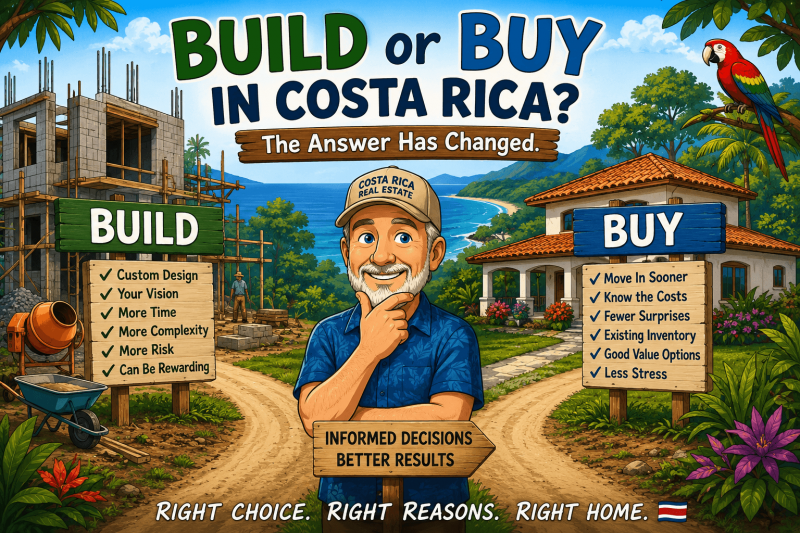
The Answer Has Changed
For years, many buyers coming to Costa Rica assumed that purchasing land and building a custom home was automatically the smarter financial decision.
And in some cases, it still is.
But today’s market is different than it was five or ten years ago.
Construction costs have risen substantially in recent years due to increases in labor, materials, transportation, and permitting expenses. At the same time, inventory levels in many parts of Costa Rica — including portions of the Southern Zone — have increased, putting downward pressure on resale home prices.
As a result, buyers should think carefully before assuming that building will necessarily save money.
Sometimes it will.
Sometimes it won’t.
And sometimes buying an existing home may actually provide better value.
When Building Makes Sense
There are certainly situations where building may still be the right decision.
Some buyers simply cannot find exactly what they want on the market. They may want a very specific architectural style, a particular view orientation, a unique floorplan, off-grid capabilities, privacy requirements, a certain elevation or climate, multi-home compound layouts, or luxury finishes tailored to their tastes.
For those buyers, building may be worth the additional time, stress, and uncertainty involved in managing a construction project in a foreign country.
Many people have successfully built beautiful homes in Costa Rica.
But it’s important to understand that building here is rarely a completely passive investment process.
Not All Land in Costa Rica Is Buildable
One of the biggest mistakes foreign buyers make is assuming that if land is being sold, it can automatically be built on.
That is absolutely not always the case.
Costa Rica has numerous zoning, environmental, road frontage, water availability, agricultural use, river setback, and permitting restrictions that can affect whether a property is legally buildable.
In some cases, the property may not have legal water availability. The land may lack sufficient public road frontage. Environmental restrictions may limit construction. Portions of the property may sit inside protected zones. Slopes or terrain may complicate permitting.
This is why strong due diligence is critical when purchasing land in Costa Rica.
A buyer should never assume that a property is buildable simply because someone says it is.
Construction Costs in Costa Rica
Construction pricing varies enormously depending on location, terrain, finishes, accessibility, and construction style.
As a very rough generalization, basic to moderate construction may range from approximately $100 to $150 per square foot. Higher-end construction can easily exceed $200 per square foot. Ultra-luxury projects may go substantially beyond that.
And those figures often do not include land costs, site preparation, excavation, retaining walls, driveways, utilities, permits, architectural plans, engineering, landscaping, pools, furnishings, or project management.
One important point that buyers often underestimate is that the quoted construction cost per square foot usually reflects only the structure itself — not the total all-in project cost.
Once site preparation, excavation, utilities, permitting, engineering, driveways, retaining walls, landscaping, pools, furnishings, appliances, project management, and contingency costs are factored in, the true total project cost may easily run 20% to 50% or more above the base construction estimate.
On steep mountain lots or complex luxury projects, ancillary costs can sometimes become substantial enough to materially change the economics of building versus buying an existing home.
A steep mountain lot with difficult access may dramatically increase overall costs.
Likewise, building in remote locations can create logistical complications that many buyers underestimate.
How Long Does It Take to Build in Costa Rica?
Construction timelines in Costa Rica can vary significantly depending on the size and complexity of the project, weather conditions, contractor availability, permitting, and site accessibility.
Timing can also depend heavily on when construction begins relative to Costa Rica’s dry and rainy seasons.
If a project begins near the start of the dry season and progresses quickly enough to get the structure under roof before the heavier rains arrive, a home may potentially be completed in approximately six to eight months, depending on the project.
However, if construction extends deeply into the rainy season before the structure is properly protected, timelines can easily stretch closer to a year or longer.
Heavy rains can slow excavation, concrete work, deliveries, site access, roofing, and overall project coordination — particularly in mountain areas or on difficult terrain.
And as with construction projects almost anywhere in the world, unexpected delays and complications can sometimes extend timelines beyond original expectations.
There is also another cost that many buyers fail to fully appreciate when considering a build project in Costa Rica: the personal investment of time, attention, energy, and stress.
Building a custom home is not simply a financial undertaking. It is often a highly involved process that requires hundreds of decisions, ongoing oversight, coordination with contractors and suppliers, problem-solving, and patience.
Even when hiring a general contractor or project manager, most owners still remain deeply involved throughout the process.
In many ways, this helps explain why owners who build custom homes often place a premium value on them later when selling. The perceived value is not based solely on construction costs, but also on the substantial personal effort and attention that went into creating the property.
For some people, that process is rewarding and deeply satisfying.
For others, it can become exhausting and stressful.
That is why the build-versus-buy decision should involve not only financial considerations, but also an honest assessment of one’s personality, experience level, available time, and tolerance for complexity.
Managing the Project Yourself vs. Hiring a General Contractor
Another major decision is whether to personally manage the build or hire a general contractor to oversee the project.
Some buyers choose to manage construction themselves in an attempt to reduce costs.
That may work for individuals with construction experience, strong Spanish skills, local contacts, and the time to actively supervise the process.
Others prefer to hire a reputable builder or contractor to manage the project from start to finish.
While that generally increases costs, it may reduce stress and improve coordination.
There is no universal right answer.
Much depends on the buyer’s personality, experience level, and tolerance for complexity.
Common Building Styles in Costa Rica
Costa Rica has several common residential construction styles, each with advantages and disadvantages.
Traditional Reinforced Concrete Block
This is the classic Costa Rican construction style.
These homes are typically built with steel-reinforced concrete block and are known for durability and solidity.
Advantages include longevity, structural strength, resistance to moisture and insects, and familiarity among local builders.
Disadvantages may include higher costs, longer construction timelines, and more heat retention in some climates.
Lightweight Steel Frame Systems
These have become increasingly popular in modern Costa Rican construction.
They often utilize steel framing combined with cement board panels and insulation systems, frequently paired with large glass walls and contemporary architecture.
Advantages include faster construction, modern aesthetics, potentially lower structural weight, and energy efficiency potential.
Disadvantages can include variable contractor experience levels, quality differences between systems, and dependence on proper installation.
Stick-Built Wood Construction
Wood homes can be beautiful and highly functional in Costa Rica, particularly in mountain climates.
However, buyers must pay close attention to the quality and type of wood being used.
Improper wood selection or inadequate treatment can create vulnerability to humidity, rot, insects, and termites.
Well-built hardwood homes using appropriate tropical species can last a very long time, but shortcuts in materials can become expensive later.
So… Is It Better to Build or Buy?
The answer depends heavily on the buyer.
Building may make perfect sense for someone who wants a fully customized home, enjoys managing projects, has patience and flexibility, and understands the risks involved.
Buying an existing home may make more sense for someone who wants certainty on pricing, wants to avoid construction stress, wants immediate usability, and finds a home that already fits most of their needs.
In today’s Costa Rica market, buyers should not automatically assume that building will save money.
Sometimes it will.
Sometimes buying an existing home may actually offer significantly better value.
The key is approaching the decision realistically, carefully, and with good local guidance.