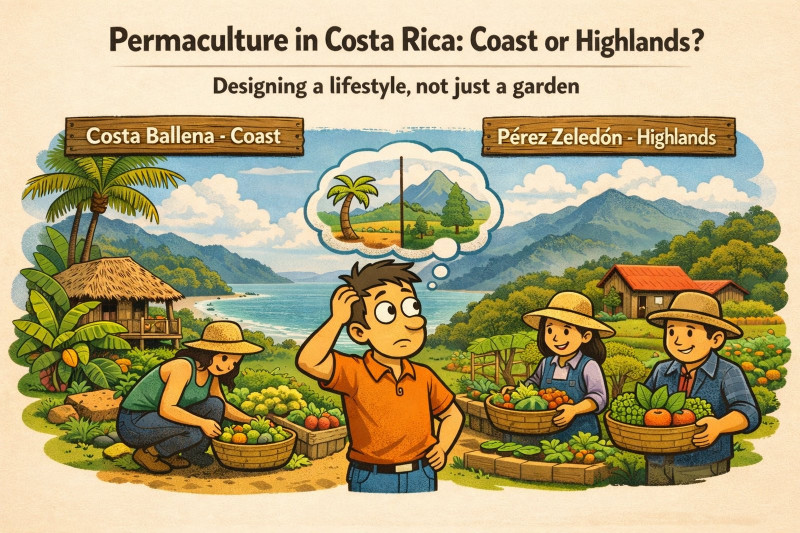
Designing a Lifestyle, not just a Garden
For many expats considering a move to Costa Rica, permaculture has become more than a farming method. It represents a lifestyle choice rooted in self-sufficiency, ecological responsibility, food security, and a closer relationship with the land. As a result, a growing number of buyers are now asking not just “Where should I live?” but “Where can I best practice permaculture?”
Costa Rica is uniquely well suited to permaculture because of its biological diversity, stable climate, and year-round growing conditions. But not all parts of the country offer the same experience or results. One of the most important distinctions for buyers is between the hot, humid lowland and coastal regions, and the cooler mid-elevation and highland regions.
In the lowland and coastal zones, such as the Costa Ballena region along the southern Pacific coast, biological productivity is extremely high. Warm temperatures, abundant rainfall, and intense sunlight create ideal conditions for rapid plant growth. Food forests establish quickly, tropical fruit trees thrive, and biomass accumulates fast. Bananas, plantains, cacao, papaya, breadfruit, jackfruit, and a wide range of palms and jungle species flourish naturally. From a purely ecological standpoint, these environments are some of the most fertile and productive on Earth.
However, that same warmth and humidity also create challenges. Fungal pressure is high, pests are more active year-round, soils are often heavily leached, and ongoing management is required to keep systems balanced. Structures are more prone to mold and decay, food storage is more difficult, and gardens require frequent attention. For full-time growers or commercial agroforestry projects this can be ideal, but for many lifestyle-oriented expats it can become demanding over time.
In contrast, Costa Rica’s mid-elevation and highland regions, such as the Pérez Zeledón area, offer a cooler, more stable climate. Daytime temperatures are moderate, nights are cooler, and there is generally less pressure from pests and fungal diseases. Soils in these areas, particularly where there is volcanic influence, tend to be richer and more balanced. Growth is slightly slower, but more predictable and often easier to manage.
These conditions support a wide diversity of crops, including coffee, avocado, citrus, leafy greens, root vegetables, herbs, berries, and even some temperate fruits at higher elevations. The environment is also more comfortable for daily living and physical work, which becomes increasingly important for retirees or part-time residents. Storage of harvested food is easier, homes stay cooler, and overall maintenance tends to be lower.
From a buyer perspective, this distinction is important. Most expat buyers interested in permaculture are not looking to become commercial farmers. They are looking for a resilient lifestyle, healthy food, connection to nature, and long-term sustainability without overwhelming daily labor. For this profile, mid-elevation environments often provide a better balance between productivity and manageability.
This is where the contrast between Costa Ballena and Pérez Zeledón becomes especially useful. Costa Ballena offers spectacular ocean views, lush jungle landscapes, and extraordinary tropical abundance. It is ideal for buyers who want an immersive tropical experience and are excited by rapid biological growth and complex ecosystems. Pérez Zeledón, on the other hand, offers a gentler climate, expansive mountain and valley views, more temperate growing conditions, and a lifestyle that many find easier to sustain long term.
Both regions are excellent for permaculture. They simply represent different expressions of it. One is fast, exuberant, and biologically intense. The other is steady, diverse, and more forgiving.
Ultimately, the best environment for permaculture is not defined only by climate or soil. It is defined by how well the land matches the goals, energy level, time availability, and lifestyle of the person working it. Costa Rica offers an extraordinary range of environments within a small geographic area, allowing buyers to choose not just a property, but a rhythm of life that suits them.
That is the real value proposition of permaculture in Costa Rica: not just growing food, but designing a life that works in harmony with the land and with oneself.