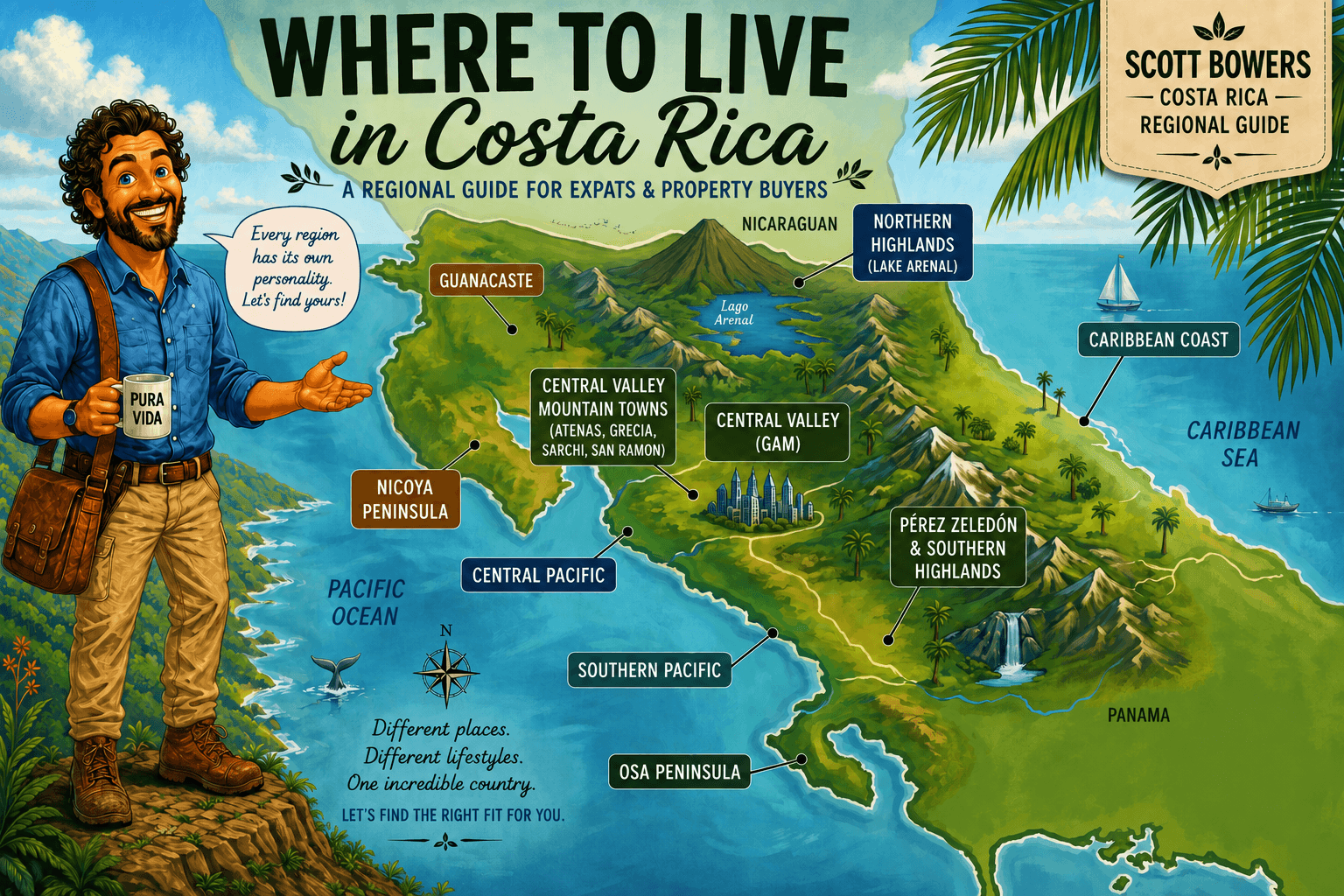
Costa Rica Regional Guide for Expats
Choosing the right region may be the most important real estate decision you'll ever make.
Many people begin their Costa Rica property search by looking at individual homes. In my experience, that's often backwards.
The first decision isn't which house to buy. It's where you want to build your life.
Costa Rica is a remarkably diverse country. Within a few hours, you can travel from cool mountain valleys to tropical beaches, cloud forests to dry forests, bustling cities to quiet farming communities. Each region offers its own climate, culture, pace of life, infrastructure, and real estate opportunities.
After helping buyers relocate throughout Costa Rica for more than a decade, I've learned that people are happiest when they choose the region that fits the lifestyle they truly want—not simply the place someone else recommended.
That's exactly why I created this guide.
Rather than focusing on individual properties, we'll start with the bigger picture. You'll learn what makes each region unique, who tends to enjoy living there, and the trade-offs that come with each lifestyle. Once you've narrowed your search to the right part of the country, choosing the right property becomes much easier.
There is no single "best" place to live in Costa Rica.
The best place is simply the one that feels most like home to you.
How to Use This Guide
This guide is organized by Costa Rica's principal real estate regions. Each chapter provides:
- An overview of the region and its overall character
- Representative communities
- Who the region is best suited for
- A quick lifestyle ratings summary
- Key advantages and trade-offs
- My personal perspective after years of helping buyers relocate
As you read, resist the temptation to ask, "Which region is the best?"
Instead, keep asking yourself:
"What kind of life do I want to live?"
That question will usually lead you to the right region long before you begin comparing individual properties.
Note: The ratings and observations throughout this guide reflect my personal experience living in Costa Rica for more than two decades and helping buyers relocate throughout the country. Every buyer's priorities are different, and no guide can replace personally visiting the regions that interest you.
Explore Costa Rica by Region
- Central Valley (Greater Metropolitan Area)
- Central Valley Mountain Towns
- Northern Highlands (Arenal & Monteverde)
- Pérez Zeledón & Southern Highlands
- Southern Pacific (Costa Ballena)
- Northern Pacific (Guanacaste)
- Nicoya Peninsula
- Central Pacific
- Osa Peninsula
- Caribbean Coast
- Which Region Is Right for You?
Costa Rica's Business, Healthcare & Cultural Center

The Central Valley—known in Costa Rica as the Greater Metropolitan Area (GAM)—is the country's economic, cultural, and healthcare center. While many people picture busy downtown San José, the region actually encompasses a collection of distinct communities, each offering a different balance of convenience, affordability, and lifestyle.
Escazú and Santa Ana have become two of Costa Rica's best-known expat enclaves, offering modern condominiums, gated communities, international schools, upscale restaurants, and shopping. These areas provide a lifestyle that feels familiar to many North American and European buyers, but they also come with some of the country's highest real estate prices.
For buyers seeking a balance between convenience and a more traditional Costa Rican atmosphere, communities such as Heredia, Alajuela, and Cartago often deserve a closer look. They generally offer lower home prices, a stronger local character, and a somewhat slower pace of life while still providing easy access to the services and amenities of the metropolitan area.

Best Suited For
- Retirees
- Families
- Professionals and remote workers
- Buyers prioritizing healthcare
- Frequent travelers
- Those seeking modern conveniences over beachfront living

What Makes the Central Valley Different?
No other region in Costa Rica offers the same level of convenience. Whether you need specialized medical care, international schools, government offices, shopping, or direct access to Juan Santamaría International Airport, the Central Valley puts everything within easy reach.
At the same time, buyers have meaningful choices within the region. Some communities cater to those looking for a highly developed, international lifestyle, while others retain a more traditional Costa Rican character at a lower price point.
Things to Consider
- Traffic can be heavy, particularly during weekday rush hours.
- Property values vary significantly between communities.
- Escazú and Santa Ana are among Costa Rica's most expensive residential markets.
- Heredia, Alajuela, and Cartago often provide better value while maintaining excellent access to services.
- Most Pacific beaches are approximately 1½–2 hours away.
Scott's Perspective
If convenience is your highest priority, the Central Valley is difficult to beat. It offers Costa Rica's best healthcare, shopping, education, and transportation infrastructure, making it an excellent fit for buyers who want modern amenities close at hand.
Within the region, however, there are important lifestyle differences. Buyers looking for a polished, international environment often gravitate toward Escazú or Santa Ana, while those who prefer a more authentic Costa Rican feel—and often better value—may find Heredia, Alajuela, or Cartago to be a better fit.
Central Valley Mountain Towns
Small-Town Charm with Big-City Convenience

The Central Valley Mountain Towns offer a lifestyle that many expats find to be one of Costa Rica's best-kept secrets. Communities such as Atenas, Grecia, Sarchí, and San Ramón combine pleasant year-round temperatures, beautiful mountain scenery, and a slower pace of life while remaining within reasonable driving distance of the Greater Metropolitan Area.
Unlike the more urban communities of Escazú and Santa Ana, these towns retain a distinctly Costa Rican character. You will find traditional town squares, weekly farmers markets, locally owned cafés, coffee farms, and a strong sense of community that has largely been preserved despite a growing expat presence.
For buyers who value convenience but do not necessarily want to live in or near a large city, these communities often represent an appealing middle ground.

Representative Communities
Atenas • Grecia • Sarchí • San Ramón
Best Suited For
- Retirees
- Remote workers
- Nature lovers
- Buyers seeking a mild mountain climate
- Those looking for authentic Costa Rican culture
- Buyers who value convenience without city living

What Makes the Central Valley Mountain Towns Different?
These communities offer many of the practical advantages of the Central Valley—including good healthcare, shopping, reliable infrastructure, and access to Juan Santamaría International Airport—without the density, congestion, and higher prices associated with the metropolitan area.
Many properties feature mountain or valley views, larger lots, gardens, and a quieter setting. The combination is particularly attractive to retirees and remote workers who value quality of life, natural beauty, and community more than nightlife or urban amenities.
Things to Consider
- A vehicle is useful, particularly for homes outside the town centers.
- Beach access generally involves a drive of approximately one to two hours.
- Nightlife and entertainment options are more limited than in the metropolitan area.
- Property values vary considerably according to elevation, views, access, and proximity to town.
- Temperatures and rainfall can vary noticeably between communities and elevations.
Scott's Perspective
If someone tells me they are looking for a mild climate, beautiful scenery, friendly communities, and a relaxed pace of life—but still want quality healthcare, shopping, and an international airport within reasonable reach—this is one of the first regions I suggest they explore.
Many buyers initially focus on beach communities simply because those are the places most heavily promoted online. After spending time in Costa Rica, however, some discover that these mountain towns offer the lifestyle they were really seeking: comfort, convenience, authenticity, natural beauty, and a stronger connection to everyday Costa Rican life.
Northern Highlands (Arenal & Monteverde)
Cloud Forests, Volcanoes & Adventure Living

The Northern Highlands are home to some of Costa Rica's most spectacular mountain scenery. Anchored by communities such as La Fortuna, Lake Arenal, Nuevo Arenal, Tilarán, Monteverde, and Bijagua, this region offers a distinctive combination of volcanic landscapes, freshwater lakes, cloud forests, waterfalls, wildlife, and year-round outdoor recreation.
Unlike Costa Rica's beach destinations or the more developed Central Valley, the Northern Highlands attract buyers seeking a lifestyle centered around nature. Hot springs, hiking trails, birdwatching, boating, waterfalls, and rainforest adventures become part of everyday life, making the region especially appealing to retirees, remote workers, and outdoor enthusiasts.
The area also has an established international community, particularly around Lake Arenal, where many expats have built homes that take advantage of panoramic lake and mountain views. Bijagua, near Río Celeste, offers an even quieter rainforest setting, while Monteverde is known for its cooler cloud-forest climate and conservation-oriented culture.

Representative Communities
La Fortuna • Lake Arenal • Nuevo Arenal • Tilarán • Monteverde • Bijagua (Río Celeste)
Best Suited For
- Retirees
- Nature lovers
- Outdoor enthusiasts
- Remote workers
- Birdwatchers and photographers
- Buyers seeking cooler mountain temperatures
- Buyers looking for scenic acreage, privacy, or lake views

What Makes the Northern Highlands Different?
Few regions in Costa Rica offer such a dramatic concentration of natural attractions. Arenal Volcano, Costa Rica's largest lake, Monteverde's cloud forests, the turquoise waters of Río Celeste, rolling green hills, rivers, waterfalls, and abundant wildlife all contribute to a lifestyle closely connected to nature.
Properties often feature panoramic lake or mountain views, larger parcels of land, gardens, and a level of privacy that can be difficult to find in more developed parts of the country. Although tourism plays an important role in La Fortuna and Monteverde, many surrounding communities still maintain a relaxed, rural, small-town atmosphere.
Things to Consider
- Rainfall is generally higher than in many other regions of Costa Rica.
- Temperatures vary significantly by elevation, with Monteverde considerably cooler than La Fortuna.
- Healthcare, shopping, and specialized services are more limited than in the Central Valley.
- Driving times between communities can be longer than the distances suggest because of winding mountain roads.
- Access to international schools is limited.
- Travel to an international airport can take several hours, depending on the community and road conditions.
Scott's Perspective
If your vision of Costa Rica revolves around volcanoes, lakes, cloud forests, waterfalls, wildlife, and outdoor adventure, the Northern Highlands deserve serious consideration.
This region tends to appeal to people who want to immerse themselves in nature rather than simply vacation near it. Buyers who prioritize urban conveniences, specialized healthcare, or easy airport access may find it too rural. For those who value scenery, tranquility, privacy, and an active outdoor lifestyle, however, it offers one of the most distinctive living experiences in the country.
Bijagua is particularly appealing to buyers seeking an even quieter rainforest environment near Río Celeste, while the Lake Arenal communities offer an established expat presence and some of Costa Rica's most impressive lake and mountain views.
Pérez Zeledón & Southern Highlands
Mountain Living with Easy Access to the Pacific Coast

The Southern Highlands of Costa Rica offer one of the country's most balanced lifestyles. Centered around the city of San Isidro de El General and surrounded by mountain communities, the region combines a mild year-round climate, modern conveniences, authentic Costa Rican culture, and exceptional natural beauty.
Unlike many mountain regions that feel isolated, Pérez Zeledón provides nearly everything residents need on a daily basis, including hospitals, shopping centers, restaurants, professional services, banks, schools, and government offices. At the same time, residents are never far from coffee farms, mountain rivers, waterfalls, protected forests, and spectacular valley views.
Perhaps most unique of all, the Southern Pacific beaches—including Dominical, Uvita, and Playa Hermosa—are within an easy drive of many mountain communities. Depending on where you live, you can enjoy cooler mountain temperatures at home while reaching the beach in approximately 20 to 45 minutes.
For buyers looking to balance comfort, convenience, culture, and nature, Pérez Zeledón has become one of Costa Rica's most compelling alternatives to both the Central Valley and the coastal communities.

Representative Communities
San Isidro de El General • Talamanca Mountain Communities • Fila Costeña Mountain Communities, including Tinamastes and Platanillo • Dota Region
Best Suited For
- Retirees
- Remote workers
- Families
- Nature lovers
- Buyers seeking larger properties and mountain views
- Buyers wanting city conveniences without metropolitan congestion
- Buyers who want access to both the mountains and the beach

What Makes Pérez Zeledón Different?
Very few places in Costa Rica offer such a complete combination of lifestyle benefits. The region is anchored by San Isidro de El General, a full-service regional city, while remaining surrounded by agricultural communities, cloud forests, rivers, waterfalls, coffee farms, and mountain landscapes.
Unlike many inland regions, Pérez Zeledón also provides relatively easy access to some of Costa Rica's finest beaches. Residents can enjoy a comfortable mountain climate at home while still making spontaneous trips to the coast for surfing, whale watching, dining, or an afternoon at the beach.
Properties range from affordable homes near town to luxury estates, coffee farms, equestrian properties, productive agricultural land, and expansive mountain acreage with panoramic views.
Dota Region: Coffee Country at High Elevation
Just north of Pérez Zeledón, the Dota region is one of Costa Rica's highest and coolest mountain areas, known for exceptional coffee, authentic rural villages, and stunning scenery. Home to San Gerardo de Dota—one of the country's best places to see the resplendent quetzal—and the headwaters of the pristine Río Savegre, the region is beginning to attract expats seeking a peaceful, high-elevation lifestyle in communities such as Santa María de Dota and Copey de Dota.
Things to Consider
- Reaching Juan Santamaría International Airport generally requires a drive of approximately 4 to 5 hours.
- Public transportation is available, but a vehicle is recommended for most buyers.
- Some mountain properties require four-wheel drive, particularly during the rainy season.
- Elevation varies considerably throughout the region, creating noticeable differences in temperature and rainfall.
- Buyers should carefully evaluate water sources, road access, zoning, setbacks, and building potential before purchasing rural land.
Scott's Perspective
I've called Pérez Zeledón home for many years, so I've had the opportunity to experience the region well beyond what most visitors see.
What continues to impress me is its balance. I can enjoy a comfortable mountain climate, complete nearly any errand without leaving the region, hike through protected forests, and still spend an afternoon at the beach whenever the mood strikes. That is a combination very few places in Costa Rica can offer.
While no region is right for everyone, I believe Pérez Zeledón deserves far more attention than it typically receives. Buyers often focus first on the Central Valley or beachfront communities, but many who spend time here discover that the Southern Highlands provide the lifestyle they were searching for all along.
Southern Pacific (Costa Ballena)
Costa Rica's Most Pristine Stretch of Pacific Coast

The Costa Ballena region has become one of Costa Rica's most desirable destinations for buyers seeking a relaxed tropical lifestyle. Stretching along the Southern Pacific coast, communities such as Dominical, Dominicalito, Uvita, Bahía Ballena, and Ojochal offer a distinctive blend of beautiful beaches, lush rainforest, abundant wildlife, and an established international community.
Unlike many beach destinations that have become heavily developed, Costa Ballena has retained much of its natural beauty. Protected national parks, marine reserves, waterfalls, rivers, and rainforest-covered mountains surround the area, creating an environment where nature remains part of everyday life.
Many visitors describe Costa Ballena as Costa Rica's answer to California's Big Sur—a dramatic coastline where jungle-covered mountains descend toward secluded beaches, rivers, waterfalls, and the Pacific Ocean.
One of the region's defining characteristics is that many homes are nestled into the rainforest-covered hills overlooking the coast. Rather than choosing between ocean views and privacy, buyers can often enjoy both, waking each morning to panoramic Pacific vistas while surrounded by tropical forest and abundant wildlife.

Representative Communities
Dominical • Dominicalito • Uvita • Bahía Ballena • Ojochal
Best Suited For
- Beach lovers
- Retirees
- Remote workers
- Surfers
- Nature lovers
- Buyers seeking ocean-view homes
- Buyers looking for luxury residences or vacation properties

What Makes Costa Ballena Different?
Costa Ballena offers one of the most spectacular combinations of rainforest and ocean found anywhere in Costa Rica. Residents enjoy easy access to beautiful beaches, year-round surfing, whale watching, waterfalls, hiking trails, and remarkable biodiversity.
The region has developed a vibrant international community while maintaining a relaxed, small-town atmosphere. Restaurants, cafés, boutique hotels, international schools, and professional services continue to expand, yet development remains relatively low-density compared with many coastal destinations.
Properties range from beachfront condominiums and luxury ocean-view estates to secluded rainforest retreats, boutique hotels, and private homes tucked into the surrounding hills.
Things to Consider
- The tropical climate is warm and humid throughout much of the year.
- Private clinics provide basic and routine medical care, but major hospitals and specialized services generally require travel to Ciudad Cortés or San Isidro de El General.
- Most residents find a vehicle essential for daily life, particularly for homes in the surrounding hills.
- Reaching Juan Santamaría International Airport typically requires a drive of approximately 4 to 5 hours.
- A proposed Southern Zone international airport near Sierpe could eventually improve access to the region, although buyers should not base current decisions on a future project.
Scott's Perspective
Costa Ballena is where many people first fall in love with Costa Rica. The combination of beautiful beaches, tropical rainforest, wildlife, and a relaxed pace of life creates an atmosphere that is difficult to match anywhere in the country.
What I appreciate most is that the region has largely resisted overdevelopment. You can still find quiet beaches, abundant wildlife, and homes surrounded by nature while enjoying a growing selection of excellent restaurants, schools, services, and amenities.
For buyers whose dream centers around surfing, sunsets, ocean views, and daily immersion in nature, Costa Ballena deserves to be high on the list of regions to explore.
Northern Pacific (Guanacaste)
Sunshine, Sandy Beaches & Resort Living

Costa Rica's Northern Pacific coast is one of the country's best-known destinations for international buyers. Centered around communities such as Tamarindo, Playa Flamingo, Playas del Coco, Playa Hermosa, and Playa Potrero, Guanacaste offers beautiful beaches, abundant sunshine, modern amenities, and one of Costa Rica's most established expat communities.
Known for its long dry season and consistently warm weather, Guanacaste appeals to buyers seeking an active outdoor lifestyle centered around the ocean. Boating, fishing, golf, surfing, scuba diving, sailing, and beach living are all part of daily life, while the region's developed infrastructure and international services make the transition to Costa Rica especially comfortable for many newcomers.
Unlike the lush rainforest landscapes of Costa Ballena, Guanacaste features tropical dry forest, rolling hills, broad sandy beaches, and spectacular Pacific sunsets. The landscape feels distinctly different from much of the rest of Costa Rica and is particularly attractive to buyers seeking sunshine and a more resort-oriented coastal lifestyle.

Representative Communities
Tamarindo • Playa Flamingo • Playas del Coco • Playa Hermosa • Playa Potrero
Best Suited For
- Beach lovers
- Retirees
- Families
- Remote workers
- Golfers
- Boaters and anglers
- Buyers seeking resort-style amenities
- Vacation-home and rental-property investors

What Makes Guanacaste Different?
Guanacaste combines an extensive selection of beaches with some of Costa Rica's best-developed coastal infrastructure. International grocery stores, bilingual medical providers, private schools, modern marinas, golf courses, and a wide range of restaurants and professional services are available throughout much of the region.
The area's long dry season is another major attraction. While much of Costa Rica experiences frequent rainfall during the green season, Guanacaste generally enjoys more sunshine and a longer stretch of reliably dry weather, supporting an outdoor lifestyle that revolves around the beach nearly year-round.
Real estate options include beachfront condominiums, luxury villas, golf-course communities, ocean-view estates, gated developments, and investment properties with strong vacation-rental potential.
Things to Consider
- The climate is among the hottest and driest in Costa Rica, particularly near the coast during the dry season.
- Property prices in the most popular beach communities are among the highest in the country.
- Tourism is a major part of the local economy, and some communities become noticeably busier during peak travel periods.
- Several established beach towns have a strongly international atmosphere and may feel less traditionally Costa Rican.
- Water availability should be carefully evaluated when purchasing land, particularly in rural areas where seasonal conditions can affect supply.
Scott's Perspective
If your vision of Costa Rica revolves around sunshine, beach living, boating, golf, and an active international community, Guanacaste deserves serious consideration.
It offers some of the country's strongest infrastructure for expats, excellent access through Liberia International Airport, and an impressive variety of recreational opportunities. Buyers looking for cooler temperatures, lush rainforest, greater affordability, or a more traditional Costa Rican atmosphere may find another region better suited to them.
Like every region in Costa Rica, Guanacaste has its own personality. For many buyers, the combination of dependable sunshine, beautiful beaches, modern conveniences, and direct international-airport access makes it an ideal place to call home.
Nicoya Peninsula
Surf, Wellness & Costa Rica's Bohemian Beach Lifestyle

The Nicoya Peninsula offers one of Costa Rica's most distinctive lifestyles. Home to communities such as Nosara, Sámara, Santa Teresa, Mal País, and Montezuma, the region attracts buyers seeking a slower pace of life centered around nature, wellness, surfing, and outdoor living.
Unlike the more developed resort communities of Guanacaste, much of the peninsula retains a laid-back, bohemian atmosphere where open-air cafés, yoga studios, surf schools, wellness retreats, and beachfront restaurants help define the local character. It is a region where people often choose lifestyle over convenience, embracing a closer connection to nature and a simpler way of living.
The Nicoya Peninsula is also internationally recognized as part of Costa Rica's Nicoya Blue Zone, one of the regions of the world associated with exceptional longevity. While no single factor explains that reputation, many visitors are drawn to the area's emphasis on community, outdoor activity, fresh local food, and a less hurried approach to daily life.

Representative Communities
Montezuma • Santa Teresa • Mal País • Nosara • Sámara
Best Suited For
- Surfers
- Wellness enthusiasts
- Remote workers
- Retirees seeking a relaxed lifestyle
- Nature lovers
- Yoga practitioners
- Buyers seeking luxury beach homes with privacy
- Buyers comfortable living farther from major cities

What Makes the Nicoya Peninsula Different?
The Nicoya Peninsula has become one of Costa Rica's leading destinations for wellness tourism and conscious living. Yoga retreats, holistic health centers, organic cafés, boutique hotels, and surf schools have helped shape an international community focused on healthy living, recreation, and personal well-being.
Despite its growing popularity, much of the peninsula remains relatively low-density. Instead of high-rise developments and large commercial centers, buyers generally find small beach towns, forested hillsides, jungle settings, and a lifestyle that emphasizes outdoor recreation and environmental preservation.
Real estate ranges from luxury ocean-view estates and modern architectural homes to secluded jungle retreats, boutique hotels, eco-lodges, and beachfront properties in some of Costa Rica's most desirable—and expensive—coastal communities.
Things to Consider
- Infrastructure is improving but remains inconsistent in parts of the peninsula.
- Healthcare options are limited, and specialized medical care generally requires travel to a larger regional center.
- Road conditions and driving times can be challenging, particularly during the rainy season.
- Property values in Santa Teresa and Nosara rank among the highest in Costa Rica.
- The climate is hot throughout the year, with substantial humidity during the green season.
- Public transportation and convenient airport access are limited in many communities.
Scott's Perspective
The Nicoya Peninsula is not for everyone—and that is precisely part of its appeal.
People who choose to live here generally are not looking for shopping malls, extensive services, or fast access to a major city. They are choosing a lifestyle centered around surfing, yoga, wellness, nature, and a strong sense of community. For many residents, life revolves around morning surf sessions, open-air cafés, healthy living, and evenings spent watching the sun disappear into the Pacific.
For buyers whose priorities lean toward simplicity, natural beauty, and an active outdoor lifestyle—and who are comfortable trading some convenience for that experience—the Nicoya Peninsula can be one of the most rewarding places to live in Costa Rica.
Central Pacific
Where Beach Living Meets Modern Convenience

The Central Pacific coast is one of Costa Rica's most active and accessible coastal regions. Home to communities such as Jacó, Playa Hermosa, Herradura, Esterillos, and Manuel Antonio, the area offers an energetic blend of beach living, outdoor recreation, tourism, and modern conveniences.
Located less than two hours from San José, the Central Pacific has long been a favorite getaway for both international visitors and Costa Ricans. Its easy accessibility, established infrastructure, and wide variety of recreational opportunities make it an attractive option for buyers seeking a beach lifestyle without feeling isolated.
From the lively streets of Jacó to the luxury marina at Los Sueños in Herradura, the quiet beaches of Esterillos, and the rainforest-covered hills surrounding Manuel Antonio, the region offers a surprising variety of lifestyles within a relatively short drive.

Representative Communities
Jacó • Playa Hermosa • Herradura (Los Sueños) • Esterillos • Manuel Antonio
Best Suited For
- Beach lovers
- Families
- Retirees
- Remote workers
- Sportfishing enthusiasts
- Golfers
- Vacation-home buyers
- Buyers seeking strong rental potential

What Makes the Central Pacific Different?
No other beach region combines accessibility and infrastructure quite like the Central Pacific. Modern supermarkets, private medical clinics, bilingual schools, restaurants, shopping, nightlife, and professional services are readily available throughout much of the area.
Jacó serves as the region's commercial hub and entertainment center, while neighboring Herradura is home to the internationally recognized Los Sueños Resort & Marina, offering world-class sportfishing, golf, and luxury residences.
Jacó is also one of Costa Rica's largest condominium markets. Buyers seeking an easy, low-maintenance beach lifestyle—with modern high-rise condominiums, panoramic ocean views, resort-style amenities, and the ability to walk from the elevator directly onto the beach—often find Jacó especially appealing.
Farther south, Manuel Antonio combines beautiful beaches with one of Costa Rica's most famous national parks, while communities such as Esterillos and Playa Hermosa provide a quieter alternative for buyers seeking a more relaxed coastal atmosphere without being far from the region's amenities.
Real estate ranges from affordable condominiums and vacation rentals to luxury villas, marina residences, ocean-view estates, and beachfront homes.
Things to Consider
- Jacó is one of Costa Rica's busiest beach towns and has an active nightlife that may not appeal to every buyer.
- Traffic can become heavy during weekends and holidays as residents of the Central Valley head to the coast.
- Property values in prime beachfront and marina communities are among the highest on the Central Pacific coast.
- The climate is warm and humid throughout much of the year.
- As with any busy tourist destination, buyers should exercise normal precautions regarding personal safety, particularly in nightlife areas after dark.
Scott's Perspective
The Central Pacific offers something few other regions can match: convenience.
For buyers who want easy access to the beach while remaining relatively close to San José, it is an outstanding option. Whether your interests include surfing, boating, fishing, golf, restaurants, or simply spending weekends by the ocean, the region provides an impressive range of choices.
At the same time, the Central Pacific has very different personalities depending on where you choose to live. Jacó offers an energetic, walkable, condominium-oriented lifestyle with abundant amenities, while communities such as Esterillos and Manuel Antonio provide a quieter atmosphere surrounded by nature.
If your ideal lifestyle combines beach living with modern conveniences and easy access to Costa Rica's capital, the Central Pacific deserves a close look.
Osa Peninsula
Costa Rica's Last Great Wilderness

The Osa Peninsula is unlike anywhere else in Costa Rica. Home to communities such as Puerto Jiménez, Drake Bay, Cabo Matapalo, Golfito, and Pavones, the region offers an extraordinary combination of biodiversity, adventure, and remote coastal living that appeals to buyers seeking a deep connection with nature.
This is Costa Rica at its wildest. Vast stretches of protected rainforest, deserted beaches, pristine rivers, and abundant wildlife dominate the landscape, while development remains intentionally limited. Life here moves at a slower pace, and residents willingly trade convenience for the privilege of living in one of the world's most biologically rich environments.
At the heart of the peninsula lies Corcovado National Park, widely considered Costa Rica's crown jewel of conservation. National Geographic famously described Corcovado as "the most biologically intense place on Earth," reflecting the extraordinary concentration of plant and animal life found within its forests.
Scarlet macaws, tapirs, monkeys, anteaters, crocodiles, dolphins, whales, and even jaguars still inhabit this remarkable ecosystem, making wildlife an everyday part of life rather than something experienced only on a guided tour.

Representative Communities
Drake Bay • Puerto Jiménez • Cabo Matapalo • Golfito • Pavones
Best Suited For
- Nature enthusiasts
- Adventure travelers
- Wildlife photographers
- Eco-conscious buyers
- Retirees seeking solitude
- Remote workers
- Eco-lodge owners and hospitality investors
- Experienced Costa Rica residents seeking a truly off-the-grid lifestyle

What Makes the Osa Peninsula Different?
The Osa Peninsula is defined by its extraordinary natural environment. Unlike most regions of Costa Rica, development remains relatively limited, allowing residents to experience rainforest, beaches, rivers, and wildlife much as they have existed for generations.
Drake Bay serves as the gateway to Corcovado National Park and Caño Island Biological Reserve, making it one of the country's premier destinations for hiking, scuba diving, snorkeling, whale watching, and wildlife observation.
Puerto Jiménez functions as the peninsula's primary service center, offering grocery stores, restaurants, banking, basic healthcare, and the area's largest domestic airport. Cabo Matapalo has become internationally known for luxury eco-lodges, spectacular beaches, and exceptional wildlife viewing.
Across the Golfo Dulce, Golfito offers a marina, sportfishing, government services, shopping, and a somewhat more developed atmosphere. Farther south, Pavones attracts surfers from around the world for its legendary left-hand point break, widely regarded as the second-longest left-hand wave on Earth.
Real estate ranges from rainforest retreats and off-grid homes to oceanfront estates, eco-lodges, conservation properties, and large acreage suitable for sustainable development.
Things to Consider
- The Osa Peninsula is one of Costa Rica's most remote regions, requiring considerably more travel than most other destinations.
- Domestic airports serve Puerto Jiménez, Drake Bay, and Golfito, but the nearest international airport remains several hours away.
- Healthcare facilities are limited, with specialized medical care generally requiring travel outside the region.
- Shopping, professional services, international schools, and infrastructure are considerably more limited than in more populated areas.
- The tropical climate is hot, humid, and receives substantial annual rainfall.
- Road conditions, utility access, and internet reliability should be carefully evaluated when considering rural or off-grid properties.
- Buyers should be comfortable living in a region where nature often takes priority over convenience.
Scott's Perspective
The Osa Peninsula isn't simply another place to live—it's a lifestyle choice.
People who move here generally aren't looking for shopping centers, nightlife, or easy access to major cities. They're choosing to wake up to scarlet macaws, howler monkeys, tropical rain, and the sounds of the rainforest instead of traffic. It's one of the few places in Costa Rica where wildlife remains an everyday part of life rather than something you experience on a guided tour.
For many buyers, that trade-off is exactly the point.
If your dream is to live surrounded by one of the most biologically diverse ecosystems on Earth, the Osa Peninsula is difficult to match. But it also demands flexibility, patience, and an appreciation for a slower, more remote way of life.
Those who embrace that reality often find it to be one of the most extraordinary and rewarding places in Costa Rica.
Caribbean Coast
Costa Rica's Caribbean Soul

Costa Rica's Caribbean Coast offers a completely different experience from the country's Pacific shoreline. Influenced by Afro-Caribbean culture, reggae rhythms, colorful architecture, and a slower pace of life, the region has developed a personality all its own.
Communities such as Cahuita, Puerto Viejo de Talamanca, Cocles, Punta Uva, and Manzanillo attract buyers looking for a relaxed tropical lifestyle where beaches, rainforest, wildlife, and culture blend seamlessly.
The southern Caribbean is distinctly multicultural. Afro-Caribbean, Indigenous Bribri, and Costa Rican influences come together in the local cuisine, music, traditions, and everyday life. For many expats, that unique cultural identity is precisely the appeal.
The region is also home to some of Costa Rica's most beautiful beaches, many backed directly by rainforest where monkeys, sloths, toucans, and other tropical wildlife remain part of daily life.

Representative Communities
Cahuita • Puerto Viejo de Talamanca • Cocles • Punta Uva • Manzanillo
Best Suited For
- Beach lovers
- Surfers
- Nature enthusiasts
- Digital nomads
- Artists and creatives
- Eco-conscious buyers
- Retirees seeking a relaxed lifestyle
- Buyers drawn to authentic Caribbean culture

What Makes the Caribbean Coast Different?
The southern Caribbean is unlike anywhere else in Costa Rica. Rather than large resorts or master-planned developments, the region is characterized by small beach communities tucked between lush rainforest and the Caribbean Sea.
Puerto Viejo serves as the area's vibrant commercial and cultural center, offering restaurants, cafés, boutiques, coworking spaces, yoga studios, nightlife, and a strong international community. Nearby Cocles offers excellent surfing and convenient access to town, while Punta Uva and Manzanillo provide a quieter and more nature-oriented atmosphere.
Cahuita combines a relaxed village lifestyle with access to Cahuita National Park, where rainforest, beaches, coral reefs, and wildlife exist within easy reach of the community.
Farther south, the Gandoca-Manzanillo National Wildlife Refuge protects one of Costa Rica's most spectacular coastal ecosystems. Coral reefs, beaches, mangroves, wetlands, and tropical rainforest combine to create exceptional opportunities for hiking, snorkeling, kayaking, wildlife observation, and quiet beach living.
Real estate includes jungle homes, beach cottages, boutique hotels, eco-lodges, vacation rentals, and small hospitality properties. Environmental protections and Maritime Zone regulations can significantly affect what may be purchased or developed, making careful due diligence especially important.
A Special Mention for Tortuguero
Although this guide focuses primarily on the southern Caribbean communities where most foreign buyers consider living, Tortuguero National Park deserves special mention.
Located along the remote northern Caribbean coast and accessible primarily by boat or small aircraft, Tortuguero is one of Costa Rica's most important naturalist destinations. It is internationally famous for its canals, rainforest wildlife, and beaches used by nesting green sea turtles.
Tortuguero is generally more appropriate as a wildlife and ecotourism destination than as a conventional residential market, but it represents an essential part of the Caribbean Coast's natural identity.
Things to Consider
- The Caribbean is one of Costa Rica's wettest regions, although its rainfall patterns differ from those of the Pacific coast.
- The climate is warm and humid throughout much of the year.
- Healthcare, shopping, and professional services are improving but remain more limited than in the Central Valley.
- The nearest international airport is several hours away by road.
- Infrastructure is less developed than in many of Costa Rica's established Pacific beach regions.
- Environmental protections, Maritime Zone restrictions, and land-use regulations require careful investigation before purchasing.
- Individual communities vary considerably in atmosphere, accessibility, services, and nightlife.
Scott's Perspective
The Caribbean isn't simply another beach destination. In many ways, it feels like entering a different country.
The culture is distinctly Afro-Caribbean, the atmosphere is more relaxed, and daily life moves according to its own rhythm. Buyers who fall in love with this region generally aren't comparing it directly with Guanacaste or the Central Pacific. They are looking specifically for the lifestyle and cultural experience that only this coast provides.
The beaches around Punta Uva and Manzanillo are among my personal favorites anywhere in Costa Rica. Combined with the extraordinary natural setting of the Gandoca-Manzanillo Wildlife Refuge, this stretch of coast offers a rare blend of beach living, biodiversity, and authentic local character.
Buyers seeking polished resorts, extensive infrastructure, or fast access to a major city may be happier elsewhere. But for those drawn to Caribbean culture, tropical rainforest, surfing, wildlife, and a genuinely laid-back lifestyle, the southern Caribbean deserves serious consideration.
Still Not Sure Which Region Is Right for You?
You don't have to figure it out alone.
Choosing where to live in Costa Rica is one of the most important decisions you'll make. Through my Strategy Call and Exploratory Trip Planning services, I'll help you narrow the options, avoid costly mistakes, and identify the regions and communities that best fit your lifestyle, priorities, and budget.
Explore My Consulting Services