The Costa Rica Real Estate Purchase Process
I get asked this all the time:
“How does buying property in Costa Rica compare to the U.S. or Canada?”
There are similarities, but there are also some very important differences.
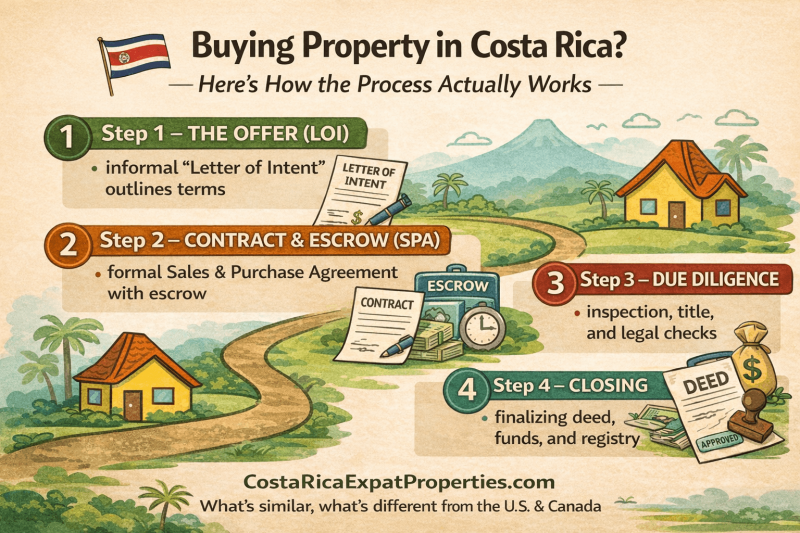
After more than two decades living here and helping clients through the process, I like to break it down into four simple steps.
📝 Step 1 – The Offer (LOI)
In Costa Rica, offers are usually made through something called a Letter of Intent (LOI).
This is not a formal contract—it is more like a written handshake that outlines:
- Price and terms
- Earnest money, typically 10%
- Due diligence timeline
- Closing timeline
There is no standardized form like in the U.S., and no deposit is made at this stage.
Important to know:
- The LOI is generally not legally binding.
- The property may or may not come off the market at this point.
It is simply the step that gets the deal moving toward a formal contract. However, it is backed by the “good faith” of the parties and should not be entered into lightly.
📄 Step 2 – Contract & Escrow (SPA)
Once the LOI is agreed upon, an attorney chosen by the buyer drafts the Sales & Purchase Agreement (SPA).
This is the real contract—and it is enforceable.
At this stage:
- The buyer sets up an escrow account.
- The earnest money deposit, usually 10%, is wired into escrow.
- The due diligence period begins, typically lasting 30–45 days.
Escrow is essential in Costa Rica—not just for security, but also for compliance with banking regulations. Buyers will need to provide documentation showing the source of their funds.
🔍 Step 3 – Due Diligence
This is where you verify everything before committing.
Typical items include:
- Home inspection, if there is a house
- Survey verification
- Title check by your attorney
During this period:
- The buyer can walk away for any legitimate reason and receive the deposit back.
- Once due diligence is completed and approved, the deposit becomes non-refundable or “goes hard.”
If issues come up, they are negotiated—repairs, price adjustments, delays, or sometimes cancellation of the deal.
🔑 Step 4 – Closing
After due diligence, closing usually happens within about two weeks.
During this time:
- The remaining funds are wired into escrow.
- The closing attorney prepares the deed, known as the “escritura.”
- The transaction is finalized and recorded in the National Registry.
Costa Rica closings are actually simpler than in the U.S.—typically involving just:
- The escritura, or deed
- Escrow disbursement instructions
💰 What About Closing Costs?
A good rule of thumb is approximately 4% of the purchase price in closing costs, including transfer tax, stamps, and notary fees.
This is usually split 50/50 between buyer and seller, although it is negotiable.
Buyers should also budget for due diligence costs, which are roughly another 0.5% of the purchase price.
Final Thoughts
Every deal has its own nuances, but this is the general roadmap.
The key is not just understanding the steps. It is knowing how to navigate them correctly in Costa Rica.
That is where experience really matters.
Thinking About Buying Property in Costa Rica?
Understanding the purchase process is just one part of making a successful move.
Whether you are planning an exploratory visit, researching from home, or getting serious about relocating, experienced guidance can help you avoid costly mistakes and make more confident decisions.
💬 If you are getting serious about your Costa Rica plans, send me a WhatsApp message and let’s see if a Strategy Call is the right next step for you.
You can also learn more about my complete Costa Rica Expat Consulting service here: