What It’s Really Like Living Here
If you spend any time researching Costa Rica—or talking to agents, expats, or folks online—you’ll start hearing a lot of “common knowledge” about the climate.
The problem is, a good chunk of it just isn’t true.
Let’s clear up a few of the biggest myths, especially if you’re thinking about buying property here.
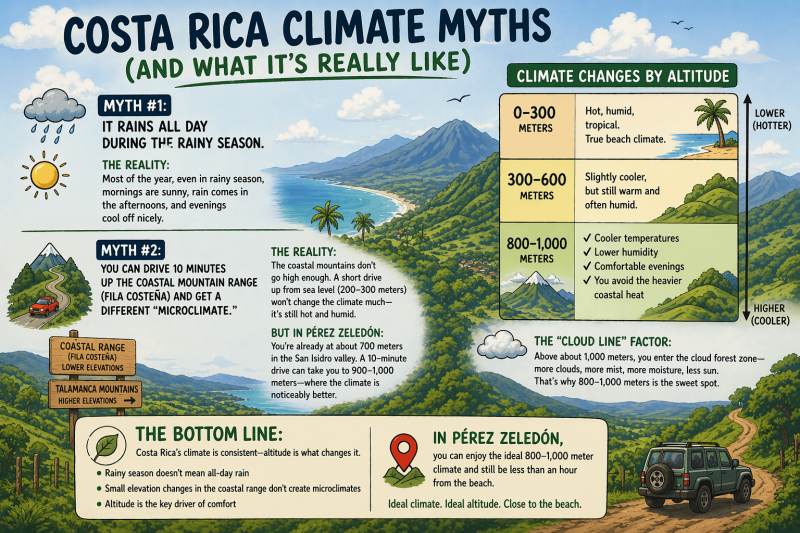
Myth #1: “It rains all day during the rainy season”
This one scares off a lot of buyers unnecessarily.
The reality? Most of the year, even in rainy season, the weather follows a pretty predictable pattern:
Mornings are typically sunny and clear
Clouds build throughout the day
Rain rolls in mid-to-late afternoon
Evenings cool off nicely
You still get plenty of usable daylight. You can surf, explore properties, run errands—no problem.
Now, there is an exception worth knowing.
During peak Caribbean hurricane season (usually October and into November), weather systems from the Caribbean side can spill over and disrupt that pattern. That’s when you’re more likely to see extended periods of rain or overcast conditions.
But outside of that window, the idea that it “rains all day” is just not how it works in most parts of the country—especially in the Southern Zone.
Myth #2: “You can drive 10 minutes up the mountain and find a totally different climate”
This one is everywhere—especially in coastal markets.
You’ll often hear that you can go just a few hundred meters up into the foothills (the Fila Costeña) and suddenly hit some magical “microclimate.”
That’s… optimistic.
Here’s the reality: Costa Rica’s climate is incredibly consistent horizontally. What changes it is altitude, not small geographic shifts.
A short drive up from sea level to 200–300 meters along the coastal range?
You might shave a degree or two off the temperature. That’s about it.
You’re still hot. You’re still humid. You’re still in essentially the same climate zone.
Now, there is an important exception.
In areas like Pérez Zeledón, you’re already sitting around 700 meters in the valley. From there, a 10–15 minute drive can realistically take you up into that 900–1,000 meter range—where the climate does change in a meaningful way.
So yes, you can find a better climate with a short drive—but only if you’re starting at the right elevation to begin with.
Where Climate Actually Changes: Altitude
If you want a meaningful shift in climate, you need to go higher. Not a little higher—a lot higher.
Here’s the general breakdown:
0–300 meters (coastal and low foothills)
Hot, humid, tropical. This is true beach climate.
300–600 meters
Slightly cooler, but still warm and often humid. Nice, but not dramatically different.
800–1,000 meters
This is the sweet spot (the "Goldilocks Zone").
Temperatures are noticeably cooler
Humidity drops significantly
Evenings are comfortable (sometimes even cool)
You often avoid the heavier coastal heat
This is where a lot of long-term expats end up once they’ve experienced both sides.
The “Cloud Line” Factor
There’s one more nuance that matters.
As you go higher, you eventually reach the cloud forest zone, where you’re frequently in the clouds—more mist, more moisture, less sun.
That’s why the 800–1,000 meter range tends to be ideal in areas like Pérez Zeledón:
You’re high enough to enjoy the cooler temperatures
But still low enough to stay below the cloud canopy most of the time
It’s a very livable, balanced climate.
The Bottom Line
Costa Rica doesn’t have wildly unpredictable weather—it’s actually quite consistent once you understand the patterns.
Rainy season doesn’t mean all-day rain
Small elevation changes don’t create true microclimates
Altitude is the key driver of comfort
If climate matters to you (and for most buyers, it should), it’s worth getting this right before choosing where to focus your search.
Because the difference between 200 meters and 900 meters here isn’t subtle—it’s lifestyle-defining.
And in places like Pérez Zeledón, you can hit that ideal 800–1,000 meter climate and still be less than an hour from the beach—a rare best-of-both-worlds setup.