Understanding the Maritime Zone, concession property, and why coastal due diligence matters
One of the more common requests I get from buyers interested in Costa Rica sounds something like this:
“I want a beachfront property where I can build right near the water… maybe even with a dock or pier extending into the ocean or river.”
That’s often the point where expectations collide with Costa Rican reality.
One of the first things many foreign buyers are surprised to learn is that owning true beachfront property in Costa Rica is often very different from owning beachfront property in the United States, Canada, or many parts of Europe.
The simple reality is this:
In most cases, you cannot buy land that extends all the way to the ocean and build freely right up to the shoreline. And if your dream includes a private dock or pier extending into the ocean or a tidal river, that generally is not realistic either.
The reason largely comes down to Costa Rica’s Maritime Zone law.
What Is the Maritime Zone?
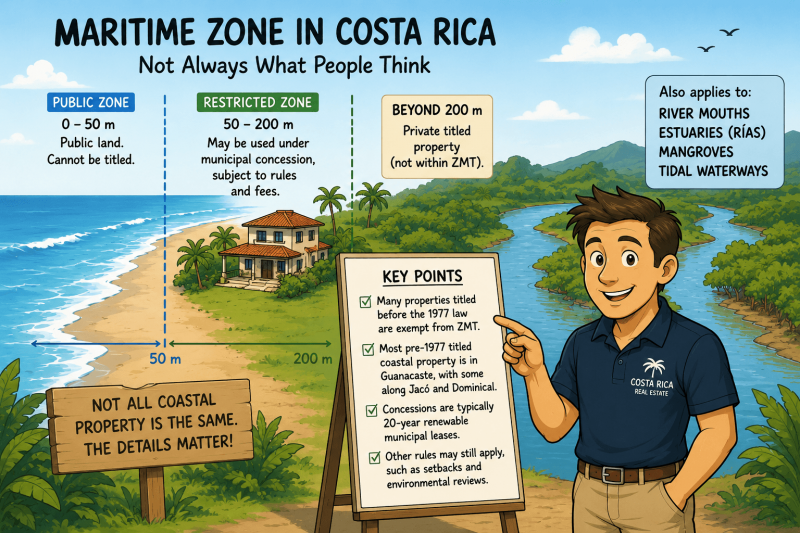
Costa Rica’s Maritime Zone (Zona Marítimo Terrestre, or ZMT) is governed primarily by Law No. 6043, enacted in March 1977.
The law was designed to protect Costa Rica’s coastlines from uncontrolled private development while preserving public access to beaches and other environmentally sensitive coastal areas.
That date is important.
Why?
Because properties that were legally titled prior to the enactment of the 1977 law may, in some cases, be exempt from the standard maritime zone restrictions. That is what gives rise to the category commonly referred to as “grandfathered” titled beachfront property.
Generally speaking, the first 200 meters inland from the ordinary high tide line falls within the maritime zone.
That 200-meter strip is divided into two sections.
The first 50 meters is known as the public zone.
This land cannot be privately owned, titled, or developed for private exclusive use. It belongs to the public.
The next 150 meters is known as the restricted zone.
This area may be occupied or developed under a concession granted by the local municipality, subject to zoning rules, environmental regulations, and ongoing compliance.
This framework exists to preserve public coastal access while also protecting environmentally sensitive areas.
Maritime Zone Issues Don’t Apply Only to Beaches
Many buyers assume maritime zone issues only matter if a property sits directly on the ocean.
That is not always true.
Similar regulatory issues can arise around:
- River mouths
- Estuaries
- Mangroves
- Tidal waterways, often referred to locally as a ría
A ría is essentially a river estuary where tidal influence from the ocean extends inland.
These areas often trigger special environmental or development restrictions even when the property isn’t directly beachfront.
That distinction matters because buyers sometimes focus only on ocean frontage while overlooking restrictions created by rivers or estuaries.
Titled Property Near the Coast: The Important Exception
Here’s where things become more nuanced.
Not every coastal property in Costa Rica is subject to the maritime zone.
There are properties that were legally titled before the maritime zone law took effect.
These grandfathered properties may be fully titled fee-simple land, meaning they are privately owned and not governed by concession rules.
This is one reason you will occasionally see homes, hotels, and resorts built much closer to the ocean than many buyers expect.
Most of these grandfathered titled coastal properties are found in Guanacaste, where historical land titling occurred before the current maritime zone framework.
However, important pockets also exist in other regions, including parts of the Central Pacific around Jacó and even portions of the Southern Pacific near Dominical.
That’s one reason you see certain resorts and homes in those areas built unusually close to the beach.
From the outside, two neighboring properties may look similar.
Legally, they may be completely different.
One may be concession land.
The other may be fully titled.
That distinction can dramatically affect value, financing, development potential, and long-term risk.
What Exactly Is a Concession?
A concession is often misunderstood.
A concession is not the same thing as fee-simple ownership.
Think of it as something more similar to a long-term lease granted by the municipality.
Concessions are typically granted for 20-year periods and are generally renewable if the concession holder remains compliant.
The concession holder pays fees and must comply with applicable zoning, use restrictions, and development requirements.
This creates an important practical difference from titled ownership.
With concession property, you generally cannot simply acquire the land and leave it vacant indefinitely as a passive hold.
Municipalities typically expect the land to be used in accordance with the approved concession plan.
Failure to comply can create risk, including possible cancellation or non-renewal.
That raises another important point.
If a concession were lost, improvements built on the property could also be at risk.
In other words, you are not just risking the right to use the land—you may also be risking what you built on it.
That sounds alarming, but in practice, properly maintained concessions that remain compliant are commonly renewed.
The key is understanding what rights you actually have before buying.
Even Titled Property May Have Other Restrictions
Here’s another misconception I frequently encounter.
A buyer learns a property is titled and assumes that means all regulatory concerns disappear.
Not necessarily.
Even if maritime zone restrictions do not apply, other regulatory issues still may.
These can include:
- River setback requirements
- Environmental protections
- Wetland restrictions
- Building footprint limitations
- Environmental review for larger developments
In other words, “not maritime zone” does not automatically mean “no restrictions.”
A Real Example from Dominical
I’m currently involved in due diligence on a commercial property near Dominical that illustrates this perfectly.
At first glance, because of its location near a river estuary, one might assume maritime zone restrictions automatically apply.
But after deeper investigation, evidence suggests the property was titled prior to the relevant law, meaning ZMT restrictions may not apply.
That’s significant.
However, our analysis did not stop there.
We still needed to investigate:
- Historical survey records
- Applicable river setbacks
- Neighboring permitting precedent
- Potential environmental review requirements for future development
That is exactly how proper due diligence works in Costa Rica.
The right question is rarely just:
“Is this property in the maritime zone?”
The better question is:
What regulatory framework actually applies to this specific property?
That question often requires legal review, survey analysis, municipal verification, and sometimes environmental consultation.
Final Thoughts
Costa Rica rewards buyers who avoid assumptions.
Coastal and waterfront properties can be spectacular—but they often require deeper due diligence than inland properties.
The presence of an ocean view, river frontage, estuary access, or proximity to the beach tells you very little by itself.
What matters is the legal status of the land and the regulatory framework attached to it.
And in Costa Rica, those details matter far more than most buyers initially realize.