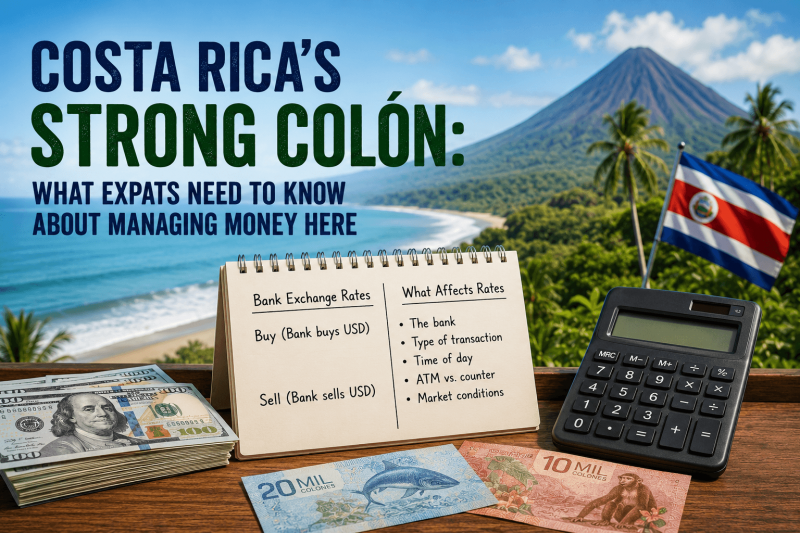
What Expats Need to Know About Managing Money Here
For decades, most long-term expats in Costa Rica got used to thinking about the exchange rate in one direction only: the colón slowly losing value against the U.S. dollar.
That was simply the reality for many years. If you earned dollars and lived in Costa Rica, things generally got cheaper over time from your perspective.
But over the past few years, something unusual has happened.
The Costa Rican colón has strengthened significantly against the dollar.
And for many expats, retirees, remote workers, and even long-time residents, that shift has created a surprising amount of confusion.
Why does Costa Rica suddenly feel more expensive?
Should you keep your money in dollars or colones?
Why does the exchange rate seem different every time you look at it?
And what’s actually going on?
Let’s break it down in plain English.
Why Has the Colón Been Strengthening?
There isn’t one single reason, but rather a combination of factors that have helped strengthen the Costa Rican currency in recent years.
Some of the biggest contributors include:
- Strong tourism inflows
- Foreign investment
- Growth in remote workers and expats bringing dollars into the country
- High local interest rates
- Multinational companies operating in Costa Rica
- General economic stability compared to many neighboring countries
All of that increases demand for colones.
At the same time, the U.S. dollar has weakened globally during certain periods, which has amplified the effect.
The result?
The same U.S. dollar that once exchanged for ₡700 may now exchange for less than ₡500.
That’s a dramatic shift.
Why This Feels So Strange to Long-Term Expats
Many long-time expats in Costa Rica are psychologically conditioned to think of the dollar as the “safe” currency and the colón as the weaker local currency.
Historically, that was often true.
But in the current environment, many expats earning dollars have quietly experienced what feels like a reduction in purchasing power.
In simple terms:
If your income stays the same in dollars, but each dollar converts into fewer colones, then your Costa Rica lifestyle becomes more expensive.
You may not notice it all at once, but you feel it gradually:
- Groceries
- Fuel
- Utilities
- Restaurants
- Labor
- Caja payments
- Day-to-day living costs
All begin consuming a larger percentage of your dollar income.
The Split-Currency Reality of Living in Costa Rica
One thing that makes Costa Rica unique is that it operates somewhat like a dual-currency economy.
Many major purchases and assets are effectively dollarized:
- Real estate
- Vehicle loans
- Some rents
- Larger investments
But daily life mostly happens in colones:
- Supermarkets
- Gas stations
- SINPE Mobile
- Utilities
- Local services
- Small businesses
That means many expats naturally end up living financially in both currencies whether they intend to or not.
And that’s actually okay.
In fact, for many people, maintaining some balance between the two currencies makes more sense than trying to predict where the exchange rate is headed next.
Should You Keep Money in Dollars or Colones?
There’s no universal answer.
It depends largely on:
- where your income comes from
- what currency your debts are in
- and where your expenses occur
For example:
If your income is entirely in U.S. dollars, but most of your day-to-day spending happens in Costa Rica, it may make sense to keep a larger operational reserve in colones than you once did.
That doesn’t necessarily mean converting all your savings into colones.
But constantly keeping only a tiny amount in colones and converting dollars every few days can expose you to ongoing exchange-rate swings.
Some expats prefer a blended approach:
- Dollar reserves for savings and major obligations
- Colones for several months of local living expenses
Others prefer staying mostly in dollars.
There’s no perfect strategy because nobody knows with certainty where the exchange rate will go next.
No One Really Knows What Happens Next
Some people believe the colón will eventually weaken again.
Others believe Costa Rica’s economic fundamentals may continue supporting a stronger currency for some time.
The reality is that predicting currency movements consistently is extremely difficult, even for professional economists and investors.
That’s why most expats are usually better served by focusing on practical money management rather than trying to “win” a currency prediction game.
Understanding Costa Rica’s Exchange Rate Confusion
One of the most confusing things for newcomers is that there isn’t just one exchange rate.
Banks typically display:
- A buy rate
- A sell rate
And many people understandably wonder:
“Which one is the real exchange rate?”
The answer is: both.
It simply depends on which side of the transaction you are on versus the bank...
For instance, when the bank posts a ‘buy’ rate, it means the bank is buying dollars from you. In that case, you multiply your dollars by the exchange rate to determine how many colones you receive. So the lower the rate, the fewer colones you get.
When the bank posts a ‘sell’ rate, it means the bank is selling dollars back to you. In that case, you divide your colones by the exchange rate to determine how many dollars you receive. So the higher the rate, the fewer dollars you get back.
That spread between the two rates is one of the ways banks and exchange services make money on currency transactions.
For a purely hypothetical example, let’s say your bank shows:
- Buy: ₡475
- Sell: ₡500
If you walk into the bank with U.S. dollars and want colones, the bank is buying your dollars. That means you receive the buy rate.
So if you exchange $1,000:
$1,000 × ₡475 = ₡475,000
Now let’s say later you want to convert those colones back into dollars.
This time, the bank is selling dollars to you, so you pay the sell rate.
₡475,000 ÷ ₡500 = $950
So in this simplified example, you started with $1,000 and ended up with $950 after converting back and forth.
What if you’re not standing at a bank exchange counter at all?
What if you’re simply buying groceries, paying for gas, or using a credit card to purchase something priced in colones?
In that case, the same basic principle still generally applies.
If you are using dollars or a U.S. dollar-denominated account to pay for something priced in colones, you are effectively selling dollars in order to obtain colones for the transaction. In practical terms, that usually means the conversion occurs closer to the bank’s buy rate rather than its sell rate.
That’s one reason many expats gradually notice the effects of exchange rates in their everyday lives even without physically exchanging money at a bank. Every colón-denominated purchase made with dollars involves some form of currency conversion happening behind the scenes.
And to make things even more confusing, the rates can vary depending on:
- the bank
- whether you use an ATM, card, or exchange counter
- whether you are buying or selling dollars
- and sometimes even the time of day
Airport exchange counters and tourist-area exchanges are often among the worst rates available.
Practical Tips for Expats Living in Costa Rica
You don’t need to become a currency trader to manage money effectively here.
A few practical habits usually go a long way:
- Understand which currency your income and debts are tied to
- Keep enough colones available for normal local expenses
- Avoid constantly making small emergency conversions
- Pay attention to exchange spreads and fees
- Be cautious about overreacting emotionally to short-term currency swings
- Remember that local purchasing power matters more than exchange-rate headlines
Most importantly, avoid panic.
Exchange rates move.
They always have.
And they always will.
The Bottom Line
The strong-colón environment has definitely changed the financial landscape for many expats in Costa Rica.
For some, it has made life noticeably more expensive.
For others, it has simply forced a rethinking of how they manage dollars versus colones on a day-to-day basis.
But ultimately, living successfully in Costa Rica has always required some degree of flexibility and adaptation.
The exchange rate is just one more example of that reality.
And like many things in Costa Rica, the key is usually balance rather than extremes.