The Questions Most People Actually Want Answered
If you spend any amount of time researching Costa Rica, eventually you’ll run into endless articles about residency.
Most of them dive deep into legal procedures, document requirements, and bureaucratic details.
But before you get lost in all of that, there are really just a handful of practical questions most people actually care about.
Questions like:
- Do I need residency to buy property?
- Do I need residency immediately?
- Can I legally live in Costa Rica without it?
- Can I work?
- What are the downsides?
- And is residency something I should really be stressing about upfront?
Let’s start there.
You Do NOT Need Residency to Own Property in Costa Rica
None.
Zero.
You can legally buy and own property in Costa Rica as a foreigner without residency.
You can hold title in your personal name or through a Costa Rican corporation or LLC structure.
So if your concern is:
“Can I buy property before getting residency?”
The answer is absolutely yes.
In fact, many foreign property owners in Costa Rica never obtain residency at all.
That part is actually relatively straightforward.
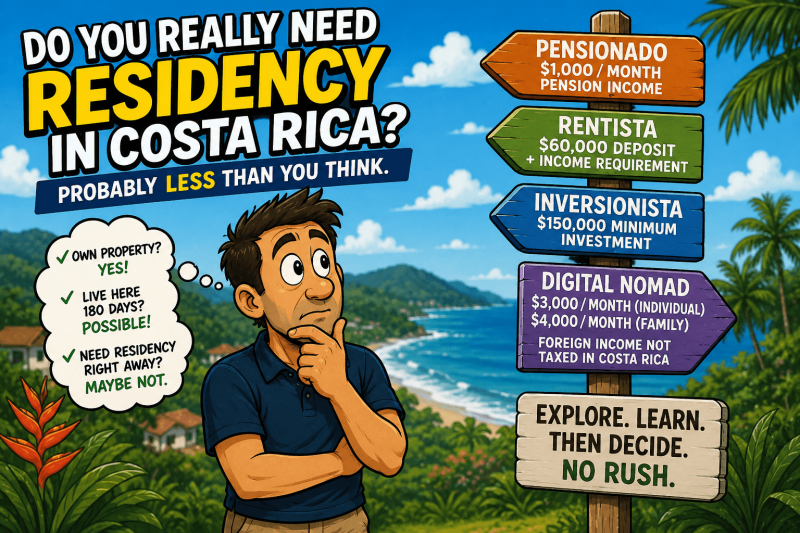
The Main Residency Categories (Briefly)
Costa Rica has several residency categories, but for most expats, the discussion usually revolves around four primary ones.
1. Pensionado Residency
This is designed for retirees.
Generally speaking, you qualify by proving a lifetime pension or social security income of at least $1,000 per month.
This is one of the most common residency categories for retirees moving to Costa Rica.
2. Rentista Residency
This category is designed for people with stable passive income or significant savings.
Typically, this involves depositing approximately $60,000 into a Costa Rican bank and demonstrating a qualifying level of income over time.
This option is often used by early retirees, remote workers, or people living off investments.
3. Inversionista Residency
This category is based on investment in Costa Rica.
Most commonly:
- Real estate
- Businesses
- Other qualifying investments
Currently, the minimum qualifying investment amount is generally $150,000.
This is a popular route for people already purchasing substantial property in Costa Rica.
4. Digital Nomad Visa
Technically this is not traditional residency, but it deserves mention because it has become increasingly popular.
This category is aimed at remote workers employed outside Costa Rica and offers certain benefits, including potential tax advantages and easier importation of certain personal items.
The current income requirement is generally around $3,000 per month for an individual or $4,000 per month for a family.
One major attraction of the Digital Nomad category is that the foreign income used to qualify for the visa is generally not subject to Costa Rican income tax.
It’s generally more temporary and streamlined than full residency categories.
Temporary vs. Permanent Residency
One important thing many people don’t initially realize is that the residency categories discussed above generally lead to temporary residency, not permanent residency.
And that distinction matters.
As a temporary resident, you generally cannot legally work as an employee in Costa Rica.
And of course, you certainly cannot legally work while simply on a tourist visa.
There are some important nuances and exceptions to this.
For example, the Digital Nomad category is specifically designed for people working remotely for clients or companies outside Costa Rica.
Likewise, many foreign residents legally own and operate businesses in Costa Rica, draw income from those businesses, or manage investments and companies here.
The key distinction is generally that you are not supposed to be working as a regular employee on a Costa Rican payroll without the appropriate status allowing it.
For most people moving to Costa Rica for retirement, investment, lifestyle, or remote work purposes, this usually isn’t a major issue.
But it’s important to understand.
After holding temporary residency for approximately three years, you generally become eligible to apply for permanent residency.
Permanent residency allows you to work legally in Costa Rica without the same restrictions imposed on temporary residents.
There are also other paths that can potentially lead directly to permanent residency, most commonly through marriage or close family ties to a Costa Rican citizen.
And just to avoid confusion:
Permanent residency is NOT the same thing as becoming a Costa Rican citizen.
Citizenship and naturalization involve a longer process, additional requirements, testing, and other legal steps.
For most expats, however, permanent residency is more than sufficient for their long-term needs.
The Caja Requirement
One thing many people don’t initially realize is that Costa Rican residency generally comes with mandatory enrollment in the Caja system, Costa Rica’s public healthcare and social security system.
In simple terms:
- Residents are generally required to contribute monthly
- Contributions are usually based on declared income
There are some differences between residency categories regarding how this works, but getting into all of those nuances is outside the scope of this post.
The important thing to understand is this:
Residency is not just a “status.”
It usually comes with ongoing obligations as well.
So… Do You Actually Need Residency?
For some people?
Absolutely.
For others?
Maybe not.
And this is where things get more practical than legal.
The Biggest Benefit of Residency
The main benefit is simple:
You no longer need to leave Costa Rica within the time limitations of a tourist visa.
Costa Rica currently allows many tourists to remain in the country for up to 180 days.
That’s a pretty significant amount of time.
And while Costa Rica has made some noise over the years about discouraging what’s often called “perpetual tourism” — people repeatedly exiting and re-entering the country to remain long term on tourist status — the reality is that the tourist period was still extended to 180 days.
That matters.
If you’re someone who:
- Returns to the U.S. once or twice a year
- Travels internationally periodically
- Doesn’t necessarily stay continuously in Costa Rica
…you may find that residency simply isn’t urgent.
At least not initially.
Driving in Costa Rica on a Foreign License
One important practical issue for many expats is driving.
The good news is that Costa Rica has updated its laws to better align driving privileges with the newer 180-day tourist visa period.
In practical terms, this means that if you are legally in Costa Rica on a tourist stay, your valid foreign driver’s license is generally recognized for the same duration as your authorized legal stay — up to 180 days in many cases.
That’s a significant improvement from the old system, which created a mismatch between immigration status and driving privileges.
For many people, this change makes long-term tourist stays far more practical than they used to be.
That said, once someone becomes a legal resident, Costa Rica expects them to eventually homologate, or convert, their foreign driver’s license into a Costa Rican license.
Should You Rush Into Residency?
In my opinion?
Usually not.
Not unless your circumstances clearly require it.
A lot of people get overly focused on residency before they’ve even figured out:
- Where they want to live
- Whether Costa Rica truly fits them long term
- What kind of lifestyle they actually want here
For many people, it makes more sense to:
- Spend meaningful time in Costa Rica first
- Explore different regions
- Get clarity on long-term plans
- Then decide whether residency makes sense
A Final Note About the Process
Costa Rican residency is very doable.
People successfully obtain residency every year.
But it is not always simple.
The process often takes roughly a year to a year and a half, sometimes longer depending on the category and circumstances.
While some people do attempt the process on their own, there are many procedural traps, document requirements, timing issues, and bureaucratic complications that can create problems.
For that reason, most people are better off using a knowledgeable immigration attorney to guide the process and help avoid mistakes.
The Bottom Line
Residency in Costa Rica is important.
But for many people, it’s not something that needs to create stress right out of the gate.
You do not need residency to own property.
You may not even need residency immediately to live comfortably in Costa Rica depending on your travel habits and lifestyle.
The key is understanding:
- What residency actually does
- What obligations come with it
- And whether it truly fits your situation right now
Like many things in Costa Rica, the answer is rarely one-size-fits-all.
Questions About Living or Investing in Costa Rica?
If you’re considering a move to Costa Rica and want practical, real-world guidance on residency, regions, lifestyle, or property ownership, feel free to reach out.
The easiest way to contact me is via WhatsApp.
I’m always happy to point people in the right direction and help simplify what can otherwise feel overwhelming.