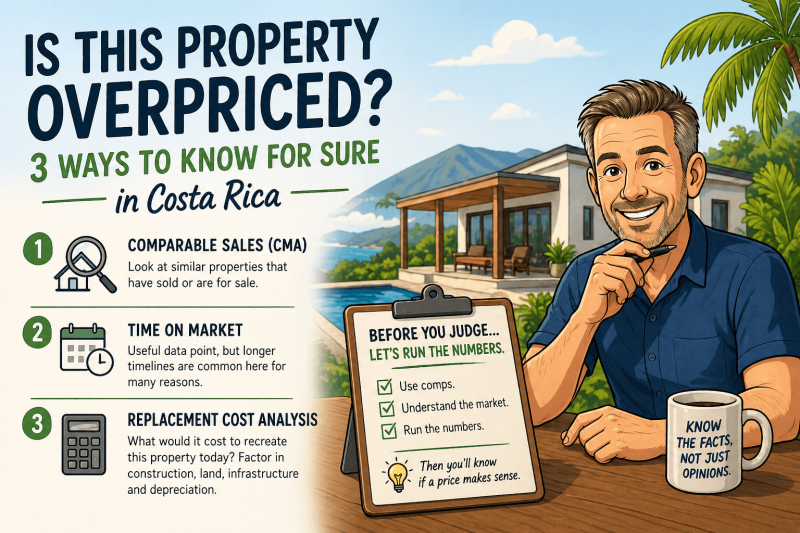
3 Data-Driven Ways to Determine Property Value in Costa Rica
One of the most common reactions I see when a property hits the market in Costa Rica is immediate judgment on price.
“Overpriced!” “Too expensive!” “No way it’s worth that!”
The reality is, most of these reactions are based on gut feeling—not actual analysis.
If you’re serious about buying property here, there are three practical ways to evaluate whether an asking price is justified.
Let’s walk through them.
First, Comparable Sales (CMA)
This is the most reliable method, and it’s what professionals use.
CMA stands for Comparative Market Analysis.
The idea is simple: compare the property you’re looking at to other similar properties that have sold (or are currently on the market).
But in Costa Rica, this isn’t always as straightforward as it sounds.
- You need to account for differences in:
- Location (micro-location matters a lot here)
- Views (ocean view vs. mountain view vs. no view)
- Access (paved road vs. 4x4 required)
- Infrastructure (water, electricity, internet)
- Quality of construction and finishes
Two properties can have the same square footage and be priced very differently based on just one or two of these factors.
Also, keep in mind that online listings don’t always tell the full story. This is where working with a knowledgeable agent who can run a proper CMA becomes extremely valuable.
Second, Time on Market (Use With Caution)
A lot of people assume that if a property has been sitting on the market for a long time, it must be overpriced.
Sometimes that’s true—but not always.
In Costa Rica, especially in the expat and second-home markets, longer timelines are common due to:
- A smaller buyer pool
- International buyers coordinating travel and logistics
- Limited financing options
- Sellers who are not under pressure to sell
It’s not unusual for well-priced properties to take months—or even longer—to find the right buyer.
So while time on market can be a useful data point, it should never be the only factor you rely on.
Third, Replacement Cost Analysis
This is one of the most overlooked—and most powerful—ways to evaluate value in Costa Rica.
Ask yourself: what would it cost to recreate this property today?
Start with construction costs.
In the Southern Zone, very general ranges currently look something like this:
- Basic construction: around $150 per square foot
- Mid-range construction: roughly $175 to $225 per square foo
- Higher-end construction: $250+ per square foot
From there, you need to add everything else that goes into a finished property:
- Land value (which varies widely depending on location, views, and accessibility)
- Site preparation and grading
- Infrastructure (driveways, drainage, water systems, electrical setup)
- Pools, landscaping, and outdoor features
Many people underestimate how quickly these costs add up—especially infrastructure, which can be significant in Costa Rica.
A Real-World Example
Let’s take a simplified version of a property similar to one I recently posted that generated a lot of commentary.
- Asking price: $199,000
- House size: approximately 1,070 sq ft
- Lot size: approximately 370 m²
- Year built: 2022
Now let’s break it down using a replacement cost approach.
First, estimate the cost to build the house today. Using a conservative figure of $150 per square foot:
1,070 sq ft × $150 = $160,500
Next, estimate the land value. Using a modest $40 per square meter:
370 m² × $40 = $14,800
That gives us a combined replacement cost of:
$160,500 + $14,800 = $175,300
And that’s before factoring in additional costs like site preparation, infrastructure, access, and landscaping, which can be meaningful in Costa Rica.
Now let’s account for depreciation.
Since the home was built in 2022, it’s only about four years old. For a concrete home in good condition, depreciation is typically modest. Using a simple estimate of about 2% per year, we get roughly 8% total depreciation over four years.
$160,500 × 8% = $12,800
Subtracting that from the structure value:
$160,500 – $12,800 = $147,700
Now add the land value back in:
$147,700 + $14,800 = $162,500
So, based on this simplified analysis, you end up with an adjusted value in the low-to-mid $160,000 range—before assigning any value to infrastructure, improvements, or the premium buyers often place on move-in-ready properties.
What does this tell us?
At first glance, someone might look at a $199,000 asking price and assume it’s too high.
But when you consider current construction costs, the relatively new condition of the home, land value, and the real-world costs and effort involved in building from scratch, the pricing starts to make a lot more sense.
This is exactly why quick, emotional reactions to price can be misleading.
A Note on Depreciation
Unlike new construction, existing homes may reflect some level of depreciation depending on age, maintenance, and design.
However, in many parts of Costa Rica, land value appreciation can offset or even exceed that depreciation over time.
This is why it’s important to evaluate the property as a whole, rather than focusing only on the structure.
The Bottom Line
Before deciding that a property is overpriced, it’s worth stepping back and looking at the full picture.
A proper evaluation should include:
- Comparable properties
- Market dynamics and time on market
- A realistic replacement cost analysis
And one method you should definitely avoid?
Relying on uneducated Facebook comments to determine value.
Without a data-driven approach, it’s easy to misjudge value—especially in a market like Costa Rica, where no two properties are exactly alike.
If you’d like help breaking down a specific property, I’m always happy to take a closer look and provide a data-driven perspective.