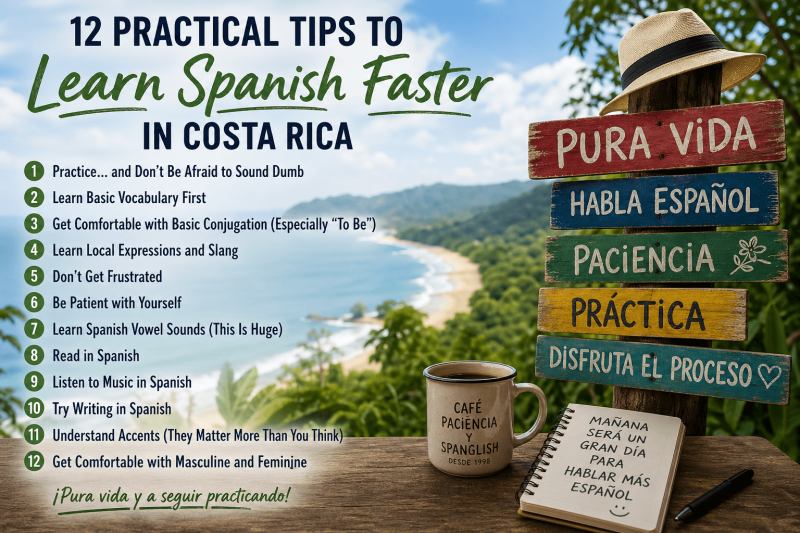
From My 26 Years of Still Trying to Get Fluent
This is a companion piece to earlier thoughts on expat life here in Costa Rica, and one topic that always comes up—learning Spanish.
I’ve been here over 26 years. I’m still learning.
That alone should tell you something.
Now, I do have one unfair advantage—I’m married to a non-English speaker. That definitely accelerates things. I’m not saying that’s the strategy I recommend… but it works.
For the rest of us, here are what I consider the most practical, real-world ways to actually make progress with Spanish in Costa Rica.
No fluff. Just what works.
1. Practice… and Don’t Be Afraid to Sound Dumb
This is the big one.
You’re going to mess up. You’re going to say things wrong. You might even accidentally say something embarrassing.
Good.
That’s part of it.
Costa Ricans are generally patient and encouraging. They’ll meet you halfway if you make the effort. The worst thing you can do is freeze up and default to English every time.
2. Learn Basic Vocabulary First
You don’t need to sound like a professor. You need to be understood.
Start with the basics:
Common nouns (food, places, everyday objects)
Basic verbs (eat, go, want, need, have)
Directions
Numbers
You’d be surprised how far a small vocabulary can take you in day-to-day life.
3. Get Comfortable with Basic Conjugation (Especially “To Be”)
Spanish lives and dies on verb conjugation.
If you can get a handle on ser and estar (both versions of “to be”), you’re already ahead of most people.
Don’t try to master everything at once—just get the basics down so you can form simple, workable sentences.
4. Learn Some Local Expressions and Slang
Textbook Spanish will only get you so far.
Costa Rica has its own flavor—words like “pura vida”, “mae”, and plenty of others you won’t find in a classroom. Use with caution for context, however!
Understanding these makes a big difference—not just in communication, but in connecting with people.
5. Don’t Get Frustrated
You will hit walls.
You’ll feel like you’re not improving. You’ll forget words you know you knew yesterday.
That’s normal.
Language learning isn’t linear—it’s messy. Stick with it.
6. Be Patient with Yourself
This ties right into frustration.
If you expect to “figure it out” in a few months, you’re setting yourself up for disappointment.
This is a long game.
I’m 26 years in… still learning.
7. Learn Spanish Vowel Sounds (This Is Huge)
If there’s one shortcut to sounding better fast, this is it.
Spanish vowels are consistent:
A = ah
E = eh
I = ee
O = oh
U = oo
Once you lock that in, your pronunciation improves immediately—even if your grammar isn’t perfect.
And don’t make the classic gringo mistake of speaking Spanish with English vowel sounds—it’ll come out completely unrecognizable to a local.
8. Read in Spanish
Start simple.
Menus. Signs. WhatsApp messages. Social media posts.
You don’t need to sit down with a novel on day one. Just start exposing your brain to written Spanish regularly.
9. Listen to Music, TV, Movies in Spanish
This is one of the easiest (and most enjoyable) ways to train your ear.
Even if you don’t understand everything, you start picking up rhythm, pronunciation, and common phrases.
Bonus: some of those phrases will stick whether you like it or not.
10. Try Writing in Spanish
Most people skip this—and it’s a mistake.
Even simple things help:
Text messages
Grocery lists
Short notes
Writing forces you to think through the language in a different way. It slows you down—in a good way.
11. Pay Attention to Accent Marks
Spanish accent marks are not just decorative little marks that make words look more Spanish.
They matter.
An accent mark tells you where the emphasis goes in a word, and that can change the pronunciation completely.
So don’t ignore them.
Learning to notice accent marks early will help you pronounce words more naturally and avoid putting the stress in the wrong place.
This is one of those small details that makes a big difference.
12. Get Comfortable with Masculine and Feminine
This one trips up just about everyone—and it sticks around longer than you’d expect.
Every noun has a gender, and it affects articles, adjectives… everything.
You’ll think you’ve got it down, and then suddenly you’re second-guessing whether it’s el or la again.
And just when you think you’ve figured out which nouns are masculine and which are feminine… you’ll discover there are about a billion exceptions.
After 26 years, I still do.
The key here isn’t perfection—it’s exposure and repetition. Over time, things just start to sound right.
Final Thoughts
There’s no magic formula.
It’s repetition, exposure, and a willingness to be uncomfortable for a while.
But if you stick with it, something clicks.
You go from “getting by” to actually having conversations… and that’s when Costa Rica really starts to open up.
And if you ever feel like you’ve finally mastered Spanish… just wait until a word like agua comes along—looks feminine, takes el in the singular (el agua fría), then flips back to las aguas frías in plural—and reminds you who’s really in charge.
If you’re thinking about making the move—or even just spending more time here—and want some on-the-ground guidance (language, areas, lifestyle, real estate), feel free to reach out.
Happy to help point you in the right direction.