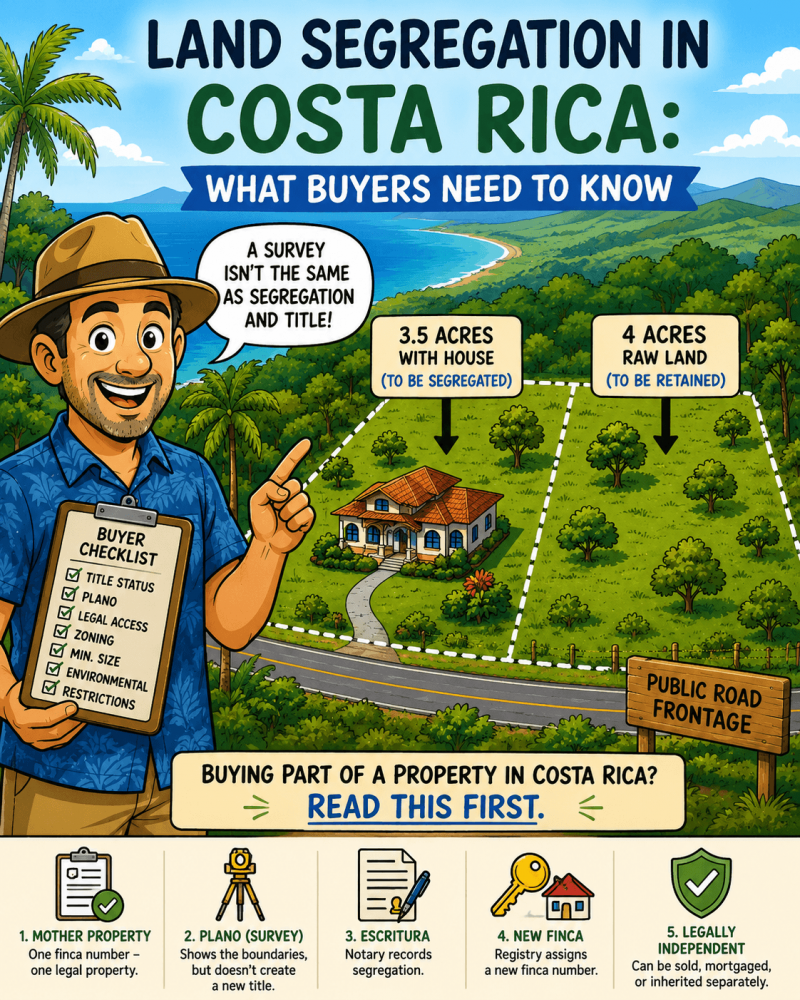
Buying Part of a Property in Costa Rica? Read This First.
One of the more confusing aspects of buying land in Costa Rica is something called segregation.
I’ve seen many buyers assume that if a seller says, “We’re selling 3 acres off a larger parcel,” then that smaller parcel already exists as a separate legal property.
Often, that is not the case.
In Costa Rica, a piece of land can be physically identified, surveyed, and even shown on a registered map—yet still not legally exist as a separately titled property.
That distinction matters.
If you are considering buying a portion of a larger parcel, understanding how segregation works can save you from expensive surprises.
What Is Land Segregation?
In simple terms, segregation is the legal process of dividing one property into two or more separate properties.
Suppose a seller owns a 7.5-acre parcel and wants to sell only the portion with the house—say 3.5 acres—while keeping the remaining 4 acres.
That sounds straightforward.
Legally, however, several steps may be required before that 3.5-acre parcel can be sold as an independent property.
Step 1: The Mother Property
Every titled property in Costa Rica has a registered legal identity called a finca number.
Think of this as the property’s official title number in the National Registry.
A single finca may contain one house, multiple building sites, farmland, forest, rivers, creeks, or future development potential.
As long as the property remains under one finca number, it is still legally one property, even if everyone informally refers to different sections of it.
Step 2: The Plano
Before land can usually be segregated, a licensed surveyor prepares a plano catastrado.
This survey identifies the boundaries, dimensions, area, access, adjacent properties, easements, or rights-of-way associated with the parcel.
Here is where confusion often begins.
A registered plano does not automatically create a new titled property.
This is one of the most common misunderstandings among both buyers and sellers.
A seller may say, “The lot is already surveyed.”
That may be true.
But a survey alone does not mean the parcel has its own legal title.
Step 3: Legal Segregation by Escritura
For segregation to become legally complete, a notary must prepare and record an escritura de segregación.
That escritura is submitted to the National Registry.
Once approved, the segregated parcel receives its own finca number. It can then usually be sold, mortgaged, or inherited separately, and the mother property is reduced accordingly.
Only at this point does the new property fully exist as its own legal parcel.
A Real-World Example
Let’s use a common scenario.
A seller owns a 7.5-acre parcel on a public road.
They want to sell:
- 3.5 acres with the house
- while retaining 4 acres of raw land
Suppose they already obtained a registered plano for the 3.5-acre homesite.
That helps—but it may still not be enough.
Important questions remain:
- Has the segregation actually been recorded in the Registry?
- Has a new finca number been assigned?
- Does the remaining 4-acre parcel still comply with municipal requirements?
- Does each parcel have legal access?
Until those questions are answered, the property may still legally be just one finca.
In many cases, segregation can still be completed as part of closing, but this must be verified during due diligence.
Important Restrictions on Segregation
Not every property can be freely divided.
This is where things get complicated in Costa Rica.
Minimum Lot Size
Many municipalities impose minimum parcel sizes.
These minimums can vary based on zoning, land use classification, municipal regulations, and whether the property is considered urban, residential, agricultural, or rural.
A parcel that looks large enough may still fail subdivision rules.
Public Road Frontage vs. Agricultural Access
This is a major issue buyers often overlook.
Properties that directly adjoin a public road typically have more flexibility for segregation because each resulting parcel may be able to satisfy frontage and access requirements.
But many rural parcels do not front a public road.
Instead, they may be accessed through easements, agricultural access roads, rights-of-way, or internal farm roads.
That changes everything.
In Costa Rica, parcels classified as agricultural land often face stricter segregation rules, especially when access depends on internal agricultural roads rather than public road frontage.
A property may be physically accessible while still facing legal limitations on subdivision.
This is why “road access” must always be examined carefully.
Not all access is legally equivalent.
Water and Environmental Restrictions
Even when a segregation appears straightforward, environmental restrictions may prevent it or limit what can be done with the resulting parcels.
Potential issues include:
- creek setbacks
- river setbacks
- springs
- wetlands
- protected forest
- water availability or concession limitations
This is particularly important in mountain and rural areas like the Southern Zone.
A beautiful creek running through a property may add value visually—but it can also reduce buildable area and complicate future segregation.
Common Buyer Mistakes
Mistake #1: Assuming Surveyed Means Titled
It doesn’t.
Mistake #2: Assuming Physical Access Means Legal Access
It may not.
Mistake #3: Assuming Any Large Parcel Can Be Subdivided
Many cannot.
Mistake #4: Waiting Until Late in Due Diligence
Segregation questions should be investigated early.
Final Thoughts
Land segregation in Costa Rica is not necessarily difficult.
But it is nuanced.
The biggest takeaway is this:
A piece of land can physically exist, be surveyed, and even be marketed for sale—without yet existing as a separately titled legal property.
That distinction matters.
Before purchasing a portion of a larger parcel, make sure your attorney verifies:
- title status
- plano status
- legal access
- zoning
- municipal restrictions
- environmental limitations
Costa Rica offers extraordinary opportunities for land buyers.
But as with many things here, success comes from understanding the details beneath the surface.
And segregation is one of those details that deserves careful attention.