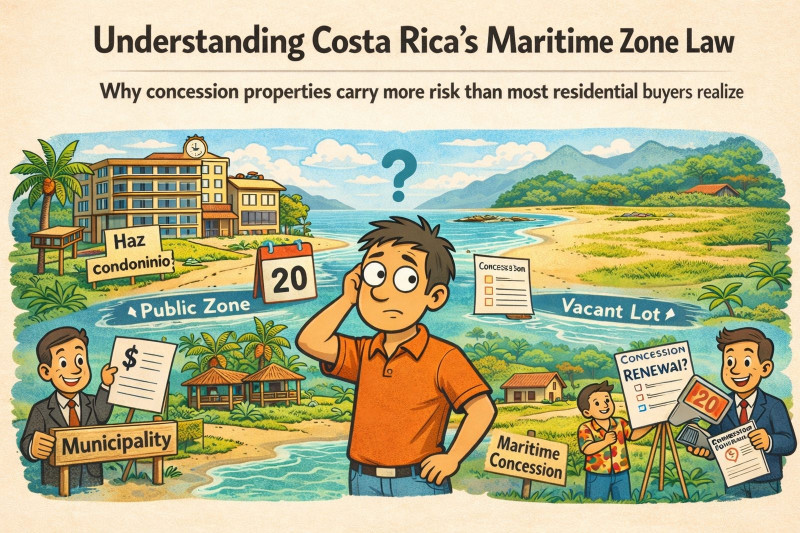
Why concession properties carry more risk than most residential buyers realize
One of the most misunderstood aspects of real estate in Costa Rica is the Maritime Zone Law. To understand both the opportunity and the risk, it’s important to understand how the maritime zone was created, how concessions work, and why these properties are generally better suited to commercial projects than private residential homes.
Costa Rica’s Maritime Zone, known locally as the Zona Marítimo Terrestre (ZMT), dates back to legislation enacted in 1977. The purpose of the law was to protect Costa Rica’s coastlines from uncontrolled private development and to preserve public access to the beach. Under this law, the first 200 meters inland from the mean high tide line is regulated land.
The first 50 meters is the public zone. This land is strictly public, cannot be developed, and cannot be privately occupied under any circumstances. The next 150 meters is known as the restricted zone. This is where concessions come into play.
Land in the restricted zone is not owned in fee simple (titled). Instead, it is owned by the state and administered by local municipalities. Individuals or companies may apply for a concession, which grants the right to use the land for a specific purpose, under specific conditions, for a defined period of time, typically 20 years.
One point of confusion for many buyers is that not all coastal properties are subject to the Maritime Zone Law. In Guanacaste in particular, there are many properties that are exempt. These exemptions generally stem from historical circumstances. Some coastal communities existed before the law was enacted, and properties that were legally titled prior to 1977 were often grandfathered in. Others fall within officially designated urban zones where the maritime law does not apply in the same way. This is why you will see fully titled beachfront or near-beach properties in certain areas, even though the general rule is that coastal land is concession-based.
From a practical standpoint, concessions are not inherently bad, but they are very different from titled ownership, and that difference matters a great deal depending on the buyer’s goals.
One of the most important distinctions is risk. A concession is not ownership. It is a right of use that can be revoked if the terms are not complied with. While concessions are typically renewable and, in practice, most are renewed as long as all requirements are met, renewal is not automatic. Each renewal requires municipal approval and compliance with zoning plans, environmental regulations, payment of fees, and fulfillment of the approved project purpose.
Maritime zone concessions may be held either by individuals or by corporations, and the rules differ in important ways. A foreign individual is legally permitted to hold a concession in their own name, with no nationality requirement. However, when a concession is held by a corporation, Costa Rican law requires that the company be majority owned by Costa Rican citizens, meaning at least 51 percent of the shares must belong to Costa Ricans. This distinction matters because, in a corporate structure, legal control ultimately rests with the Costa Rican majority shareholder regardless of private agreements. While both structures are legal, they each carry different risks, and in all cases a concession remains a conditional right of use rather than outright ownership, subject to compliance, renewal, and municipal approval over time.
There are also ongoing costs associated with maintaining a concession. These include annual concession fees paid to the municipality, property taxes, and often higher legal and administrative costs. Any changes to the project typically require additional approvals, environmental studies, or modifications to the concession agreement. This makes concessions more complex and more expensive to maintain over time compared to titled residential properties.
Another critical point that buyers often overlook is that concession land is generally not intended to be held as a vacant investment. When applying for a concession, the applicant must specify what they intend to do with the property. That might be a hotel, a restaurant, a mixed-use development, or another approved project. In most cases, the concession holder is expected to actually carry out that project within a reasonable timeframe. Holding concession land indefinitely without development can put the concession at risk.
This is one of the reasons concession properties tend to make more sense for commercial projects than for private residences. Commercial developers are accustomed to regulatory oversight, timelines, permits, environmental impact studies, and ongoing compliance. They are also better positioned to absorb the financial and administrative costs associated with concessions.
For private residential buyers, especially retirees or lifestyle buyers, concessions introduce a level of uncertainty that many are not comfortable with. The inability to simply own the land outright, the need for ongoing approvals, the lack of guaranteed renewal, and the requirement to actively use and maintain the property all add layers of risk that are often unnecessary when titled alternatives exist nearby.
This does not mean concession properties should be avoided entirely. In some cases, they offer unique locations and opportunities that cannot be replicated elsewhere. But they require careful due diligence, a clear understanding of the rules, and realistic expectations about long-term ownership and use.
In my professional opinion, concession properties in the maritime zone are best approached as specialized investments rather than straightforward residential purchases. They can work very well for the right buyer with the right project, but they are not a casual or passive form of real estate ownership.
As with many aspects of real estate in Costa Rica, the key is not whether something is legal, but whether it is appropriate for your goals, risk tolerance, and long-term plans.