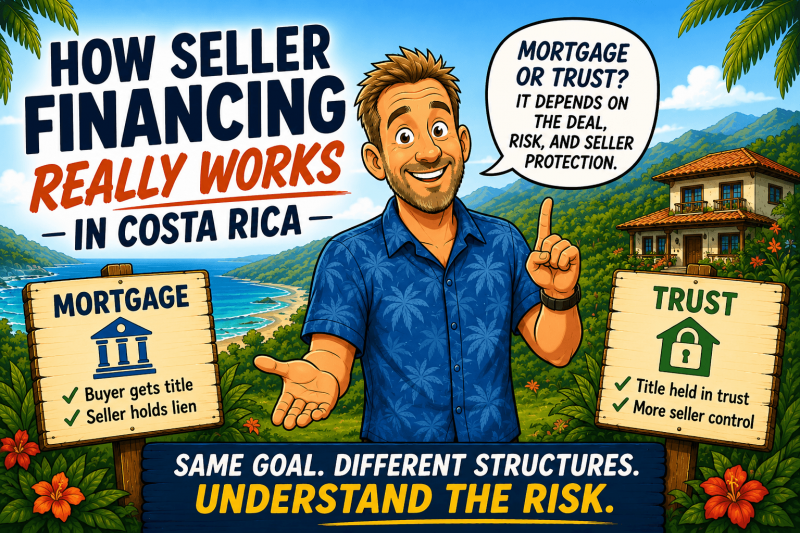
How seller financing typically works in Costa Rica—and the two primary ways sellers protect themselves
With buyers having more negotiating leverage in the Costa Rica real estate market than they have had in some time, seller financing has become a more common topic of discussion.
In a softer market, sellers who might once have insisted on all-cash offers may become more open to financing part of the purchase price in order to get a deal done.
That said, seller financing in Costa Rica typically comes with some important conditions.
First, the buyer is usually expected to make a substantial down payment, often 50% or more of the agreed purchase price. In most cases, a buyer requesting seller financing should not expect to also negotiate a significant discount on price. Put simply, sellers are generally willing to offer financing instead of a discount—not in addition to one.
Second, seller financing is usually structured over a relatively short period—often three to five years or less—with a negotiated annual interest rate. In transactions I’ve seen, rates commonly fall in the 4% to 6% range, though terms vary depending on the parties and the risk profile of the deal.
It is also worth noting that conventional mortgage financing from Costa Rican banks has become more available in recent years, particularly for qualified buyers. But that is a topic for another article.
This article focuses on a different question:
When a seller finances a property in Costa Rica, what actually protects the seller if the buyer stops paying?
Generally speaking, there are two primary security structures used in Costa Rica:
- Traditional mortgage security (hipoteca)
- Trust deed / security trust structure (fideicomiso de garantía)
Both are designed to protect the seller—but they work very differently.
1. Traditional Mortgage Structure
This is the more familiar structure, especially for buyers coming from North America.
Under a mortgage structure, the transaction usually works like this:
- The seller transfers title to the buyer at closing
- The buyer signs a promissory note or financing agreement
- The seller records a mortgage lien against the property in the National Registry
At that point, the buyer owns the property, but the seller has a registered legal claim securing repayment.
If the buyer makes all payments as agreed, the mortgage is eventually discharged and the lien removed.
If the buyer defaults, however, the seller must enforce the mortgage through the legal foreclosure process.
That is where things get more complicated.
In Costa Rica, mortgage enforcement generally involves a judicial process that can culminate in a public auction of the property. Often, the lender or seller ends up as the primary bidder and effectively takes the property back, but the process can involve time, legal expense, and procedural complexity.
Advantages of a Mortgage Structure
- Familiar and widely understood
- Lower legal/setup costs
- Common in seller-financed transactions
- Buyer receives title immediately
Potential Drawbacks
- Enforcement can be slow
- Foreclosure may require court proceedings
- Seller does not control title after closing
For many straightforward deals, a mortgage works perfectly well. But for higher-value or more customized transactions, some parties prefer something stronger.
That brings us to the second structure.
2. Trust Deed / Security Trust Structure
A security trust, commonly called a trust deed structure, is more sophisticated.
Instead of transferring title directly to the buyer, the property is transferred into a legally established trust (fideicomiso).
A third party—called the trustee—holds legal title to the property according to the terms of the trust agreement.
The parties’ rights are then defined inside that trust structure.
In practical terms:
- The buyer gets possession and beneficial use of the property
- The seller receives security rights under the trust
- The trustee holds legal title until financing obligations are satisfied
This changes the risk dynamic in an important way.
Because title is controlled within the trust structure rather than held outright by the buyer, default remedies may be more efficient and more flexible than traditional mortgage foreclosure—depending on how the trust documents are drafted.
In other words, instead of the seller having to “chase” a defaulting borrower through foreclosure, the trust itself may provide a contractual mechanism for recovering control of the asset.
That is the major appeal.
Advantages of a Trust Structure
- Stronger control over the collateral
- Greater contractual flexibility
- Potentially smoother default remedies
- Often preferred in complex or high-value deals
Potential Drawbacks
- Higher legal and administrative costs
- More complex documentation
- Requires careful drafting by experienced counsel
A Simple Example
Let’s look at a hypothetical seller-financed transaction.
Suppose a property in Costa Rica is being sold for $1,000,000.
The buyer wants seller financing, and the seller agrees to the following terms:
- Purchase Price: $1,000,000
- Down Payment: $500,000 (50%)
- Amount Financed: $500,000
- Interest Rate: 5% annually
- Term: 3 years, with monthly interest payments and a balloon payment at the end
Under either a mortgage structure or a trust structure, the buyer takes possession of the property and begins making payments.
But the legal security behind the transaction differs significantly.
If Secured by a Mortgage
The seller transfers title directly to the buyer at closing.
A mortgage is then recorded against the property securing the unpaid $500,000 balance.
If the buyer stops making payments after 18 months, the seller has a legal claim—but typically must enforce that claim through the foreclosure process.
That may involve legal proceedings, delay, and potentially a public auction before the seller fully recovers the asset.
If Secured by a Trust Structure
Instead of transferring title directly to the buyer, the property is placed into a security trust.
The buyer has beneficial use and possession of the property, but legal title remains under trustee control until the financing obligations are satisfied.
If the buyer defaults after 18 months, the seller may have a more direct path to recovering control of the collateral, depending on how the trust documents were structured.
That doesn’t mean recovery is automatic or effortless—but it may reduce some of the friction associated with traditional foreclosure.
This example highlights the core distinction:
In both cases, the seller finances the same $500,000.
The difference is not the financing itself.
The difference is how the seller is protected if something goes wrong.
Which Structure Is Better?
There is no universal answer.
For many ordinary residential seller-financing transactions, a traditional mortgage may be entirely adequate.
For larger commercial deals, higher-risk borrowers, or situations where the seller wants stronger protection, a trust structure may be worth the added complexity and expense.
A simple way to think about it is this:
With a mortgage, the seller relies primarily on a recorded lien and legal enforcement.
With a trust, the seller relies more on control of title and contractual enforcement mechanisms.
Final Thoughts
Seller financing can be a valuable tool in Costa Rica real estate.
For buyers, it may create opportunities that would not otherwise exist.
For sellers, it can expand the pool of potential buyers and help move properties in a slower market.
But one point cannot be overstated:
The financing terms matter—but the security structure matters just as much.
A low default risk on paper can look very different when a payment is missed and enforcement becomes necessary.
That is why both buyers and sellers should understand not only how much is being financed, but also how that financing is secured.
As always, seller-financed transactions in Costa Rica should be structured with competent Costa Rican legal counsel familiar with both mortgage and trust-based security mechanisms.