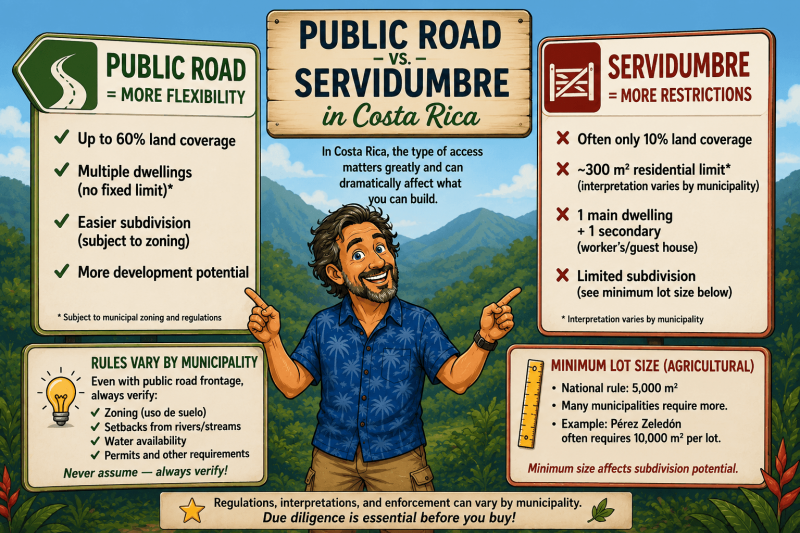
In Costa Rica, the type of access matters greatly and can significantly affect what you can build
One of the most misunderstood aspects of buying land in Costa Rica—especially among foreign buyers—is that two properties with the same size, same view, and even the same price can have dramatically different development potential simply because of how they are accessed.
In other words, the road matters. A lot.
I regularly speak with buyers who assume that if a property has legal access, they can build whatever makes sense for the land. Unfortunately, that is not always the case.
A key question you should always ask when evaluating land is this:
Does the property front a public road, or is it accessed via a servidumbre?
That distinction can significantly affect what—and how much—you can build.
Properties Fronting a Public Road
Generally speaking, land with frontage on a public road offers the greatest flexibility for development.
If a property fronts a legally recognized public road and the local municipality grants favorable uso de suelo, that property may qualify as a standard building lot or development parcel rather than an agricultural parcel.
In many rural parts of Costa Rica, that can mean:
- Up to 60% land coverage may be allowed for construction
- Multiple structures may be permitted
- There may be no fixed cap on the number of dwellings, subject to zoning and permitting
- Subdivision or segregation may be easier, depending on municipal regulations
This gives owners far more flexibility to build:
- A primary residence
- Guest homes or rental cabins
- Family compounds
- Hospitality or commercial projects
That does not mean unlimited development. You still need to verify:
- Municipal zoning
- Water availability
- Setbacks from rivers, quebradas, or springs
- Environmental restrictions
- Utility access
- Local permitting requirements
But in general, public road frontage creates substantially more development potential.
Properties Accessed by Servidumbre
Now let’s talk about the category that causes the most confusion.
A servidumbre is essentially a legal right-of-way or easement that allows access through another property.
Many beautiful rural properties in Costa Rica are accessed this way.
A servidumbre is not inherently problematic. Some outstanding mountain and view properties sit behind private access roads.
The issue is not necessarily the access itself.
The issue is how the municipality classifies the parcel because of that access.
In many cases, a property accessed only via servidumbre is treated as a parcela agrícola, and that classification often comes with meaningful building limitations.
Common Parcela Agrícola Restrictions
This is where buyers need to pay close attention.
While regulations can vary by municipality—and interpretations can differ between municipalities, architects, surveyors, and even permitting officials—common restrictions often include the following.
1. Limited Buildable Footprint
A common rule is that only 10% of the total land area may be developed.
That means a 5,000 m² parcel may only allow roughly 500 m² of total developed area.
For buyers hoping to build multiple structures, this becomes critical.
2. Maximum Residential Construction Size
In many jurisdictions, agricultural parcels are subject to a limit of approximately 300 m² of enclosed residential construction.
That may sound generous at first, but once you account for:
- Main living areas
- Storage
- Garage or bodega
- Covered spaces
- Guest accommodations
…the space can disappear quickly.
This is also an area that creates significant confusion, because there is some ambiguity in how the 300 m² limit is interpreted.
A common question is whether that limit applies to:
- All residential dwellings combined, or
- Only the principal dwelling, with additional square meters potentially allowed for a secondary structure such as a worker’s or guest house
Unfortunately, the law and its practical application do not always provide a perfectly clear answer, and interpretations can vary between municipalities, architects, surveyors, and permitting officials.
That means two professionals may look at the same parcel and arrive at different conclusions regarding what is allowable.
This ambiguity also helps explain a very common pattern in rural Costa Rica: some owners will obtain permits for a primary residence up to the commonly accepted limit, and then later construct a guest house or secondary dwelling without obtaining additional permits.
That does not necessarily mean the additional structure would have been impossible to permit—but in many cases, owners either assume it would not be approved, want to avoid delays and costs, or simply choose to build first and deal with the consequences later.
As a result, it is not unusual to encounter properties with unpermitted secondary structures, especially on agricultural parcels accessed via servidumbre.
For that reason, buyers should avoid making assumptions and instead verify what has actually been permitted during due diligence.
3. Limited Number of Dwellings
Agricultural parcels are generally intended for agricultural use with supporting residential occupancy.
That often translates to permission for:
- One primary residence
- One secondary support structure or worker’s house
Historically, the worker’s house was intended for agricultural staff.
In practice, many owners interpret that secondary structure as:
- A guest house
- Caretaker quarters
- Family accommodation
Again, local interpretation matters.
4. Pools and Accessory Structures
A common question is:
Can I build a pool on a servidumbre-access parcel?
In many cases, yes.
Pools and certain accessory structures are often permitted, assuming setbacks and permitting requirements are satisfied.
But this should always be confirmed during due diligence.
Minimum Parcel Size for Agricultural Lots
Another major issue buyers often overlook is minimum lot size.
At the national level, agricultural parcels are generally subject to a minimum size of 5,000 m² for segregation.
In plain English, that means you typically cannot subdivide agricultural land into lots smaller than 5,000 square meters.
However, municipalities may impose stricter local rules.
For example, in Pérez Zeledón, the municipality commonly requires 10,000 m² per lot when subdividing agricultural parcels.
That means even if national regulations suggest one threshold, local municipal rules may be more restrictive.
This is why subdivision potential should never be assumed.
Same Acreage, Very Different Outcome
Here’s why all of this matters so much.
Imagine two 5-acre properties.
Both have:
- Great views
- Water
- Utilities nearby
- Similar asking prices
Property A fronts a public road.
Property B is accessed via servidumbre.
On paper, they may appear nearly identical.
But their development potential may be dramatically different.
Property A might support:
- A main home
- Multiple guest villas
- Rental cabins
- Future subdivision
Property B might legally support only:
- One primary residence
- One secondary dwelling
- Limited overall construction footprint
That difference can materially affect both value and future resale appeal.
Don’t Assume Legal Access Equals Development Flexibility
This is where buyers frequently make expensive mistakes.
They hear:
“Don’t worry—it has legal access.”
That may be true.
But legal access does not automatically equal favorable development rights.
Access is only one piece of the puzzle.
What really matters is how that access interacts with:
- Parcel classification
- Municipal regulations
- Zoning
- Permitting realities
Final Thoughts
If you are evaluating land in Costa Rica—especially in rural areas—one of the smartest questions you can ask early is:
“Is this property on a public road or accessed via servidumbre—and how does that affect buildability?”
That single question can save enormous time, money, and frustration.
As with most real estate questions in Costa Rica, the answer is rarely black and white.
Rules vary by municipality. Interpretations evolve. Exceptions exist.
That is exactly why careful due diligence matters before falling in love with a property.
Because in Costa Rica, sometimes the most important thing about a property isn’t the view…
It’s the road that gets you there.