The Risk of Multiple Planos in a Single Property Sale
One of the most confusing water issues in Costa Rica real estate comes up when a single property consists of multiple planos, but only some of those planos have water letters. This post is Part 2 of a previous one on the issue of Costa Rica water rights.
This situation is far more common than many buyers realize, especially with large farms, legacy properties, and older subdivisions. It can also surprise sellers and even experienced real estate professionals, because at first glance it feels like a purely practical problem with a simple solution.
After all, if the land is contiguous, under the same ownership, and already has legal water on part of the property, why wouldn’t that water be usable for the rest?
The answer, once again, lies in the difference between physical access to water and legal entitlement to water in Costa Rica.
Water Rights Are Tied to the Plano, Not the Property as a Whole
In Costa Rica, water availability is not tied to ownership, total acreage, or physical proximity. It is tied to the specific cadastral parcel, or plano.
Each plano is treated as its own legal entity for purposes of permitting, construction approval, and water authorization. This is true even when multiple planos are adjacent, under identical ownership, and marketed as a single property.
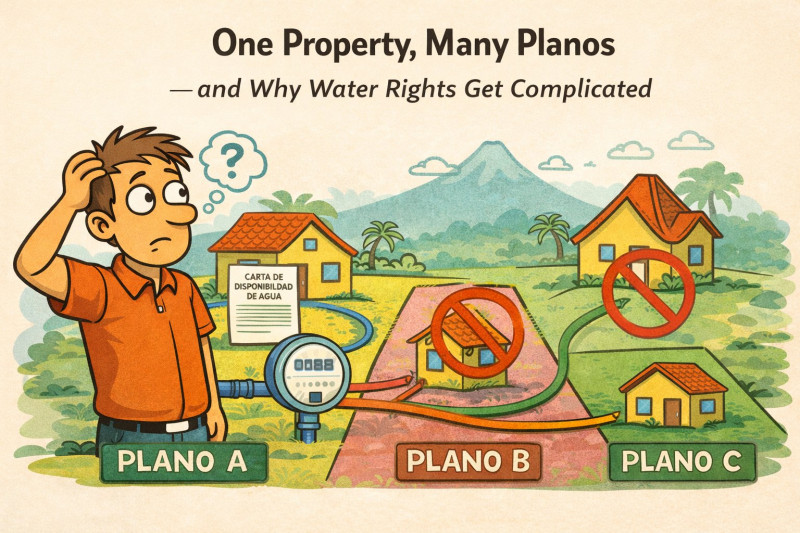
A water letter issued for Plano A legally applies only to Plano A. It does not automatically extend to Plano B or Plano C, even if all three are part of the same farm or estate.
This is where confusion often arises.
Why Physical Water Distribution Is Not Enough
In practice, landowners often distribute water internally from one plano to another. From a purely functional standpoint, this can work perfectly well.
However, internal distribution does not create a legal water right.
Municipalities, CFIA, lenders, and attorneys do not ask whether water can be piped from another lot. They ask whether the plano being built on has a legally recognized water availability.
If a construction permit is requested for a plano that does not have its own water letter, the municipality will almost always require one, regardless of whether water exists nearby or on an adjacent parcel.
Same Ownership Does Not Change This
A common assumption is that if all planos are under the same ownership, the water letter should apply to the entire property. Unfortunately, Costa Rican permitting does not work that way.
Ownership does not substitute for entitlement.
From a legal standpoint, the municipality sees multiple separate parcels, each of which must independently demonstrate water availability unless they are formally treated as one.
This becomes especially important when a property is large, subdivided, or marketed as having multiple potential building sites.
The Cleanest Legal Solution: Plano Consolidation
In most cases, the simplest and most defensible solution is to consolidate the planos into a single cadastral parcel.
When planos are legally consolidated:
The individual planos cease to exist
A new plano number is created
The property becomes one legal unit for water, zoning, and permitting
At that point, a water letter issued for the consolidated plano applies to the entire property, because legally it is now one parcel.
This is why attorneys and municipalities are generally comfortable approving construction on a consolidated property, even if water access originates from a single connection.
However, consolidation comes with an important tradeoff.
What Consolidation Does and Does Not Do
Consolidation solves the water entitlement issue for development as a single property. It does not preserve independent build rights for each former plano.
If the owner later wants to subdivide again, build multiple independent homes for resale, or sell portions of the land separately, each new plano will need to requalify for water under the rules in effect at that time.
In other words, consolidation works best when the intent is to build:
One primary residence
One compound
One long-term ownership structure
It is not a shortcut for creating multiple legally buildable lots without securing water for each one.
A Real-World Example
Consider a large property of over 100 acres made up of a dozen planos. Four of those planos have water letters, while the remaining eight do not.
From a marketing perspective, it may feel natural to describe this as a single large property with water. From a legal perspective, however, only the planos with water letters currently have guaranteed build rights.
If a buyer wants to develop the land as a single estate, consolidation is often the logical path. If the buyer’s intent is future subdivision or multiple independent builds, water availability must be evaluated plano by plano.
This distinction can materially affect value, development potential, and buyer expectations.
The Takeaway
In Costa Rica, water rights follow the plano, not the fence line.
Having water on part of a property does not automatically entitle the rest of the land to construction permits, even under the same ownership. The cleanest way to unify water rights is through legal consolidation, not informal distribution.
Understanding this distinction early helps buyers make informed decisions, helps sellers position properties accurately, and avoids unpleasant surprises during due diligence.
As water regulation becomes increasingly strict in many regions of Costa Rica, these issues are no longer theoretical. They are central to how land can be used, developed, and ultimately valued.