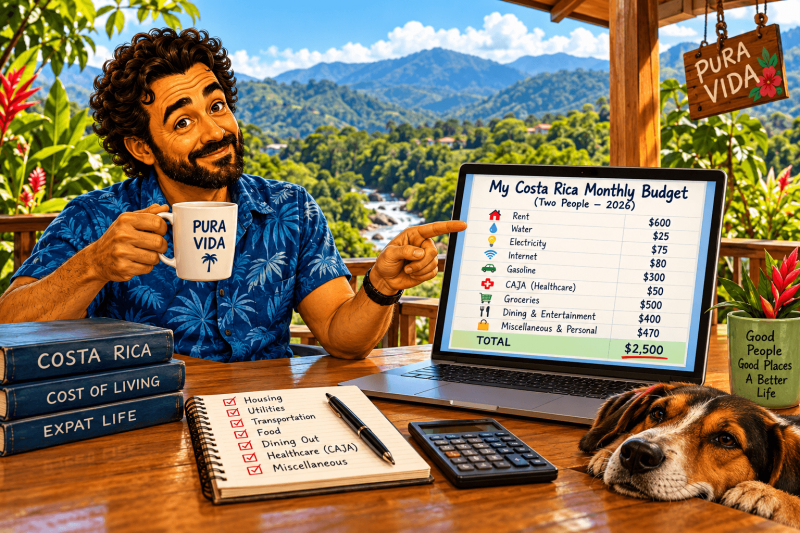
A Real-World Monthly Budget for Two — and Why Your Number Could Be Very Different
One of the questions I get asked all the time is: How much does it cost to live in Costa Rica?
The problem is that there really isn't one good answer.
Where you live matters. How you live matters. Whether you shop primarily at local stores or imported-goods supermarkets matters. And whether you're trying to recreate your North American lifestyle in Costa Rica or adapt to a more local lifestyle matters—a lot.
So rather than give you another generic estimate of what it supposedly costs to live here, I thought I'd do something more useful:
I'll tell you what it actually costs me.
My wife and I live in the Pérez Zeledón area in Costa Rica's Southern Zone. I've lived in Costa Rica for more than 20 years, and this remains a relatively local market compared with heavily touristed areas such as Manuel Antonio, Uvita, Nosara, Tamarindo or Santa Teresa.
That distinction is important.
If you're planning to live in one of Costa Rica's more popular tourist or beach communities, I'd probably add somewhere in the neighborhood of 25% to 50% to my budget as a rough starting point. Some individual expenses could be considerably higher.
Electricity is an obvious example. I live in the mountains, where the climate is cooler and air conditioning isn't a significant part of my electric bill. If you're living at a hot beach location and running A/C regularly, your electricity expense could easily be double mine—or more.
So think of this as one real-world data point, not a universal Costa Rican budget.
First, Why Am I Renting?
Since I'm a Costa Rica real estate broker, I should probably explain this one.
My wife and I recently purchased a condo in Colombia, and we're now splitting some of our time between Colombia and Costa Rica. At this stage of our lives, renting in Costa Rica gives us flexibility and makes more sense than owning two properties.
Costa Rica remains home. Right now, renting simply works for us.
Spending part of the year in Colombia also naturally reduces some of our annual spending in Costa Rica, particularly things like gasoline, groceries and dining out. That's unique to our situation, though, so for purposes of this article I'm looking at what our normal monthly lifestyle costs us when we're living in Costa Rica.
My Actual Monthly Budget
Rent: $600
We rent a relatively modest two-bedroom, one-bathroom home in Quebradas, just outside San Isidro de El General.
It's not fancy, but we love it. We have a substantial backyard, we're right on a river, and we're in a beautiful mountain environment with a climate that suits us extremely well.
You can still find relatively simple homes in this general price range in Pérez Zeledón.
But here's where expectations become important.
Some North Americans moving to Costa Rica are going to want something larger, newer and more modern, perhaps with two bathrooms, newer finishes and more of the amenities they're accustomed to.
In Pérez Zeledón, I'd consider roughly $1,000 to $1,500 per month a more realistic starting range for that kind of rental.
So don't read my $600 rent and assume that's what your housing budget will necessarily be. Housing is probably the single biggest variable in this entire exercise.
Water: $25
Not much to say here. Water is one of the smaller items in our monthly budget.
Electricity: $75
Our mountain climate helps tremendously. We don't have the kind of air-conditioning expense you can encounter along the coast.
Internet: $80
Reliable internet is important to me because so much of my real estate and consulting work is done online.
Gasoline: $300
This one may be higher than it would be for some people because I drive quite a bit for work. I generally fill my tank about once a week, at roughly $80 per fill-up.
CAJA: $60
My healthcare coverage is through Costa Rica's public healthcare system, the Caja Costarricense de Seguro Social, commonly called the CAJA.
My contribution is approximately $60 per month.
My approximately $60 monthly CAJA payment is specific to my circumstances as a naturalized Costa Rican citizen and should not be used as a benchmark for someone obtaining residency today. New foreign residents are subject to different enrollment rules, and their monthly CAJA contribution can be substantially higher depending on their income and residency category. Contributions vary, and many expats supplement the public system with private insurance or private medical care.
Groceries: $500
That's approximately what the two of us spend on groceries in a typical month.
This is another category where lifestyle matters. Buy primarily local products and you can spend less. Insist on imported brands and familiar North American products and you can spend considerably more.
Dining Out and Entertainment: $400
We generally have a nice meal out about once a week, typically spending around $75 for the two of us. I've rounded this category to $400 to account for other meals, coffee and miscellaneous entertainment outside the house.
Miscellaneous and Personal Expenses: $460
Real life doesn't fit perfectly into a spreadsheet.
There are household items, cell phone services, housekeeper and gardener services, pharmacy purchases, subscriptions, clothing, haircuts, small purchases and all the other things that inevitably come up during the course of a month.
I don't track every one of those expenses individually, but allowing roughly $470 for miscellaneous spending brings the budget much closer to what we actually spend.
The Bottom Line: About $2,500 Per Month
| Expense | Monthly Cost |
|---|---|
| Rent | $600 |
| Water | $25 |
| Electricity | $75 |
| Internet | $80 |
| Gasoline | $300 |
| CAJA | $60 |
| Groceries | $500 |
| Dining & Entertainment | $400 |
| Miscellaneous & Personal | $460 |
| TOTAL | $2,500 |
That's approximately $2,500 per month for two people, or about $30,000 per year.
I'm deliberately leaving out debt payments and other financial obligations specific to me. I'm also not including international travel, major purchases, major vehicle repairs, unexpected medical expenses or other unusual expenditures.
This is simply a realistic estimate of what our normal lifestyle costs us.
Don't Forget the Exchange Rate
There's another factor that often gets overlooked in discussions about Costa Rica's cost of living: the dollar-colón exchange rate.
This is particularly important for retirees and other expats whose income is primarily in U.S. dollars.
In June 2022, the exchange rate approached ₡692 to the dollar. Today we're operating in a very different exchange-rate environment, with the dollar recently trading in the mid-₡400s.
Consider what that means.
At ₡692 to the dollar, $1,000 buys approximately ₡692,000.
At ₡455 to the dollar, that same $1,000 buys only about ₡455,000.
That's roughly 34% fewer colones for the same $1,000.
For someone receiving Social Security, a pension or investment income in dollars while paying many everyday expenses in colones, that's significant.
It can feel like inflation even when the colón price of what you're buying hasn't changed.
That's also why I'd be careful relying on older articles and videos telling you what it costs to live in Costa Rica. A budget calculated when the dollar was buying 600, 650 or nearly 700 colones doesn't translate very well into today's environment.
Can You Live Here for Less? Or More?
Absolutely—to both.
You could rent a simpler home, live without a car, eat out less and shop primarily for local products, and spend considerably less than we do.
You could also spend dramatically more.
Move into a modern home near the beach, run air conditioning throughout the day, buy mostly imported foods and regularly eat at restaurants catering to tourists and expats, and your budget will look nothing like mine.
That's why I'm skeptical whenever someone declares that you need a particular amount of money to live in Costa Rica.
There is no single Costa Rica cost of living. There is the cost of your life in Costa Rica.
And location may be the biggest variable of all.
Living in Pérez Zeledón isn't economically identical to living in Uvita. Uvita isn't Santa Teresa. Santa Teresa isn't Grecia. And none of those necessarily resembles life in a smaller Costa Rican community where relatively few foreigners live.
Tourism and concentrations of foreign residents tend to change the economics of a community—not just real estate, but restaurants, services and many everyday expenses.
That's one reason I've always encouraged people considering a move to Costa Rica to explore beyond the places that dominate Instagram and YouTube.
You might discover that the Costa Rica you actually prefer is also considerably less expensive.
So, Is Costa Rica Still Affordable?
I think the better question is:
Can Costa Rica accommodate the lifestyle you want at a cost you're comfortable with?
For my wife and me, the answer is yes.
We're living comfortably in a part of Costa Rica we love for roughly $2,500 per month in normal living expenses.
But I wouldn't tell someone that they can move to Costa Rica and live comfortably on $2,500 a month simply because I do.
Your housing expectations may be different. Your healthcare costs may be different. You may want to live at the beach. You may eat out five nights a week. You might not need a car—or you might want a four-bedroom home with a pool, ocean views and air conditioning running all day.
Those choices matter far more than any generic cost-of-living number.
After more than two decades of living here, that's probably the most useful answer I can give:
Costa Rica can still be an affordable place to live. But how affordable it is depends far more on where and how you choose to live than on any number you'll find in a cost-of-living chart.