Why I use AI to enhance property photographs—and why that doesn't mean what you're seeing isn't real.
Every so often, someone comments on one of my real estate posts on Facebook with something along the lines of, "These are all AI images!" And I understand where the concern comes from. Artificial intelligence has reached the point where it can generate extraordinarily realistic images of things that don't actually exist. That's a legitimate concern, particularly in real estate, where buyers need to know that what they're seeing is an accurate representation of a property they might purchase.
But there's an important distinction that seems to be getting lost in the conversation: an AI-generated image and an AI-enhanced photograph are not the same thing. And frankly, I think it's time we started recognizing the difference.
A Camera Doesn't Always Capture What Your Eyes See
I've been selling real estate in Costa Rica for years, and one thing I've learned is that photographing tropical properties can be surprisingly challenging. Consider a beautiful mountain property in Pérez Zeledón on a sunny afternoon. You're standing on the terrace looking out across a lush green valley. The mountains are vivid, the sky is a brilliant blue, and the sunlight brings out dozens of shades of green in the surrounding vegetation. It's spectacular.
Then you take a photograph, and suddenly the sky looks washed out, the mountains seem dull, and the shaded terrace is almost black. The photograph simply doesn't capture what you're experiencing with your own eyes. That's because cameras have limitations. Even excellent cameras cannot always reproduce the full range of light, color, and contrast that our eyes and brains perceive.
Professional photographers have been dealing with these limitations for decades. They adjust exposure, contrast, white balance, saturation, shadows, and highlights to produce images that more faithfully represent the original scene. And nobody seriously argues that every photograph adjusted in Photoshop is somehow fake.
AI Has Simply Made the Process More Efficient
Today, artificial intelligence allows us to accomplish many of those same adjustments in a fraction of the time. Instead of sitting down and spending considerable time manually editing an entire group of property photographs in Photoshop, I can use AI-assisted tools to improve lighting, balance colors, recover details in shadows, and enhance the overall clarity of the images much more efficiently.
The objective is exactly the same. I'm not trying to create a property that doesn't exist. I'm trying to show the property as accurately and attractively as possible, and there's nothing inherently deceptive about that. In fact, I would argue that a carefully enhanced photograph can sometimes be a more faithful representation of a property than an unedited photograph straight out of the camera.
The important question isn't whether technology was used. It's whether the resulting photograph accurately represents the property.
There's a Line That Shouldn't Be Crossed
Now, let me be clear. I don't believe that every use of AI in real estate photography is acceptable. There's a significant difference between improving the lighting in a living room and digitally removing a neighboring building. There's a difference between restoring the natural colors of a landscape and inventing an ocean view that doesn't exist. And there's a difference between correcting a poorly exposed photograph and making a small room appear twice its actual size.
Those aren't enhancements. They're misrepresentations.
As a real estate broker with Coldwell Banker here in Costa Rica, I take that distinction seriously. When I use AI to enhance photographs, my objective is to improve their presentation without materially changing the property itself. The buildings, landscaping, views, terrain, and physical characteristics should remain faithful to reality. That's the standard I believe real estate professionals should follow, regardless of which editing tools they use.
And Then There's Facebook's AI Labeling
Here's where things get particularly interesting. Facebook has increasingly begun attaching AI-related labels to images, including photographs that may have undergone some form of AI-assisted editing. The problem is that these labels don't necessarily communicate how AI was used. A photograph of an actual home, taken with a real camera and subsequently adjusted using AI tools, may receive an AI-related label.
To someone scrolling through Facebook, that label can create the impression that the entire image was artificially generated. But that's not necessarily what happened. There is a world of difference between creating an imaginary house using AI and enhancing a genuine photograph of an existing house. Yet that distinction isn't always obvious from the label.
I understand why Meta wants greater transparency about artificial intelligence. Given how realistic AI-generated content has become, transparency is important. But transparency should also be accurate and meaningful. If a photograph was merely enhanced using AI, the label should ideally communicate that fact rather than leaving viewers to wonder whether the property itself is real.
As a real estate agent, I don't control Facebook's labeling decisions, nor do I believe a social media platform should dictate which legitimate photo-editing tools I use. What I can control is the integrity of the images I publish, and that's where I believe the focus should be.
Let's Look at a Real Example
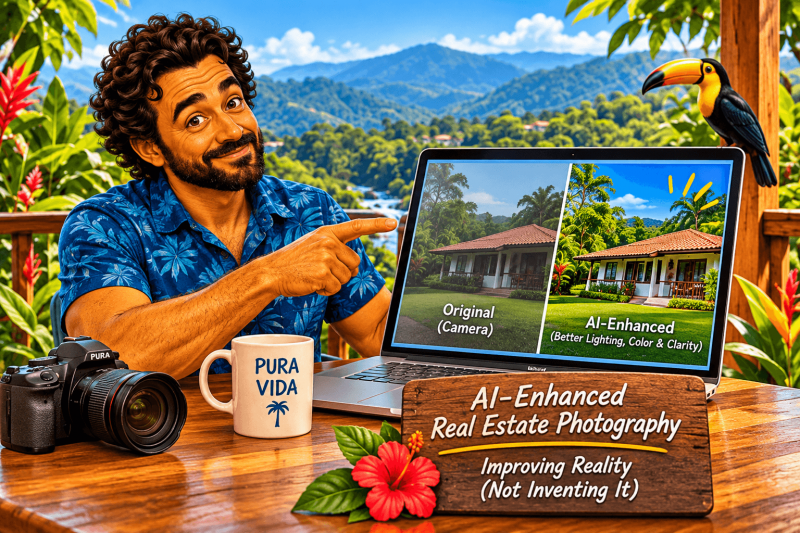
Here's an example from my own real estate photography. These are two versions of the same photograph: the original image and the AI-enhanced version. The comparison illustrates how modern editing tools can improve the presentation of an actual property photograph.


Original and AI-enhanced versions of the same property photograph. Click either image to enlarge.
Notice the differences in lighting, color, contrast, and clarity. Now consider what matters even more: whether the property's actual physical features have been faithfully preserved. Responsible enhancement should improve the photograph without materially adding, removing, or altering buildings, landscaping, terrain, views, or other features that buyers rely on when evaluating a property.
The goal is for the enhanced photograph to do a better job of communicating what someone standing at that location would actually experience. It isn't about creating an imaginary version of the property. It's about using technology to present the real one more effectively.
AI Isn't Going Away. Nor Should It.
Artificial intelligence is becoming part of everyday life, whether we're talking about photography, medicine, education, business, or countless other fields. And I don't see much value in resisting a useful technology simply because it's new. Of course, we should question how it's being used. We should demand honesty and transparency, and we should hold professionals accountable when they use it to mislead people. But we shouldn't confuse the responsible use of technology with deception.
If I can use an AI tool to produce more accurate and visually appealing photographs of a property in a fraction of the time it would take me to sit down and manually edit the entire group of images, why wouldn't I? The technology isn't the problem. How we use it is what matters.
The Real Test Is What You See When You Arrive
Ultimately, I think there's a very simple standard for real estate photography. When a prospective buyer visits a property after seeing it online, does the property live up to what the photographs led them to expect? If the answer is yes, the photography has done its job. If the answer is no because important features were altered, concealed, or invented, then we've crossed a line.
And let me add something else that I think is even more important. I would never encourage anyone to purchase a property based solely on photographs they've seen on Facebook—or anywhere else online. AI-enhanced or otherwise. Photographs are a starting point. They're intended to introduce a property, highlight its features, and help buyers decide whether it's worth investigating further.
But the reverse is equally true. I don't believe a prospective buyer should dismiss an otherwise interesting property simply because its photographs have been enhanced using AI—or because Facebook has decided to attach an "AI content" label to them. That label alone tells you very little about whether the property is accurately represented. If a property meets your needs, fits your budget, and looks appealing, why eliminate it from consideration because of the technology used to improve its photographs?
Take a closer look. Ask questions. Arrange a showing or virtual tour. Judge the property on its actual merits, not on a label assigned by a social media platform.
And remember, photographs can't tell you everything you need to know. They can't fully convey the feel of a neighborhood, the sounds of the surrounding countryside, the condition of a home, or what it's actually like to stand on the terrace and look out across the landscape. And they certainly can't tell you whether a property has legal access, reliable water, proper documentation, or any of the other issues that need to be investigated before making a substantial investment.
That's why I encourage buyers to visit properties personally whenever possible, ask questions, work with experienced professionals, and conduct thorough due diligence before completing a purchase. If an in-person visit isn't immediately practical, a live virtual tour is a useful next step. But even that isn't a substitute for proper inspections and legal due diligence.
I've always believed that trust is one of the most important things a real estate professional has to offer. And that trust isn't built by refusing to use modern tools. It's built by using them responsibly—and by helping buyers look beyond the photographs.
My goal isn't to make a property look better than it is. It's to make the photograph look as much like the actual property as possible.
There's a difference. And I think it's an important one.


