How Much of Your Costa Rica Property Can You Actually Use?
One of the easiest mistakes to make when evaluating land in Costa Rica is to focus too much on the number of acres or hectares.
A ten-acre property is not necessarily more useful than a five-acre property. And a fifty-acre farm may have considerably less land available for your intended purposes than the numbers on the survey would lead you to believe.
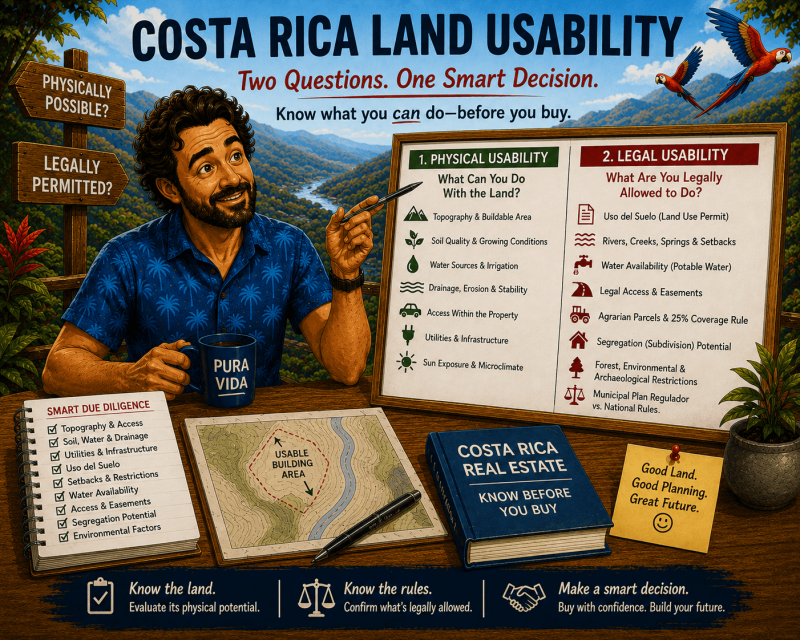
When evaluating land, I think it's useful to separate usability into two very different categories:
Physical usability: What can you realistically do with the land based on its topography, access, soil, water, drainage and other physical characteristics?
Legal usability: What are you actually permitted to do with the property under municipal, environmental, subdivision and other applicable regulations?
A property can be physically perfect for what you want to do and legally unsuitable. It can also be perfectly legal to develop but physically impractical or prohibitively expensive.
You need to understand both.
PART ONE: PHYSICAL USABILITY
Topography Comes First
Costa Rica is mountainous. That's part of what makes so much of the country spectacular, but it also means acreage numbers can be deceiving.
A property can contain ten acres and have only an acre or two that is relatively flat. Another property of the same size may consist of gently rolling terrain that is usable almost everywhere.
That doesn't necessarily make the first property inferior.
Steep land can provide privacy, protect views, create wildlife habitat and provide beautiful hiking areas. I've also seen some remarkable construction on slopes that many North American buyers would initially assume were unusable.
But there is an important distinction between land having value and land being physically suitable for your intended use.
If you want horses, extensive gardens, additional homes, rental cabins or substantial agricultural production, the amount and location of genuinely usable terrain become considerably more important.
It also matters where that usable land is located.
A property might have a beautiful flat area near the entrance and another excellent area farther down the mountain. But if getting between them requires traversing an extremely steep slope, those two areas may function almost like separate properties.
Access Within the Property
People understandably pay attention to whether they can reach a property from the public road. They don't always think as much about whether they can reach the places they want to use after they get through the gate.
If you plan to build cabins, establish gardens, keep animals or develop different sections over time, consider:
- Can vehicles reasonably reach those areas?
- Would substantial excavation or retaining walls be necessary?
- Can an internal road be built without creating serious drainage or erosion problems?
- What would that road cost to construct and maintain?
A beautiful building site 500 meters down a mountainside isn't quite as attractive if reaching it requires an extremely expensive road.
Soil, Sun and Microclimate
For someone planning extensive gardening, farming or a food forest, relatively flat land alone doesn't answer the question.
Soil quality matters.
So do rainfall, drainage, sun exposure, orientation, elevation, prevailing winds and microclimate.
Costa Rica can change dramatically within relatively short distances. Two properties only a few kilometers apart can experience noticeably different rainfall, temperatures and growing conditions.
Even different slopes on the same property can behave differently depending on their orientation to the sun and prevailing weather.
If agriculture is an important part of your plans, don't simply assume that because everything is green, everything will grow equally well.
For a serious agricultural project, professional soil analysis can be money well spent.
Water and Irrigation
Abundant water is one of the great advantages of many rural Costa Rican properties, but again, location matters.
A year-round creek along the bottom of a steep twenty-acre property may be a wonderful natural amenity but a very different irrigation resource from gravity-fed water originating above your growing areas.
If you intend to irrigate extensively, consider where the water originates, where your growing areas are located, whether gravity can do much of the work and what infrastructure would be necessary to move and store the water.
And remember something important:
Physical access to water and the legal right to use that water are two different things.
Don't assume that because a river, creek or spring crosses your property, you automatically have an unrestricted right to divert it.
Drainage, Erosion and Stability
Costa Rica gets rain. In some areas, a tremendous amount of it.
A property that looks perfect after two weeks of sunshine can behave very differently during the middle of the rainy season.
Look for natural drainage patterns, erosion, evidence of previous slides, steep cut banks and places where water collects.
This becomes particularly important on properties that have been heavily terraced or mechanically altered. A flat building pad cut into a mountain may look wonderful, but how it was created and how water moves around it matter enormously.
Depending upon the property and your intended development, a geotechnical or engineering evaluation may be appropriate.
Utilities and Infrastructure
A physically beautiful building site isn't particularly useful if getting electricity, potable water or reliable internet to it becomes prohibitively expensive.
Don't simply ask whether utilities exist somewhere on the property.
Determine how practical and expensive it will be to bring them to the places you actually intend to use.
Distance and elevation matter.
PART TWO: LEGAL USABILITY
This is where things become more complicated.
You can find a perfectly flat, beautiful piece of land with excellent soil, great access and abundant water—and still discover that you cannot legally use it the way you intended.
Start With the Uso del Suelo
One of the most important documents when evaluating the legal usability of Costa Rican property is the Certificado de Uso de Suelo, generally referred to simply as the Uso del Suelo.
It is issued by the local municipality and addresses whether the proposed use of a property conforms with the applicable land-use regulations.
In plain English:
Before assuming you can do something with a property, find out whether you're legally permitted to do it.
This becomes particularly important when a buyer's plans go beyond simply owning an existing residence.
- Can you build another house?
- Can you build rental cabins?
- Can you operate a business?
- Can you create a hospitality project?
- What density or coverage is permitted?
- Can you subdivide?
Don't rely on what the seller says the property can be used for. Don't rely on what somebody did next door ten years ago. And don't assume that because something has already been built nearby, you'll necessarily receive permission to do the same thing.
Get the Uso del Suelo and have it evaluated in the context of what you actually intend to do.
Not Every Municipality Has the Same Rules
Land-use rules aren't necessarily identical throughout Costa Rica.
Depending upon the location, a property may be subject to a municipal Plan Regulador, with zoning, density, minimum-lot-size, setback and other development requirements specific to that area. In other locations, national regulations administered through INVU play a larger role.
This is another reason you should never assume that something permitted on one property will necessarily be permitted on a seemingly identical property in another canton.
Legal Access Matters
Seeing a road leading to a property doesn't necessarily tell you everything you need to know about access.
Ask:
- Is it a public road?
- Is it a registered private easement?
- Is it an agricultural, livestock or forestry easement?
- What width is legally established?
- Is the easement properly registered against the affected properties?
- Who maintains it?
- What development and subdivision rights does that particular form of access permit?
The physical existence of a road and the legal nature of the access are separate questions.
Rivers, Creeks and Springs
Water features can add enormous value to a property while simultaneously reducing the area available for construction.
Costa Rica's Forestry Law establishes protected areas around permanent springs and along rivers, creeks and streams.
As a general rule, permanent springs have a 100-meter horizontal protection radius. Along rivers, creeks and streams, the protected strip is generally 15 meters on each side in rural flat terrain and 10 meters in urban areas, increasing to 50 meters where the terrain is considered steep.
Other circumstances, including certain water sources used for human consumption, can involve greater protection.
Those distances can dramatically affect the actual building envelope of a property.
And here's something buyers sometimes overlook:
The relevant water source doesn't necessarily have to be located on the property you're buying.
A spring located on neighboring land can potentially create a protection area extending onto your property.
This is one of the reasons I consider a good topographer extremely valuable during due diligence.
The Topographer Does More Than Find the Boundary
A cadastral plan tells you what is registered.
A good on-the-ground topographic investigation helps tell you what is actually there.
Those aren't always the same thing.
A topographer can help identify boundaries, existing roads and easements, waterways, slopes, neighboring features that could affect setbacks, potential building locations and other conditions affecting development.
For larger rural properties, this can be one of the most valuable pieces of due diligence a buyer performs.
Water Availability Is Not the Same as Having Water
This distinction deserves special attention.
A property can have a creek running through it, a spring nearby or even an existing water system and still present questions about whether adequate legally recognized potable water service is available for the development you intend.
Water availability can become particularly important when subdividing or creating additional construction.
The applicable requirements depend upon the type of subdivision or development and the relevant water provider, so this is another issue to establish before assuming future development is possible.
Agrarian Parcels Require Special Attention
This is one of the most misunderstood areas of rural Costa Rican real estate.
Some properties are divided or accessed under special rules for agricultural, livestock, forestry or mixed-purpose parcels.
These are not simply residential lots that happen to be located in the country.
Current INVU regulations impose specific requirements on these parcels, including rules governing parcel size, access, coverage and permitted improvements.
For example, current regulations provide a maximum 25% coverage for qualifying agricultural, livestock, forestry or mixed-purpose subdivisions, subject to additional restrictions regarding the types and amount of construction included within that coverage.
Likewise, an agricultural-type easement must connect to a public road and satisfy applicable requirements—but the easement itself does not become a public road, and public authorities are not obligated to maintain it or provide services along it.
This distinction can have enormous consequences for future development.
If you're buying an agrarian parcel, don't assume:
"It's my land, so eventually I can build whatever I want on it."
That's simply not a safe assumption.
Can the Property Actually Be Segregated?
This is another potentially expensive assumption.
"It's twenty acres. I'll keep five and sell the rest later."
Maybe.
Maybe not.
Subdivision—or segregación—depends upon the applicable national and municipal regulations, access, parcel classification, minimum dimensions, water availability and the particular type of subdivision being proposed.
Public-road frontage can make an enormous difference.
Agricultural-type easements are not public roads and can carry significant limitations on the kinds of subdivisions that can subsequently use them.
If future segregation is part of your investment plan, determine whether it is legally possible before you buy, not after.
Forest and Other Environmental Restrictions
The fact that you own land doesn't necessarily mean every square meter can be cleared or developed.
Existing forest cover, protected water areas, wetlands and other environmental restrictions can affect development.
Current INVU rules, for example, contain special provisions for subdivisions involving forest-covered parcels, while the Forestry Law independently protects designated areas around waterways and permanent springs.
This doesn't make forested land undesirable.
Quite the opposite.
For many buyers, the forest is one of the primary reasons they want the property.
But once again:
Value and buildability are not the same thing.
Archaeological and Other Unusual Restrictions
Less commonly, archaeological discoveries or known archaeological sites can create additional requirements involving Costa Rica's archaeological patrimony authorities.
This isn't something most buyers will encounter, but on a property where archaeological evidence is known or discovered, it shouldn't be ignored.
Likewise, specialized regulatory regimes can apply to particular properties.
Coastal land located within or affected by Costa Rica's Maritime-Terrestrial Zone (ZMT) is perhaps the most obvious example. ZMT presents an entirely separate set of ownership, concession and development issues and deserves its own discussion rather than being reduced to a paragraph here.
Usable Doesn't Always Mean Buildable—and Unbuildable Doesn't Mean Worthless
This may be the most important point of all.
Suppose you buy twenty acres and discover that only four acres are appropriate for construction.
Does that mean the other sixteen acres are worthless?
Absolutely not.
Those sixteen acres may provide your privacy.
They may protect your view.
They may prevent somebody from building immediately beside you.
They may provide hiking trails, wildlife habitat, forest, water features or growing areas.
They may be the reason the property feels like a private Costa Rican sanctuary rather than a house sitting on a residential lot.
The mistake isn't buying land that can't all be developed.
The mistake is paying for land under the assumption that it can be used in ways that it cannot.
Know What You Want to Do Before You Decide What the Land Is Worth
That's really the key.
There is no universal percentage of a property that has to be "usable" for it to be a good purchase.
A buyer looking for privacy, forest and a single homesite may be delighted with a steep twenty-acre property containing only a couple of relatively flat acres.
Someone planning an equestrian property, agricultural operation or cabin development may consider that same property almost useless.
Before evaluating acreage, start with one question:
What do I actually want to do here?
Then evaluate the property from both sides:
Can the land physically accommodate it?
And:
Can I legally do it?
Once you've answered both of those questions, the number of acres on the listing becomes much more meaningful.
And that's when you begin to understand what you're really buying.