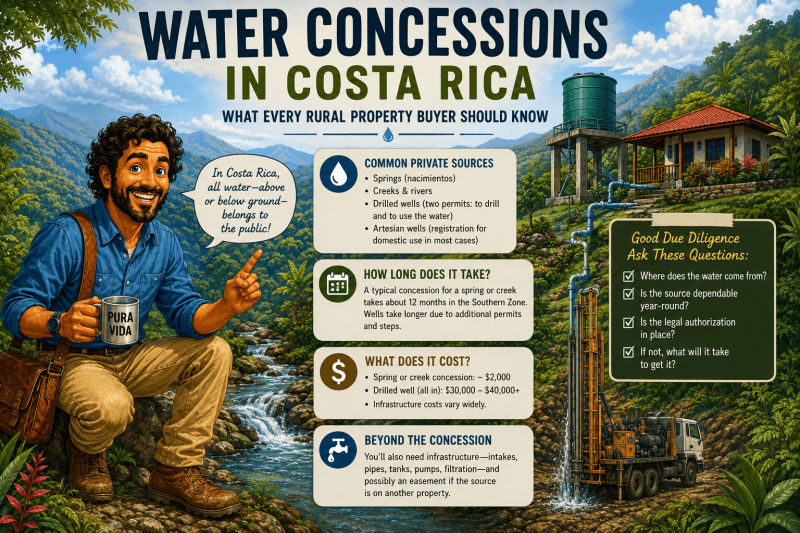
A Practical Guide to Water Concessions for Rural Property Buyers in Costa Rica
One of the biggest surprises for people buying rural property in Costa Rica is learning that finding water on your land doesn’t automatically mean you have the legal right to use it.
Whether it’s a crystal-clear spring emerging from a hillside, a creek flowing across your property, or even groundwater beneath your feet, the water itself is considered a public resource under Costa Rican law. Owning the land does not necessarily mean you own the right to use the water.
For anyone considering the purchase of rural land—especially in areas like Pérez Zeledón, Costa Ballena, Ojochal, Tinamastes, or the surrounding Southern Zone—understanding how water concessions work should be an important part of your due diligence.
One important point before we get started: Not every rural property needs its own water concession. If a property already has access to an ASADA or municipal water connection, you may never need to develop a private water source at all.
This article is primarily intended for properties that rely—or may eventually rely—on private water from a spring, creek, or well. Even then, some owners choose to have both a public connection and a private water source for added reliability.
This issue becomes especially important if you’re planning to build, since obtaining a building permit generally requires demonstrating that the property has a legal source of water.
What Is a Water Concession?
A water concession is a legal authorization issued by Costa Rica’s Ministry of Environment and Energy, commonly known as MINAE, through its Dirección de Agua. It grants the right to use a specific amount of water from a particular source for a particular purpose.
It’s important to understand that a concession does not transfer ownership of the water itself. Instead, it grants permission to use a public resource under defined conditions.
For most private water sources, obtaining a concession is necessary before using the water to supply a home, farm, or development.
The Most Common Private Water Sources
Not every property in Costa Rica is served by an ASADA or municipal water system. In many rural areas, private water sources are the norm.
Natural Springs
Springs, known locally as nacimientos, are among the most desirable water sources in Costa Rica’s mountains.
A properly developed spring can provide excellent water quality and dependable year-round flow. However, simply having a spring on your property does not automatically authorize its use. In most cases, you’ll need a water concession before legally developing it.
Creeks and Rivers
Some rural properties obtain water from a creek or river.
As with springs, using surface water generally requires a concession. During the application process, the government evaluates factors such as available flow, downstream users, and environmental impacts before determining whether water can be allocated.
Drilled Wells
Groundwater is another common option, particularly in areas without dependable surface water.
Many buyers assume that once a well has been drilled, they’re free to use the water. In reality, drilling the well is only part of the process.
Generally speaking, two separate approvals are involved:
- Permission to drill the well.
- Authorization to withdraw groundwater through a water concession.
Receiving approval to drill does not automatically grant the legal right to use the groundwater.
While considerably more expensive than developing a spring or creek, a productive drilled well can be an excellent long-term water source when surface water isn’t available.
Artesian or Hand-Dug Wells
One area that often creates confusion is the traditional artesian or hand-dug well.
Unlike drilled wells, these wells may, in certain circumstances, be registered for domestic use rather than requiring a full groundwater concession. The exact requirements depend on the nature of the well, its intended use, and current regulations.
Because these rules have evolved over time, buyers should always verify the current requirements with qualified professionals before relying on an artesian well as their primary water source.
How Do You Obtain a Water Concession?
Although every property is different, the general process usually includes several steps.
First, the water source must be identified and evaluated.
Depending on the project, engineers, geologists, or other qualified professionals may prepare technical studies documenting available flow, proposed usage, and environmental considerations.
An application is then submitted to MINAE’s Dirección de Agua for review.
The review process may include publication requirements, technical analysis, requests for additional information, and, in some cases, site inspections before a final resolution is issued.
Every property is unique, so the exact requirements vary depending on the type of water source and the intended use.
How Long Does It Take?
One of the most common questions buyers ask is how long the process takes.
The honest answer is that there is no universal timeline.
In my experience here in Costa Rica’s Southern Zone, obtaining a water concession from a spring or creek typically takes around 12 months from start to finish. Some are completed sooner, while others take considerably longer depending on the complexity of the application, agency workload, and whether additional information or studies are required.
If your plan involves drilling a well, you should expect a more involved process. Before groundwater can be legally used, you’ll generally need approval to drill the well and, once completed, the appropriate authorization to withdraw groundwater. That additional permitting process can add both time and complexity.
If obtaining a concession is critical to your building plans, it’s wise to factor these timelines into your overall project schedule.
What Does It Cost?
The cost of obtaining a concession varies depending on the water source and the complexity of the project.
For a typical spring or creek concession in Costa Rica’s Southern Zone, buyers can often expect to spend around $2,000 for the professional services required to prepare and process the application, although some projects cost less and others considerably more.
Drilled wells are a different matter altogether. Between drilling, permits, testing, equipment, and associated work, it’s not uncommon for a drilled well to cost $30,000 to $40,000 or more, depending on depth, geology, access, and other site-specific factors.
It’s also important to remember that obtaining the concession is only part of the overall cost. Developing the actual water system—including collection works, storage tanks, pipelines, pumps, filtration, and distribution infrastructure—can vary tremendously from one property to another and should be budgeted separately.
Developing the Water Source
Obtaining the concession is only one part of the equation.
Actually delivering water to your home typically requires infrastructure such as:
- Spring collection boxes
- Intake structures
- Storage tanks
- Transmission pipelines
- Pressure systems
- Pumps, where necessary
- Filtration or treatment equipment
- Distribution plumbing
Many first-time buyers underestimate these development costs. In some cases, constructing the water system can represent a significant portion of a property’s overall development budget.
What If the Water Source Is on Another Property?
This situation is more common than many buyers realize.
Perhaps the best spring serving your property is actually located on neighboring land.
In that case, obtaining the water concession alone is usually not enough.
You’ll also need a properly documented easement, known in Spanish as a servidumbre, allowing you to install, access, maintain, and repair the pipeline crossing the neighboring property.
Without that legal easement, your long-term access to the water source may be uncertain, regardless of whether you’ve obtained the concession.
This is an important issue that should always be addressed during the due diligence period.
Common Misconceptions About Water Rights in Costa Rica
“The spring is on my property, so I own the water.”
Not necessarily.
While you own the land, Costa Rican law generally treats the water itself as a public resource.
“The seller has been using the water for years.”
That doesn’t automatically mean all permits or concessions are in place.
Long-standing use is not the same as legal authorization.
“There’s plenty of water, so getting permission shouldn’t be a problem.”
Water quantity is only one factor.
Environmental considerations, downstream users, and regulatory requirements all play important roles in determining whether a concession will be granted.
“A drilled well solves everything.”
Not quite.
Drilling approval and legal authorization to withdraw groundwater are separate issues.
Final Thoughts
One lesson I’ve learned over the years is that when evaluating rural property in Costa Rica, it’s not enough to ask, “Is there water?”
The better questions are:
- Where does the water come from?
- Is the source dependable year-round?
- Is the necessary legal authorization already in place?
- If not, what will it take to obtain it?
A beautiful mountain property with an abundant spring can be an incredible investment—but only if the legal, technical, and practical pieces all come together.
As with many aspects of buying property in Costa Rica, a little extra due diligence before closing can save a tremendous amount of time, money, and frustration later.
Disclaimer: This article is intended as general informational guidance based on my experience in Costa Rica real estate. Water concession requirements can change, and every property presents unique circumstances. Buyers should always consult qualified engineers, geologists, attorneys, and the appropriate government agencies before making decisions regarding private water sources.