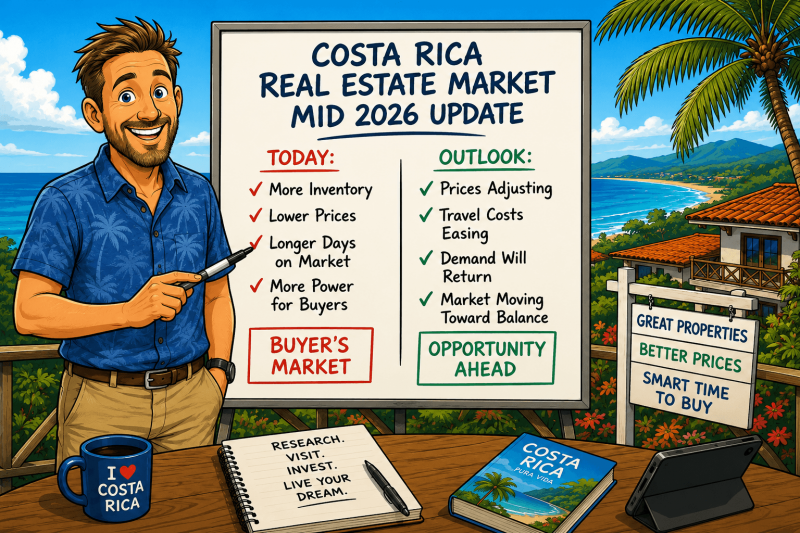
Why Buyers Have the Advantage
If you’ve been watching the Costa Rica real estate market lately, you’ve probably noticed something has changed.
Properties that would have moved quickly a couple of years ago are now sitting longer. Sellers who entered the market with aggressive pricing are increasingly being forced to adjust. Buyers have more choices, more leverage, and—perhaps most importantly—more time.
In my view, we are currently in the softest Costa Rica real estate market we’ve seen in years, arguably since the aftermath of the 2007–2008 global financial crisis.
That doesn’t mean the market has crashed. It hasn’t.
But it does mean the market has shifted meaningfully in favor of buyers.
From Frenzy to Inventory
To understand where we are today, it helps to look at what happened during and after COVID.
During the pandemic and its immediate aftermath, Costa Rica experienced a surge in international demand. Remote work, lifestyle reevaluation, and growing interest in relocation drove significant buying activity. Many buyers—especially from North America—began viewing Costa Rica not merely as a vacation destination, but as a viable place to live, invest, or semi-retire.
That surge in demand created a hot market.
As usually happens, strong demand attracts more supply.
Developers launched projects. Sellers listed properties. New inventory entered the market at elevated prices, often anchored to peak-pandemic expectations.
The problem is that much of that inventory is still here.
Simply put, supply grew faster than sustained demand.
The result is the market we see today: abundant inventory and downward pressure on pricing.
Why Has Demand Slowed?
Demand has clearly cooled in 2026.
No market shift happens for just one reason, but from my vantage point, two major factors stand out.
The first is global uncertainty.
When people feel uncertain about the economy, markets, politics, inflation, or broader geopolitical events, discretionary purchases tend to slow. Buying overseas real estate—especially lifestyle real estate—is often something people delay until confidence improves.
The second factor is the rising cost of travel.
Higher oil prices have pushed airline costs upward, making exploratory trips to Costa Rica significantly more expensive for many prospective buyers.
That matters more than some people realize.
Costa Rica is not a market where most serious buyers purchase sight unseen. They typically visit multiple times, rent for a period, explore regions, and do extensive due diligence before committing.
When the cost of simply getting here rises sharply, friction enters the buying process.
A Buyer’s Market—Clearly
Today, buyers hold the stronger negotiating position.
They have more inventory to choose from, more time to evaluate options, and more room to negotiate price and terms.
Price reductions are increasingly common.
Sellers who remain anchored to peak-market pricing may find themselves waiting a very long time.
Sellers who price realistically, however, are still getting attention—and in some cases, still getting deals done.
That distinction is important.
This is not a dead market.
It is a selective market.
Well-priced, desirable properties still attract serious interest.
Overpriced properties do not.
Why I Remain Bullish on Costa Rica
Despite current softness, I remain optimistic about Costa Rica’s long-term outlook.
Why?
Because the fundamental reasons people are drawn here have not changed.
Costa Rica still offers something increasingly rare in today’s world: natural beauty, political stability, biodiversity, favorable climate, and a lifestyle many people find deeply appealing.
People continue to dream about moving here.
I see evidence of that every day.
The continued growth of my own audience—people actively researching relocation, lifestyle changes, and property ownership in Costa Rica—suggests interest remains strong.
In other words, I do not believe demand has disappeared.
I believe it is paused, cautious, and waiting for better alignment between price and perceived value.
What Happens Next?
Markets correct.
That is what markets do.
As sellers gradually adjust to current realities, pricing becomes more attractive.
As travel costs moderate—and we may already be seeing early signs of that—the friction affecting buyer activity may ease.
When those forces begin to align, demand can return faster than many expect.
I do not expect an overnight rebound.
But I do expect a gradual move toward a healthier, more balanced market.
My Advice to Buyers
If you are seriously considering purchasing property in Costa Rica, this is a time to pay attention.
Not panic. Not rush.
Pay attention.
Buyer-friendly windows do not remain open forever.
Right now, good inventory exists. Prices are adjusting. Negotiating leverage is real.
That combination creates opportunity.
For prepared buyers—those doing careful due diligence and staying patient—2026 may prove to be one of the better buying windows we’ve seen in years.
Markets have a habit of rewarding those who act before consensus shifts.
For now, the advantage belongs to buyers.
I don’t expect that to remain true indefinitely.