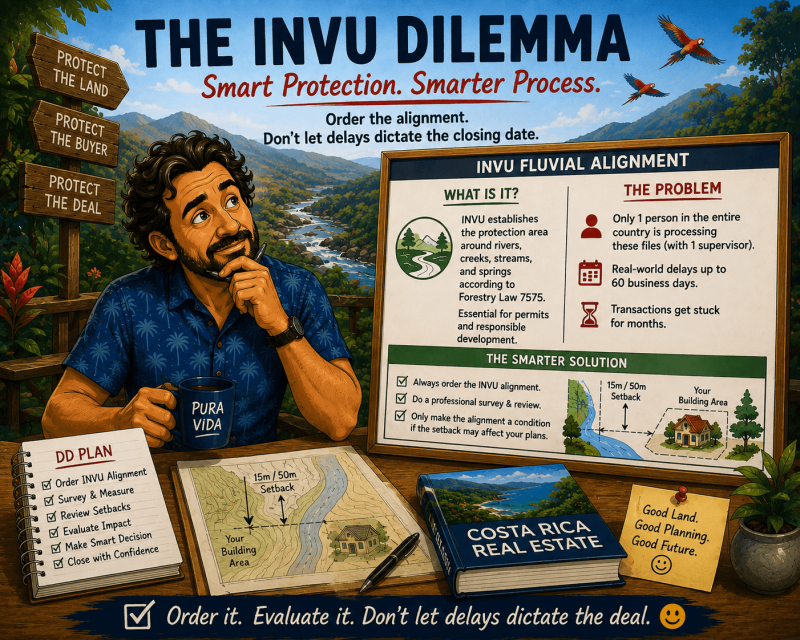
Do We Really Need to Wait for INVU?
If you’ve bought, sold, developed, or represented rural property in Costa Rica, you’ve probably encountered four letters that can suddenly change the course of a transaction:
INVU.
The Instituto Nacional de Vivienda y Urbanismo plays an important role in Costa Rica’s land-use system. Among its responsibilities is issuing alineamientos fluviales—official determinations of the protection areas that must be respected around rivers, creeks, streams, springs, and other protected water features.
Those protections matter.
The problem is that obtaining the official INVU alignment can now take so long that otherwise viable real estate transactions can sit in limbo for months.
Why INVU Matters
Costa Rica’s Forestry Law establishes protection areas around water features.
For rivers, creeks, and streams, the setback can generally range from 10 or 15 meters to 50 meters depending upon the location and terrain.
Permanent springs are potentially much more significant, generally involving a 100-meter protection radius. In certain circumstances involving potable-water sources, the applicable protection area can extend up to 200 meters.
If you’re buying raw land and planning to build, these restrictions obviously matter. A creek or spring can dramatically affect where—and sometimes whether—you can construct.
INVU’s official alignment is therefore important, particularly for permitting and whenever a buyer’s plans depend upon the exact location of a protection area.
My issue isn’t with the regulation.
It’s with allowing the administrative process itself to unnecessarily control the timing of every transaction.
The Real-World Problem
I’m dealing with this right now on a property transaction in the Dominical area.
An INVU alignment was requested during due diligence, and the transaction has essentially been waiting on the process.
I eventually went personally to the INVU office in San José to find out what was happening.
What I was told was pretty remarkable.
At present, essentially one person is processing these fluvial-alignment files for the entire country, with one supervisor overseeing the work.
I was also told that the current processing time can reach 60 business days.
That can push a real estate transaction out roughly three months or more.
For buyers, sellers, agents, and attorneys, that’s not a minor inconvenience. It can become a deal killer.
Does Every Watercourse Require Waiting for INVU?
I don’t think so.
Suppose a property has a creek along one boundary and the buyer intends to build 75 meters away.
A qualified topographer identifies the creek, the proposed building area, the terrain, and the distance between them.
Even if the maximum potentially applicable setback were 50 meters, the proposed building area is still well outside it.
So what material question are we waiting three months for INVU to answer?
Or consider another common situation.
There is already a house on the property. The house was legally constructed with a municipal construction permit. The buyer intends to use the existing residence and has no plans to build near the creek.
Again, an INVU alignment may still be appropriate to order, but that doesn’t necessarily mean the entire transaction should remain open until INVU issues it.
Start With the Survey
I believe the better approach begins with a thorough survey and topographic review during due diligence.
A qualified topographer can identify watercourses and springs on the property, locate existing improvements and contemplated building areas, and measure the relevant distances.
Just as importantly, the review should consider water sources located outside the property that could still affect it.
This is especially important with springs.
A permanent spring located on a neighboring property could potentially create a protection area extending onto the property being purchased. That protection area is generally 100 meters and, in certain circumstances involving potable-water sources, can extend up to 200 meters.
A good survey or topographic report will generally identify a nearby spring that is sufficiently close to potentially affect the subject property and may show the potentially applicable protection area.
That report does not replace INVU.
Only INVU can establish the official alignment.
But the professional report tells us something extremely useful:
Is there actually a potential problem here that requires an official determination before the buyer proceeds?
If the report identifies a nearby spring, an uncertain watercourse, or a potential setback conflict with the buyer’s intended building area, that’s precisely the kind of situation where I would want the official INVU determination before completing due diligence.
If the professional review identifies no on-property or nearby off-property water source capable of materially affecting the property—and the other identified watercourses are comfortably distant from the relevant improvements and building areas—the risk analysis is very different.
Order It—But Don’t Automatically Wait for It
Where the professional review indicates that an INVU alignment is appropriate, I believe it should be ordered.
The next question is whether receipt of that alignment must always be a condition of due diligence or closing.
That’s where I think we need more flexibility.
If the buyer’s intended development depends upon exactly where the protection line falls, wait for INVU.
If a proposed building site is close to the potential setback, wait for INVU.
If there is uncertainty concerning a spring, creek, or other water feature, wait for INVU.
But if the professional work establishes that the existing improvements and contemplated building areas are comfortably outside any potentially applicable protection area, why should the transaction automatically stop?
Order the alignment. Let the INVU process continue.
But don’t necessarily make the government’s processing time the length of the real estate transaction.
A Warning to Sellers: Don’t Wait Until You Have a Buyer
There’s also an obvious lesson here for property owners contemplating a sale.
If your property contains or may be affected by a river, creek, stream, or spring, don’t wait until you have a buyer under contract to begin dealing with INVU.
Order the appropriate alignment when you decide to put the property on the market—or, better yet, while you’re preparing it for sale.
INVU alignments are generally valid for 24 months, so there is little reason to wait until a buyer is already in due diligence and the clock is ticking.
With current processing delays, ordering the alignment in advance gives INVU time to process the application while the property is being marketed. Ideally, by the time a buyer arrives, the seller already has the alignment in hand. At a minimum, the application is well underway.
For listing agents, this should increasingly become part of the conversation with sellers at the beginning of the listing process.
Don’t discover a three-month governmental bottleneck after you have a signed deal. Deal with it before the deal arrives.
How I’m Changing the Way I Write Offers
This experience has changed the way I intend to address these issues in my Letters of Intent.
Obviously, most of this investigation won’t have occurred when the LOI is written. The purpose of the LOI language is to establish the process that will take place after the offer is accepted, the formal Sale and Purchase Agreement (SPA) is signed, and the buyer’s due-diligence period has commenced.
Rather than automatically making receipt of an INVU alignment a condition of due diligence whenever water appears on or near a property, the LOI can establish a more practical, risk-based process for how that issue will be investigated and addressed during due diligence.
The buyer obtains the appropriate survey and topographic review. That work identifies relevant watercourses and springs—both on the property and, where applicable, on neighboring property—as well as their relationship to existing improvements and areas where the buyer intends to build.
Based upon that professional review, the buyer and the buyer’s advisors can determine whether an INVU alignment is appropriate and, more importantly, whether receipt of that alignment must be a condition of completing due diligence and proceeding to closing.
If the professional review reveals a material uncertainty—a nearby spring, an uncertain watercourse, a proposed building area potentially within a protection zone, or some other issue affecting the buyer’s intended use—then the buyer should require the official INVU determination before proceeding.
If the professional review establishes that the relevant improvements and contemplated building areas are comfortably outside any potentially applicable protection area, an INVU alignment may still be ordered without necessarily making its issuance a condition of completing due diligence or closing.
That’s the distinction I’m trying to build into my offers.
The LOI establishes the process. The investigation happens during due diligence. Whether the transaction needs to wait for INVU depends upon what that investigation actually finds.
Regulation Has to Work in the Real World
Costa Rica needs environmental protections.
Anyone working in the Southern Zone understands why. Rivers, creeks, springs, steep terrain, heavy rainfall, and sensitive ecosystems are part of what makes this area extraordinary—and part of what makes responsible development essential.
This isn’t an argument for weakening those protections.
It’s an argument for applying them intelligently.
The purpose of due diligence is to identify and evaluate risk—not simply to accumulate certifications.
Sometimes an INVU alignment is absolutely essential before a buyer should proceed.
Sometimes it should be ordered, but there is no good reason to hold up closing while waiting for it.
And sometimes the professional investigation establishes that there isn’t an INVU issue requiring an alignment in the first place.
The current backlog makes that distinction more important than ever.
Identify the water. Measure the risk. Order INVU when appropriate. Respect the setback. Protect the buyer. But don’t automatically let an administrative backlog dictate the deal.