Surprisingly Low, but Important to Understand
One of the questions I get asked constantly by foreign buyers considering a move to Costa Rica is:
“How high are the property taxes?”
The answer usually comes as a pleasant surprise.
Compared to the United States, Canada, and many parts of Europe, property taxes in Costa Rica are generally very low. In fact, many buyers are shocked by how inexpensive annual carrying costs can be — even for fairly substantial properties.
That said, there are a few important things to understand about how Costa Rican property taxes work, including the standard municipal tax, the so-called “luxury home tax,” and how property values are assessed.
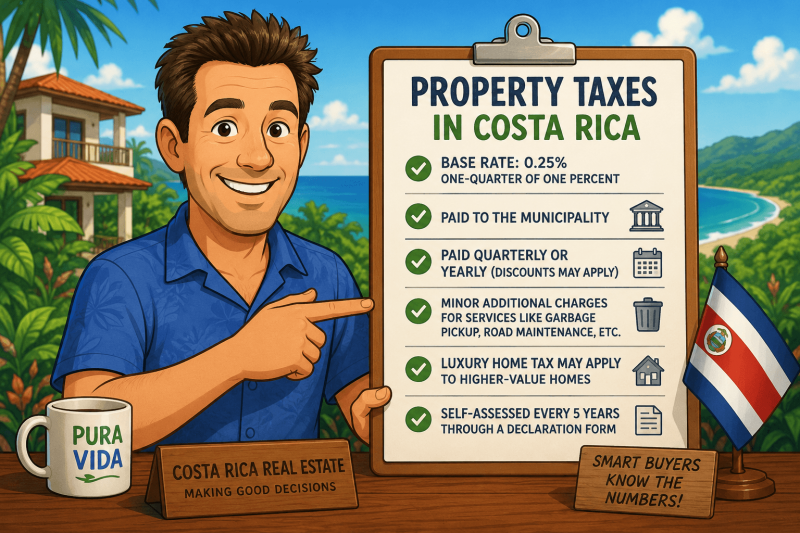
The Standard Property Tax Rate: Just 0.25%
The base property tax rate in Costa Rica is remarkably simple:
0.25% annually — one-quarter of one percent.
That means if your property is declared at a value of:
- $100,000 — annual property tax would be approximately $250
- $300,000 — approximately $750 per year
- $500,000 — approximately $1,250 per year
That’s it.
The tax is paid to the local municipality where the property is located. For example, if your property is in Pérez Zeledón, the taxes are paid to the Municipalidad de Pérez Zeledón. If the property is in Osa, they’re paid to the Municipalidad de Osa, and so forth.
How Often Are Property Taxes Paid?
Property taxes in Costa Rica are generally paid quarterly, although many property owners choose to pay the entire year in advance.
Some municipalities offer a small discount for paying the full year upfront, though this varies somewhat depending on the municipality.
Property taxes in Costa Rica are paid in Costa Rican colones and can typically be paid either directly through the municipality’s website or through most Costa Rican online banking platforms. Many local banks allow you to look up the property by its finca number and pay the taxes electronically through online banking, making the process relatively simple for property owners.
In addition to the base property tax, there may also be minor municipal charges included for services such as:
- Garbage collection
- Road maintenance
- Local municipal services
These ancillary charges are usually quite modest.
Costa Rica’s “Luxury Home Tax”
In addition to the standard property tax, Costa Rica also has what’s commonly referred to as the Luxury Home Tax, or Impuesto Solidario.
This tax only applies to higher-value residential homes that exceed a government-established threshold.
The threshold changes periodically based on inflation and government calculations, so the exact amount can vary from year to year. In general terms, however, it applies only to relatively expensive homes.
Importantly:
- It applies to homes, not raw land
- It is separate from the standard 0.25% municipal property tax
- The tax is progressive, meaning higher-value homes pay higher rates
I’ve written separately in more detail about Costa Rica’s luxury home tax, so I won’t get too deep into the weeds here. But it is something higher-end buyers should be aware of when evaluating the total annual carrying cost of a property.
A Simplified Example
Let’s say a luxury home has an assessed construction value high enough to exceed the luxury tax threshold.
The owner would still pay the normal 0.25% property tax, but may also owe an additional luxury tax amount calculated under a separate formula.
For example:
- Standard municipal property tax: approximately $2,000 annually
- Additional luxury tax: perhaps another several hundred or few thousand dollars depending on the assessed value
The important point is that the luxury tax impacts only a relatively small percentage of properties in Costa Rica.
For the vast majority of buyers — especially those purchasing modest homes, condos, or undeveloped land — only the standard municipal property tax applies.
How Are Property Values Determined?
This is where Costa Rica differs significantly from many other countries.
Property tax values are largely based on a self-declared valuation system.
The property owner submits what is called a declaration, or declaración de bienes inmuebles, to the municipality.
Here’s how it generally works:
- When you purchase a property, the declared value will usually reflect the purchase price or transaction value
- After that, a new declaration is typically required every five years
- The owner updates the property information and declared value
In practice, many owners simply maintain similar declared values from one declaration cycle to the next unless there has been a substantial change to the property.
Why the Seller’s Current Tax Bill May Not Tell You Much
Buyers will often ask me, “What is the current owner paying in property taxes?”
It’s a fair question, but in many cases the answer is not especially relevant to you as the buyer. That’s because when you purchase the property, the value should generally be re-declared based on the actual purchase price.
In the old days, some people would suggest buying the shares of the corporation that owned the property, rather than transferring the property itself, as a way to preserve the former owner’s lower declared value. That is no longer a technically legal workaround in Costa Rica.
If you are buying a property today, the safer and proper assumption is that the property should be declared at the real transaction value, whether the transaction is structured as a direct property transfer or as the purchase of shares in a corporation that owns the property.
What Counts as a “Substantial Improvement”?
If significant improvements have been made to the property, those should be reflected in the updated declaration.
Examples might include:
- Building a new home
- Adding a guest house or pool
- Major renovations or expansions
- Significant additional construction
In other words, if the property has materially increased in value because of improvements, the declaration should be updated accordingly.
Final Thoughts
One of the reasons many foreign buyers find Costa Rica attractive is the relatively low annual cost of holding property.
While closing costs, legal due diligence, and maintenance costs should absolutely be considered when purchasing real estate here, annual property taxes themselves are usually quite modest by international standards.
And for most ordinary residential properties, the tax system is relatively straightforward:
- Base tax rate: 0.25%
- Paid to the municipality
- Paid in Costa Rican colones
- Can often be paid online through the municipality or local banking platform
- Self-declared valuation system
- Luxury tax applies only to higher-end homes
For many buyers, the first annual tax bill in Costa Rica feels almost too low to be real.