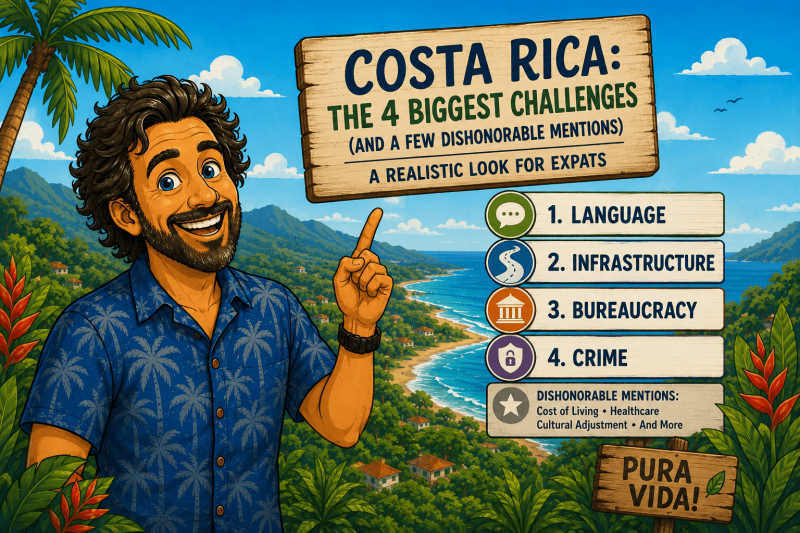
What You Should Know Before Making the Move
If you follow me regularly, you already know that I tend to be pretty positive about Costa Rica.
And why wouldn’t I be?
I’ve lived here for more than two and a half decades. I’m a real estate broker who helps people relocate here, and despite all of its imperfections, Costa Rica is still the country I choose to call home.
But I don’t want to be Pollyannish about it either.
Costa Rica is not paradise. It isn’t perfect. And people considering a move here deserve to understand not only what makes the country special, but also some of the things that can make living here frustrating.
From my experience, four challenges stand above the rest: language, infrastructure, bureaucracy and crime.
1. Language: You Can Get By Without Spanish. But Should You?
This one is at the top of my list for a reason.
It is entirely possible to live in Costa Rica without becoming fluent in Spanish, particularly in areas with large expat populations. You’ll find English-speaking real estate agents, attorneys, doctors, business owners and plenty of other people who can help you navigate your daily life.
But there’s an enormous difference between being able to function in Costa Rica and actually becoming part of Costa Rica.
If you don’t speak Spanish, you’re dependent on other people for things that should be simple. You’re also going to miss a tremendous amount of what is happening around you.
More importantly, language is your doorway into Costa Rican culture.
You don’t have to speak perfect Spanish. You don’t need a flawless accent. But making the effort changes the experience of living here dramatically.
I’ve written about the language issue in considerably more detail before. You can read that article here.
2. Infrastructure: Getting From Point A to Point B Isn’t Always Simple
Costa Rica has made tremendous progress during the years I’ve lived here, but infrastructure remains one of the country’s most obvious shortcomings.
And I’m not just talking about potholes.
Roads can be narrow, poorly maintained or simply overwhelmed by the amount of traffic they’re carrying. Bridges can become bottlenecks. A relatively short distance on a map can take considerably longer to drive than a newcomer expects.
The OECD’s 2025 Economic Survey of Costa Rica points to significant transportation bottlenecks and continuing weaknesses in the country’s road network.
Then there are the occasional interruptions in electricity, water or internet service that can become more noticeable once you get outside the major population centers.
Does any of this make Costa Rica unlivable?
Of course not.
But you learn something fairly quickly after moving here: distance in kilometers doesn’t necessarily tell you how long it’s going to take to get somewhere.
And sometimes getting from Point A to Point B really does become an adventure.
3. Bureaucracy: Bring Your Patience
If infrastructure tests your patience on the road, bureaucracy will test it almost everywhere else.
Opening accounts, obtaining permits, registering property, dealing with government agencies, resolving municipal issues or simply trying to get an answer to what seems like a straightforward question can take considerably longer than a North American newcomer expects.
Sometimes you’ll receive different answers from different people working in the same institution.
And yes, corruption exists.
I’m not suggesting that the average expat is going to encounter someone demanding a bribe every time he walks into a government office. That’s not the Costa Rica I know.
Corruption tends to be less visible to foreigners than it is to Costa Ricans themselves. Spend enough time talking to Ticos, however, and you’ll hear plenty of frustration about political favoritism, public contracts, municipal spending and money that doesn’t always seem to accomplish what it was supposedly intended to accomplish.
This isn’t uniquely Costa Rican. Similar complaints exist throughout Latin America — and certainly aren’t unknown in the United States or elsewhere.
But if you’re moving to Costa Rica, you need to understand that the system doesn’t always operate with the speed, consistency or predictability you may be accustomed to.
Patience isn’t merely a virtue here.
Sometimes it’s practically a survival skill.
4. Crime: Put the Problem in Perspective
Crime deserves a more nuanced discussion than either “Costa Rica is perfectly safe” or “Costa Rica has become terribly dangerous.”
Neither is particularly useful.
Costa Rica has experienced a significant increase in homicides in recent years, much of it connected to organized crime and the international drug trade.
According to InSight Crime’s 2025 homicide roundup, Costa Rica recorded approximately 16.8 homicides per 100,000 residents.
That’s not insignificant.
But perspective matters.
Among nearby Central American countries reporting comparable figures, Costa Rica sits well below some of the region’s more violent countries while remaining above several others. In other words, it is neither the safest country in the region nor the extraordinarily violent outlier that some commentary would have you believe.
There’s another important distinction.
A significant portion of Costa Rica’s recent increase in homicides has been associated with organized crime, drug trafficking and territorial disputes. That isn’t necessarily the type of crime most expats are likely to encounter in their daily lives.
For most foreigners, property crime is the more practical concern — theft, burglary, things disappearing from an unattended vehicle and other crimes of opportunity.
The U.S. State Department currently advises travelers to exercise increased caution in Costa Rica because of crime and specifically notes that petty crime is common.
My biggest frustration with crime in Costa Rica, however, isn’t simply the number of crimes committed.
It’s what happens afterward.
There’s a widespread perception among residents that too many crimes go unsolved, prosecution can be slow, punishment can be inadequate, and repeat offenders sometimes find themselves back on the street far sooner than people think they should.
That’s an issue Costa Rica needs to address.
But it’s also important to distinguish between acknowledging a real problem and living in fear of it.
I’ve lived in Costa Rica for decades. I take sensible precautions. I pay attention to where I am and what’s around me.
And I don’t spend my days worrying about becoming a crime victim.
A Few Dishonorable Mentions
Those are my big four, but a few other challenges deserve at least an honorable — or perhaps dishonorable — mention.
Cost of Living
Costa Rica isn’t the bargain destination some newcomers expect. Imported goods, vehicles, electricity and certain foods can be surprisingly expensive.
You can absolutely design a less expensive lifestyle here, particularly if you live more like a local and less like a permanent tourist. But moving to Costa Rica does not automatically mean living cheaply.
Healthcare Navigation
Costa Rica has both public and private healthcare options, and I’ve generally had positive things to say about healthcare here.
But learning how the Caja works, when to use private care, how to find specialists and how the public and private systems can complement one another takes some time.
Cultural Adjustment
Things don’t always happen on your timetable.
Concepts of punctuality, urgency, customer service and even communication can be different from what you’re accustomed to.
Some people adapt to that fairly quickly. Others spend years fighting it.
And that brings me back to something I’ve said many times: if you move to another country expecting it to operate exactly like the country you left, you’re probably setting yourself up for disappointment.
So Why Do I Still Choose Costa Rica?
As I write this, I’m actually in Colombia.
I spend quite a bit of time here, and some of the shortcomings I’ve just described about Costa Rica exist here as well. You’ll encounter variations of them throughout Latin America — and every country in the world has its own list.
That’s the part I think prospective expats sometimes get wrong.
They’re looking for the perfect country.
There isn’t one.
I’ve lived in Costa Rica for more than two and a half decades. I’ve experienced the good and the bad. I’ve dealt with the roads, the bureaucracy, the language barrier and the frustrations that occasionally make you wonder why something has to be so difficult.
I’ve also experienced the people, the mountains, the beaches, the climate, the natural beauty, the sense of community and the way of life that made me stay in the first place.
Given the choice, I’d still choose Costa Rica.
Because ultimately, the trick isn’t finding a country without imperfections.
It’s finding the country whose imperfections you can live with.