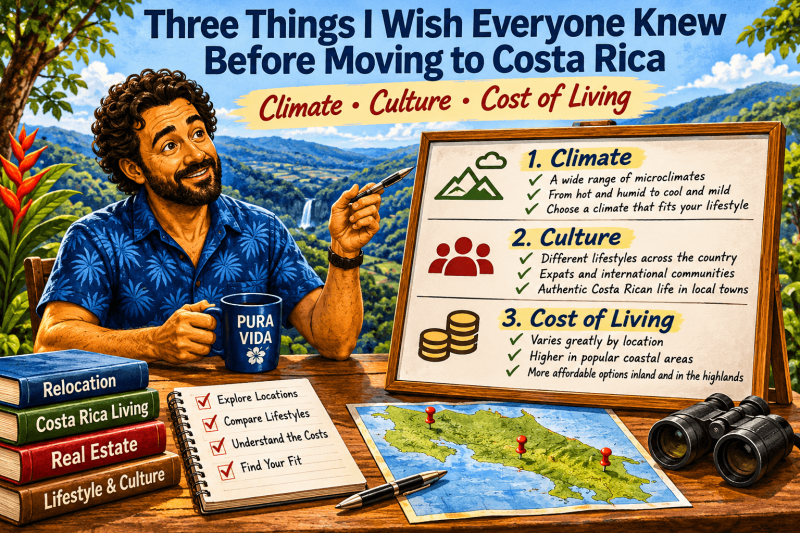
Climate, culture, and cost of living — why choosing the right location can make all the difference.
Costa Rica is a relatively small country. You can drive from the Pacific coast into the mountains in a matter of hours, passing through landscapes, climates, and communities that feel remarkably different from one another.
And that's something I wish more people understood before deciding where to live.
After nearly 25 years of living in Costa Rica, I've come to appreciate that there's no single Costa Rican lifestyle. What works beautifully for one person might be completely wrong for someone else.
When people contact me about relocating, I often find that they've already developed a fairly specific picture of what life here will look like. Maybe it's a house near the beach, a tropical garden, warm weather year-round, and a slower pace of life.
Nothing wrong with that picture. But Costa Rica offers considerably more variety than most people realize.
In my experience, there are three things that deserve particular attention before choosing where to settle: climate, culture, and cost of living.
And I've learned a few things about each of them along the way.
1. Climate: Paradise Comes in Different Temperatures
One of the biggest misconceptions about Costa Rica is that the entire country is hot and humid.
It isn't. Not even close.
Costa Rica has an extraordinary variety of microclimates, largely influenced by elevation, geography, and proximity to the oceans.
Along much of the coast, you can expect tropical heat and humidity throughout the year. Move inland and upward into the mountains, however, and the climate can change dramatically.
At elevations of roughly 800 to 1,300 meters (2,600 to 4,300 feet), you'll find communities where daytime temperatures are often quite comfortable and evenings can be pleasantly cool. Go higher still, and you might occasionally find yourself reaching for a sweater or even a jacket.
Rainfall patterns also vary considerably. Some regions experience a relatively pronounced dry season, while others receive substantial rainfall throughout much of the year.
The point is that Costa Rica offers a wide range of climates, and you don't have to settle for one that doesn't suit you.
My own preferences have certainly evolved over the years.
When I first moved to Costa Rica, I was in my early 40s and still doing a lot of surfing. Back then, the heat at the beach didn't bother me much. In fact, spending time in the warm tropical environment was part of the attraction.
But as I've gotten older, I've developed a much greater appreciation for the milder, more temperate climates of Costa Rica's mountains and highlands.
These days, I much prefer waking up to a cool morning, enjoying comfortable temperatures throughout the day, and sleeping without air conditioning.
And here's the beauty of it: I can still go to the beach whenever I want. I just don't have to live in the heat 24 hours a day.
For me, that's become a pretty appealing arrangement.
Of course, plenty of people absolutely love the coastal climate. If you're happiest in shorts and flip-flops every day of the year, the beach might be exactly where you belong.
But before you commit to a particular location, I'd strongly encourage you to spend some time there during different seasons, particularly the rainy season.
A place that feels like paradise during a weeklong vacation might feel quite different after six months of everyday living.
2. Culture: Which Costa Rica Do You Want to Experience?
Here's another thing that surprises newcomers: Costa Rica isn't culturally identical everywhere.
The lifestyle in a small agricultural community in the mountains can be quite different from what you'll experience in a popular beach destination or an upscale neighborhood around San José.
Some areas have large international communities, English-speaking businesses, restaurants catering to foreign tastes, and a lifestyle that can feel surprisingly familiar to someone arriving from North America.
Other communities remain predominantly Costa Rican, where Spanish is the language of everyday life, neighbors know one another, and local customs and traditions play a much larger role in the daily routine.
Neither is inherently better. They're simply different experiences.
And again, my own background has influenced my preferences.
I grew up in Myrtle Beach, South Carolina, a community heavily influenced by tourism. When I moved to Costa Rica, I ended up spending roughly 15 years working in the tourism industry here.
So I've certainly had plenty of exposure to tourist destinations, both in the United States and Costa Rica.
But interestingly enough, I always preferred living outside those environments.
Part of that was personal. I married into a Costa Rican family, which naturally brought me into closer contact with local communities, traditions, and everyday life.
But part of it was simply that I'd already had my fill of living in tourist areas.
I enjoyed the work, and I still enjoy visiting those places. But when it comes to where I actually live, I've generally preferred communities where daily life revolves more around local residents than visitors.
There's something appealing about that to me.
I enjoy the local markets, the small businesses, the conversations with neighbors, and the sense that I'm participating in Costa Rican life rather than simply observing it.
That said, this lifestyle does require some adaptation.
If you choose to live in a predominantly Costa Rican community, learning Spanish becomes much more important. You'll also need to develop some patience with cultural differences, adjust your expectations, and accept that things aren't always done the way they were back home.
But for those willing to make that adjustment, the experience can be tremendously rewarding.
And just as with the climate, there's another advantage to living outside the tourist centers.
You can always visit those places when you want to.
I can enjoy a weekend at the beach, visit a favorite restaurant, or spend time in one of Costa Rica's more cosmopolitan communities without making that environment my everyday home.
Of course, for someone else, living in an established expat community might be exactly the right choice, especially during the first few years of relocation.
The important thing is to understand what kind of cultural environment you're looking for before deciding where to settle.
3. Cost of Living: Location Can Make an Enormous Difference
Let's talk about money, because this is probably one of the most misunderstood aspects of relocating to Costa Rica.
First, let's acknowledge something important.
Costa Rica isn't the inexpensive retirement paradise it once was.
The cost of living has increased substantially over the years, and periods of weakness in the U.S. dollar against the Costa Rican colón have made matters more challenging for people whose income comes from dollars.
Imported goods can be expensive. Vehicles are expensive. Electricity isn't particularly cheap. And in certain parts of the country, housing costs can rival or even exceed what you'd pay in many communities in the United States.
But here's what often gets overlooked.
The cost of living varies enormously depending on where you choose to live.
If you settle in an upscale coastal community with luxury homes, international restaurants, imported groceries, and a substantial foreign population, you can expect to pay a premium for that lifestyle.
And there's nothing wrong with that, provided it's what you want and you can comfortably afford it.
But if your goal in moving to Costa Rica includes reducing your living expenses, choosing one of the country's most expensive locations might not be the smartest place to start.
There are still plenty of communities throughout Costa Rica where housing is more affordable, locally produced food is readily available, and everyday services cost considerably less than in the major tourist destinations.
Places like Pérez Zeledón, where I've spent much of my time, can offer a very different financial picture from some of the more expensive coastal communities.
And depending on your lifestyle, it's certainly still possible to enjoy a lower cost of living than you might experience in the United States.
But I always caution people against assuming that simply moving to Costa Rica will automatically save them money.
It won't.
Your spending habits matter. Your expectations matter. And perhaps most importantly, your location matters.
If you want to maintain an upscale North American lifestyle, complete with imported products, frequent restaurant meals, and all the conveniences you're accustomed to, you may find Costa Rica surprisingly expensive.
On the other hand, if you're willing to adapt somewhat to local customs, shop where Costa Ricans shop, and consider communities outside the most popular tourist destinations, the financial advantages can be substantial.
The key is being realistic about the lifestyle you want and understanding what it will actually cost.
The Real Secret? Finding Your Costa Rica
After all these years, one of the things I appreciate most about Costa Rica is its diversity.
Within a relatively small geographic area, you can find tropical beaches, cool mountain communities, bustling cities, quiet agricultural towns, established expat enclaves, and places where foreign residents are still relatively uncommon.
Each offers a different combination of climate, culture, and cost of living.
And that's why I always encourage prospective residents to explore more than one area before making a decision.
Don't assume that the Costa Rica you experienced on vacation is the only Costa Rica available to you.
And don't assume that the place your friends love will necessarily be the best place for you.
Your ideal location may be somewhere you haven't even considered yet.
Costa Rica is a small country, but where you live can make it feel like an entirely different country.
Finding the version of Costa Rica that suits you best is one of the most important steps toward making a successful move.
And it's a decision worth getting right.
Thinking About Making the Move?
If Costa Rica is somewhere in your future, I offer two ways to help you make more informed decisions.
Costa Rica Dreaming Webinar — December 12, 2026
Join me for an interactive online webinar where we'll explore the practical realities of relocating to Costa Rica, including choosing where to live, budgeting, healthcare, residency, real estate, and much more.
I'll share firsthand insights that can help you avoid common mistakes and make more confident decisions.
Learn More & Register for the Webinar
Personalized Costa Rica Relocation Consulting
If you're further along in your plans and would prefer more individualized guidance, I also offer relocation consulting services.
Whether you're trying to narrow down potential locations, plan an exploratory visit, or better understand the practical considerations of moving here, I can help you approach the process with greater clarity and confidence.
After nearly 25 years of living and working in Costa Rica, I've learned that a successful relocation isn't simply about moving to a beautiful country.
It's about finding the right place within that country to build the life you want.
Scott Bowers
Coldwell Banker Pérez Zeledón


