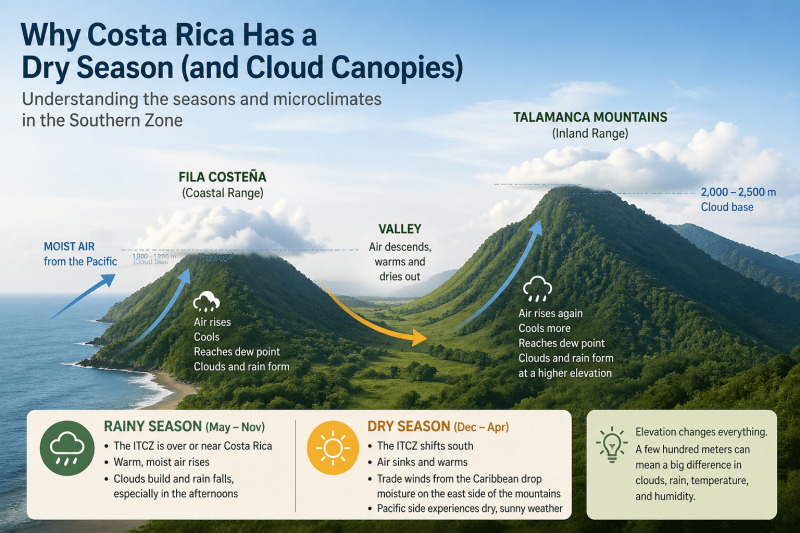
And What’s Really Going On in the Southern Zone Mountains
Have you ever asked yourself, what actually causes the dry and wet seasons in Costa Rica? I know I have...
This post is a companion piece to my earlier post on Costa Rica weather myths (I’ll link that here), where I break down some of the common misconceptions about climate in this country.
If you’ve spent any time in Costa Rica—especially here in the Southern Zone—you’ve probably heard it said:
“We have a dry season and a rainy season.”
Simple enough… but what’s actually causing that?
And more importantly—why does it feel so different depending on where you are?
Let’s break it down in plain English.
The Big Picture: Why There’s a Dry and Rainy Season
Costa Rica sits right near the equator, so temperatures don’t change much year-round. What does change is rainfall—and that comes down to one thing:
A moving band of weather called the Intertropical Convergence Zone (ITCZ).
Think of it as a belt of clouds and rain that shifts north and south throughout the year.
When that belt is over Costa Rica → rainy season
When it moves south → dry season
That’s the nationwide driver.
Rainy Season (Green Season)
Typically:
May through November (varies a bit by region)
During this time:
Warm, moist air rises
As it rises, it cools
Eventually it hits the “dew point” (the point where air can’t hold more moisture)
That’s when clouds form… and then rain.
This is why you’ll often see:
Sunny mornings
Clouds building mid-day
Rain in the afternoon
Dry Season
Typically:
December through April
Now the system flips:
The rain belt shifts south
Instead of rising air, we get sinking air
Sinking air warms up, which makes it harder for clouds to form.
At the same time:
Trade winds come from the Caribbean
Moisture drops on the east side of the mountains
Air descends toward the Pacific side warmer and drier
That combination is what gives the Pacific side those long stretches of blue skies.
Now Let’s Zoom In: The Southern Zone Effect
Up to this point, that’s Costa Rica in general.
But here in the Southern Zone, the terrain adds another layer—specifically:
The Fila Costeña (closer to the coast)
The Cordillera de Talamanca (larger inland range)
These don’t change the seasons themselves—but they absolutely shape how those seasons show up locally.
How the Mountains Shape Local Rainfall
As moist air moves inland:
It hits the coastal range first
Gets pushed upward
Cools and drops moisture
By the time that same air continues inland:
It’s drier
And has warmed again as it descends
So when it rises again, it has to climb higher before clouds can form.
The “Cloud Canopy” Effect
This is something you can actually see most days.
At certain elevations, clouds tend to form at a consistent height.
That’s the altitude where rising air is hitting its dew point.
Coastal range (lower cloud formation)
Along the Fila Costeña:
Air is coming straight off the Pacific
It’s full of moisture
It doesn’t need to rise much before clouds form.
Result:
Cloud layer around 1,000–1,200 meters
Earlier cloud buildup
More frequent mid-day or even late-morning rain in some areas
Inland mountains (higher cloud formation)
By the time that air reaches the Cordillera de Talamanca:
It has already dropped moisture
It has warmed again
It needs more elevation to cool enough to condense.
Result:
Cloud formation around 2,000+ meters
More stable mornings
Later cloud buildup
Why This Matters
Costa Rica’s seasons are driven by large-scale weather patterns.
But in places like the Southern Zone, elevation and terrain fine-tune those patterns—creating very real differences in climate over relatively short distances.
A change of a few hundred meters in elevation can mean:
More or less rain
Earlier or later cloud cover
Noticeable differences in temperature and humidity
The Bottom Line
Rain comes from rising air hitting its dew point
Dry season comes from sinking, warming, drying air
And in the Southern Zone, the mountains decide exactly where and when that happens
If you understand that, you understand why Costa Rica doesn’t have just one climate—it has many.