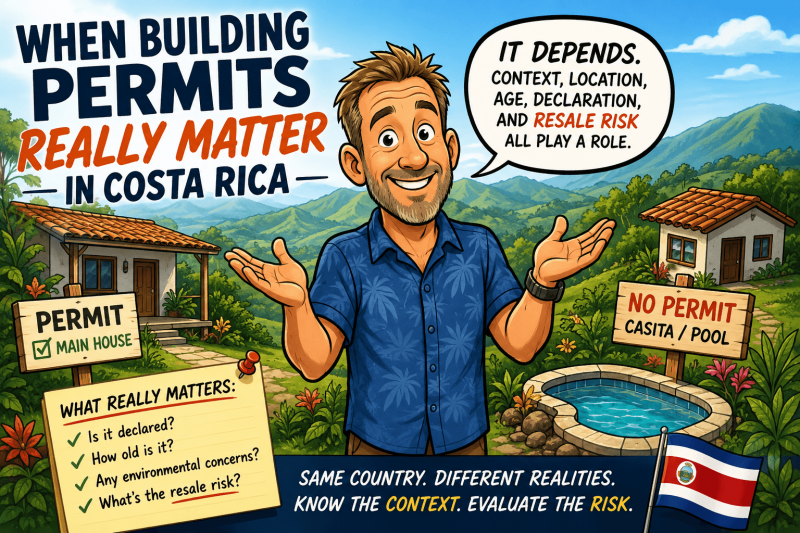
Why Missing Permits Aren’t Always a Deal Breaker—But Sometimes They Are
One of the most common questions I hear from buyers—especially during due diligence—is some version of this:
“This house (or casita, or pool) was built without permits. Is that a deal breaker?”
The frustrating but honest answer is:
It depends.
And in Costa Rica, it depends on more than just what the law says.
That may sound unsatisfying, but if you spend enough time in Costa Rica real estate, you learn something important:
There is the legal system… and there is the practical system.
They overlap, but they are not always the same.
First, an Important Caveat
Before diving in, it’s important to understand that Costa Rica is not one uniform permitting environment.
Rules may exist at the national level, but enforcement—and practical reality—can vary significantly from one municipality to another.
This article is written primarily from the perspective of what I see working in the Southern Zone, particularly in more rural mountain areas such as Pérez Zeledón and surrounding communities.
That matters because a permit issue that may be treated as a serious obstacle in a heavily developed area may be viewed very differently in a rural agricultural zone.
For example, municipalities serving high-growth tourist markets—think parts of Guanacaste, coastal resort areas, or luxury beach communities—often apply building requirements much more strictly, and for understandable reasons. Higher density, stronger infrastructure demands, greater environmental scrutiny, and more sophisticated buyers all tend to increase enforcement.
By contrast, in more rural areas, real-world practice can be considerably less rigid.
That doesn’t mean the law changes.
It means how risk is evaluated often changes.
I have personally seen municipalities approve permits for homes relying on long-standing community water arrangements that were not perfectly aligned with textbook legal requirements. That doesn’t mean water legality doesn’t matter—it means local practical realities sometimes influence outcomes.
This is one reason broad statements like “you must always have a permit” or “permits don’t matter” are both misleading.
In Costa Rica, context matters—sometimes a lot.
The Legal Reality
Legally speaking, most permanent construction in Costa Rica requires permits.
That includes obvious things like:
- Main houses
- Guest houses or casitas
- Rental cabins
- Pools
- Major additions
Even smaller structures that people assume are exempt—like a plunge pool or a small detached casita—may still require permits if they involve excavation, plumbing, electrical work, or permanent foundations.
So if you want the black-and-white answer:
Yes—most permanent structures should be permitted.
But that’s only part of the story.
The Practical Reality
Here’s the part many newcomers find surprising.
In many rural parts of Costa Rica—particularly in areas like the Southern Zone where agricultural and low-density mountain communities remain common—it is not unusual for secondary structures to have been built without formal permits.
That might include:
- A guest casita
- A caretaker house
- A workshop
- A deck
- A plunge pool
- A storage building
Sometimes, people even build the main house without permits.
Is that legal?
Usually not.
Is it common?
Very.
That doesn’t automatically make the property problematic—but it does mean you need to ask better questions than simply:
“Was there a permit?”
The better question is:
“What is the actual risk?”
When Permit Problems Usually Don’t Scare Buyers
In my experience, many buyers—particularly in the mountains—are comfortable with some level of permit imperfection if the structure:
- Has existed for many years
- Has been openly occupied
- Appears on the municipal tax declaration
- Has utility connections installed without issue
- Has no active disputes or enforcement actions
This is where you often hear attorneys talk about a kind of “grandfather” concept.
I want to be careful with that term.
I am not aware of a simple national law that says:
“After five years, unpermitted construction becomes legal.”
I don’t believe it works that cleanly.
What usually happens instead is more practical than legal.
If a structure has existed for years, has been declared, taxes have been paid, and the municipality has done nothing, buyers and attorneys often conclude the risk is relatively low.
That does not necessarily make the structure legal.
But it may reduce the likelihood of future problems.
In other words:
Old and tolerated is not the same as legal—but it often feels less risky than new and noncompliant.
When Permits Matter a Lot
This is the part buyers should pay close attention to.
Permit issues become much more serious when environmental or regulatory protections are involved.
Examples include properties near:
- Rivers or creeks
- Protected setbacks
- Wetlands
- Maritime zone areas
These situations are different.
A structure built inside a protected setback does not suddenly become harmless just because years have passed.
Environmental restrictions tend to matter far more than ordinary rural construction irregularities.
Another important question buyers should ask is whether the missing permit issue is still curable.
In some cases, even if a seller built without permits, it may still be possible to obtain permits after the fact—either during due diligence or even after closing.
That process may involve architectural plans, updated inspections, and often fines or penalties paid to the municipality for having built without prior approval.
In other words, a missing permit does not always mean the situation cannot be corrected.
But this is where environmental restrictions become critical.
If the reason the property was never permitted is simply because the owner skipped the process, that may be fixable.
If the reason it was never permitted is because the structure could not legally have been permitted in the first place—for example, because it violates a river setback, wetland protection, or maritime restriction—that is a very different situation.
That is why one of the most important due diligence questions is not simply:
“Why wasn’t this permitted?”
It is this:
“Could this property be permitted today?”
If the answer is no, the risk increases dramatically.
That leads to one of the most useful practical distinctions I’ve found when evaluating permit issues:
Unpermitted but permitable → maybe manageable
Unpermitted and unpermittable → major red flag
This is why the same missing permit can feel like a minor issue on one property and a major red flag on another.
What About Pools?
Pools are a great example of Costa Rica nuance.
Many buyers assume a small dipping pool doesn’t matter.
Legally, most permanent pools should be permitted because they usually involve:
- Excavation
- Structural engineering
- Drainage
- Plumbing
- Electrical systems
An inflatable or portable above-ground pool is one thing.
A concrete plunge pool built into a hillside is something else entirely.
Again, context matters.
The Real Question Buyers Should Ask
When reviewing a property with unpermitted construction, I encourage buyers to stop thinking in absolutes.
Instead of asking only:
“Does it have permits?”
Ask:
- How old is the structure?
- Is it declared for tax purposes?
- Has the municipality effectively acknowledged it?
- Are there environmental concerns?
- Will future expansion create problems?
- Does this affect financing, insurance, or resale?
Those questions usually tell you more than the permit file alone.
Final Thought
Here’s my general rule of thumb.
A recently built house without permits should raise concern.
A 20-year-old mountain casita that has been openly used, declared, taxed, and never challenged may simply represent a manageable risk.
In fact, one practical way I often advise buyers to think about permit issues is through the lens of resale risk.
For example, if the main house was properly permitted but a secondary casita was not, many mountain buyers may view that as an acceptable imperfection.
On the other hand, if the main residence itself lacks permits, that becomes a more significant concern—not necessarily because the property cannot be sold, but because future buyers will likely be asking the same questions you are asking now.
Properties without permits do get bought and sold all the time in rural Costa Rica.
But missing permits—especially on the primary residence—can narrow the buyer pool and become a factor during resale.
That doesn’t mean you ignore permit issues.
It means you evaluate them intelligently.
Because in Costa Rica, permit questions are rarely just about legality.
They’re about risk (especially resale risk), context, buyer tolerance, and future plans.
And that’s why the most important question often isn’t:
“Was it permitted?”
It’s this:
“Will this matter for what I want to do with the property—and what a future buyer may think when I eventually sell?”