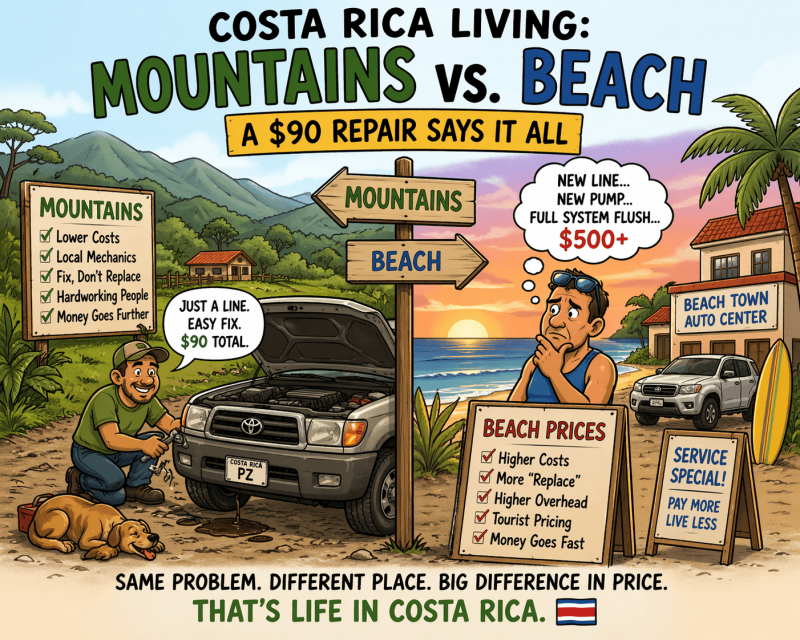
A $90 Auto Repair Story
I had one of those “only in Costa Rica” moments the other day—and it turned into a perfect real-world reminder of something I talk about all the time with buyers.
The difference between living in the mountains and living at the beach.
It started on a rough dirt road. The kind we all drive regularly up here in the Pérez Zeledón mountains—rocky, bumpy, nothing unusual. Then suddenly, the steering got weird. Tight. Not right.
By the time I stopped and checked it, the power steering fluid was completely gone.
Not low. Gone.
Now, if you’ve spent any time in Costa Rica, you know that’s not a great situation—especially when you’re not exactly around the corner from a dealership.
Luckily, I made it to a small roadside gas station. There happened to be a local mechanic there. He took one look, crawled under the truck, and within minutes he found the issue.
A leak in a line over the left front wheel area. Nothing catastrophic. Just a failure point.
Here’s where it gets interesting.
Instead of telling me I needed a tow, a new pump, or a major repair, he said:
“Don’t waste money on expensive fluid. Just use engine oil to get home. It’ll protect the pump.”
Now, I’m not recommending that as standard practice—but in that moment, it worked. We filled it, drove, stopped, refilled a few times, and made it home without damaging anything.
Next morning, I took it to my local mechanic.
They fixed the issue—a line connection, no major parts needed—flushed the system completely, replaced the fluid properly, checked the pump, and sent me on my way.
Total cost?
$90.
Now let’s pause there for a second.
Same issue. Same vehicle. Different location.
At the beach—Dominical, Uvita, Tamarindo—you’re far more likely to hear something like:
“We need to replace the line… maybe the pump… full system service…”
And you’re looking at several hundred dollars, easily.
Not because anyone’s necessarily trying to rip you off. It’s just a different market:
Higher overhead
More transient clientele
More “replace instead of repair” mentality
Pricing driven by foreign demand
Up in the mountains, especially around Pérez Zeledón, it’s different.
You’ve got:
Mechanics who troubleshoot instead of upsell
Labor costs that still reflect the local economy
A mindset of fixing what’s broken—not replacing everything around it
People who know how to keep things running without turning it into a major event
And this isn’t just about cars.
This same dynamic shows up in:
Construction
Property maintenance
Landscaping
General repairs
Any kind of hands-on service work
If it involves labor, skill, or problem-solving:
The mountains are almost always more affordable.
Now, to be clear—this is just one story.
One breakdown. One repair. One $90 invoice.
But it’s also a perfect example of a much bigger reality.
Costa Rica hasn’t become uniformly expensive.
It’s become selectively expensive.
And where you choose to live—mountains vs. beach—has a direct impact on your cost of living, your day-to-day expenses, and even how problems get solved.
I’ve said it before and I’ll say it again:
If you’re looking for a more sustainable, practical, and cost-effective lifestyle in Costa Rica, don’t overlook the mountains.
Sometimes the difference isn’t theoretical.
Sometimes it’s as simple as a $90 repair instead of a $500 one.
And sometimes, that tells you everything you need to know.